Sahrmann John M, Nickel Katelin B, Stwalley Dustin, Dubberke Erik R, Lyons Patrick G, Michelson Andrew P, McMullen Kathleen M, Gandra Sumanth, Olsen Margaret A, Kwon Jennie H, Burnham Jason P
Division of Infectious Diseases, Washington University in St. Louis School of Medicine, St. Louis, Missouri.
Division of Pulmonary and Critical Care Medicine, Washington University in St. Louis School of Medicine, St. Louis, Missouri.
Antimicrob Steward Healthc Epidemiol. 2023 Jan 17;3(1):e14. doi: 10.1017/ash.2022.361. eCollection 2023.
To use interrupted time-series analyses to investigate the impact of the coronavirus disease 2019 (COVID-19) pandemic on healthcare-associated infections (HAIs). We hypothesized that the pandemic would be associated with higher rates of HAIs after adjustment for confounders.
We conducted a cross-sectional study of HAIs in 3 hospitals in Missouri from January 1, 2017, through August 31, 2020, using interrupted time-series analysis with 2 counterfactual scenarios.
The study was conducted at 1 large quaternary-care referral hospital and 2 community hospitals.
All adults ≥18 years of age hospitalized at a study hospital for ≥48 hours were included in the study.
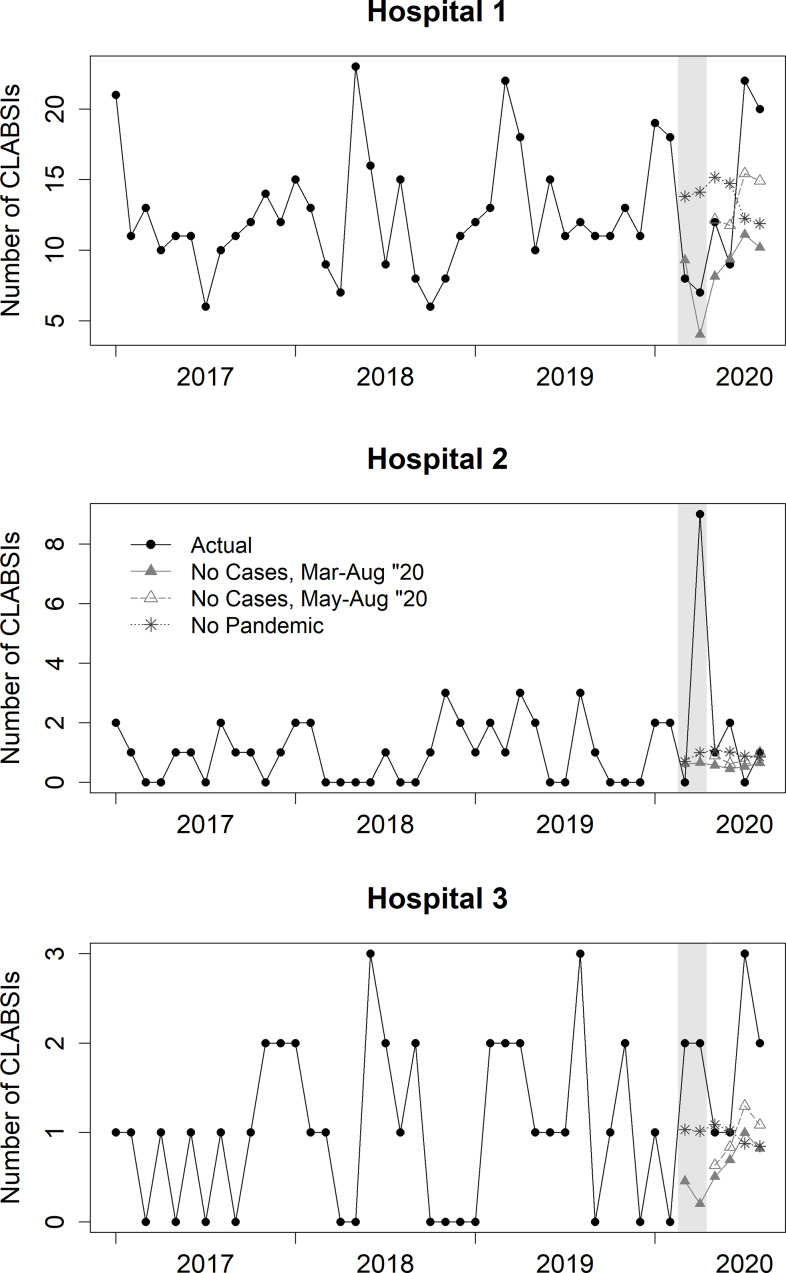
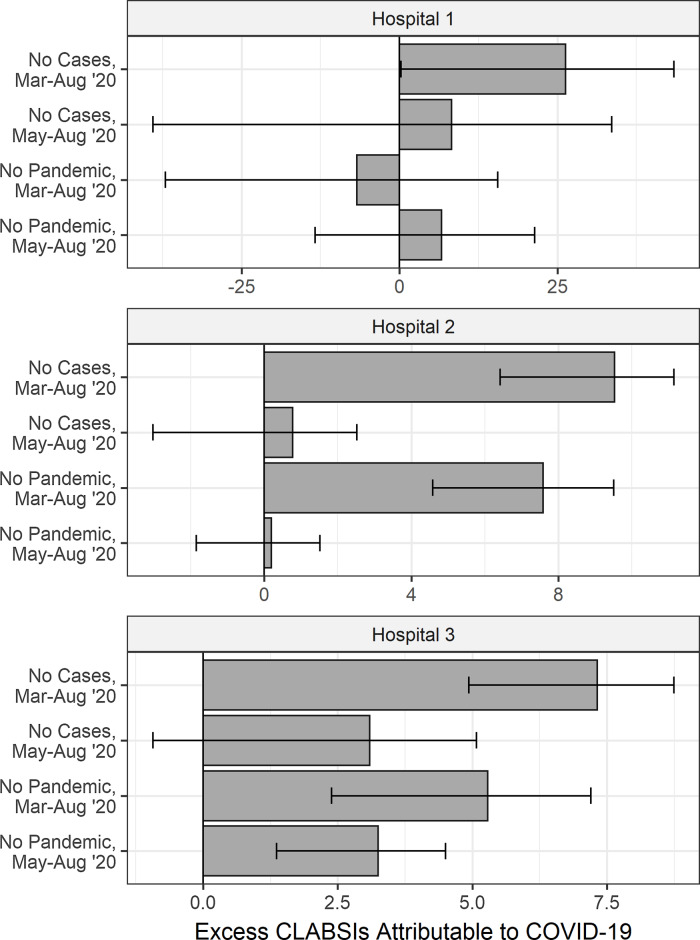
In total, 254,792 admissions for ≥48 hours occurred during the study period. The average age of these patients was 57.6 (±19.0) years, and 141,107 (55.6%) were female. At hospital 1, 78 CLABSIs, 33 CAUTIs, and 88 VAEs were documented during the pandemic period. Hospital 2 had 13 CLABSIs, 6 CAUTIs, and 17 VAEs. Hospital 3 recorded 11 CLABSIs, 8 CAUTIs, and 11 VAEs. Point estimates for hypothetical excess HAIs suggested an increase in all infection types across facilities, except for CLABSIs and CAUTIs at hospital 1 under the "no pandemic" scenario.
The COVID-19 era was associated with increases in CLABSIs, CAUTIs, and VAEs at 3 hospitals in Missouri, with variations in significance by hospital and infection type. Continued vigilance in maintaining optimal infection prevention practices to minimize HAIs is warranted.
采用中断时间序列分析,研究2019冠状病毒病(COVID-19)大流行对医疗相关感染(HAIs)的影响。我们假设,在对混杂因素进行调整后,大流行将与更高的HAIs发生率相关。
我们对密苏里州3家医院在2017年1月1日至2020年8月31日期间的HAIs进行了横断面研究,采用中断时间序列分析和2种反事实情景。
该研究在1家大型四级医疗转诊医院和2家社区医院进行。
所有在研究医院住院≥48小时的≥18岁成年人纳入研究。
在研究期间,总共发生了254,792例住院时间≥48小时的病例。这些患者的平均年龄为57.6(±19.0)岁,其中141,107例(55.6%)为女性。在医院1,大流行期间记录了78例中心静脉导管相关血流感染(CLABSIs)、33例导尿管相关尿路感染(CAUTIs)和88例呼吸机相关性事件(VAEs)。医院2有13例CLABSIs、6例CAUTIs和17例VAEs。医院3记录了11例CLABSIs、8例CAUTIs和11例VAEs。假设性额外HAIs的点估计表明,各机构所有感染类型均有增加,但在“无大流行”情景下,医院1的CLABSIs和CAUTIs除外。
COVID-19时代与密苏里州3家医院的CLABSIs、CAUTIs和VAEs增加相关,不同医院和感染类型的显著性存在差异。有必要继续保持警惕,维持最佳感染预防措施,以尽量减少HAIs。