Seattle Children's Research Institute, Seattle, USA.
University of Washington, Seattle, USA.
Nat Commun. 2023 Jan 30;14(1):499. doi: 10.1038/s41467-023-36002-4.
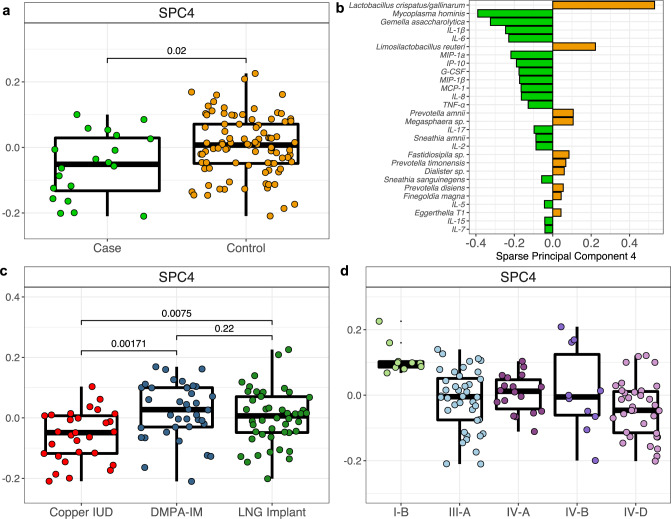
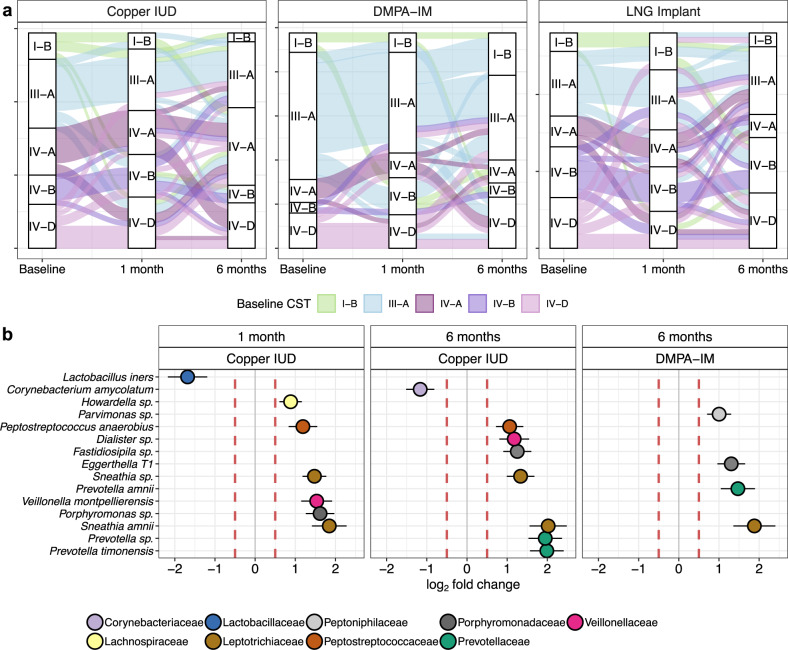
Effective contraceptives are a global health imperative for reproductive-aged women. However, there remains a lack of rigorous data regarding the effects of contraceptive options on vaginal bacteria and inflammation. Among 218 women enrolled into a substudy of the ECHO Trial (NCT02550067), we evaluate the effect of injectable intramuscular depot medroxyprogesterone acetate (DMPA-IM), levonorgestrel implant (LNG), and a copper intrauterine device (Cu-IUD) on the vaginal environment after one and six consecutive months of use, using 16S rRNA gene sequencing and multiplex cytokine assays. Primary endpoints include incident BV occurrence, bacterial diversity, and bacterial and cytokine concentrations. Secondary endpoints are bacterial and cytokine concentrations associated with later HIV seroconversion. Participants randomized to Cu-IUD exhibit elevated bacterial diversity, increased cytokine concentrations, and decreased relative abundance of lactobacilli after one and six months of use, relative to enrollment and other contraceptive options. Total bacterial loads of women using Cu-IUD increase 5.5 fold after six months, predominantly driven by increases in the concentrations of several inflammatory anaerobes. Furthermore, growth of L. crispatus (MV-1A-US) is inhibited by Cu ions below biologically relevant concentrations, in vitro. Our work illustrates deleterious effects on the vaginal environment induced by Cu-IUD initiation, which may adversely impact sexual and reproductive health.
有效的避孕措施是生殖年龄段女性的全球健康要务。然而,关于避孕选择对阴道细菌和炎症的影响,仍缺乏严格的数据。在 ECHO 试验(NCT02550067)的子研究中,我们招募了 218 名女性,评估了注射用肌肉内 depot 醋酸甲羟孕酮(DMPA-IM)、左炔诺孕酮植入剂(LNG)和铜宫内节育器(Cu-IUD)在使用后 1 个月和 6 个月对阴道环境的影响,使用 16S rRNA 基因测序和多重细胞因子检测。主要终点包括 BV 发生、细菌多样性以及细菌和细胞因子浓度的变化。次要终点是与 HIV 血清转化相关的细菌和细胞因子浓度。与其他避孕方法相比,随机分配到 Cu-IUD 的参与者在使用 1 个月和 6 个月后,细菌多样性增加,细胞因子浓度增加,乳杆菌相对丰度降低。使用 Cu-IUD 的女性的总细菌负荷在 6 个月后增加了 5.5 倍,主要是由于几种炎症性厌氧菌浓度的增加。此外,Cu 离子在低于生物学相关浓度时,体外抑制 L. crispatus (MV-1A-US)的生长。我们的研究表明,Cu-IUD 启动会对阴道环境产生有害影响,可能对性健康和生殖健康产生不利影响。