Jiangsu Collaborative Innovation Center of Regional Modern Agriculture & Environmental Protection, School of Life Sciences, Huaiyin Normal University, Huai'an223300, China.
Nanjing Lishui People's Hospital, Zhongda Hospital Lishui Branch, Southeast University, Nanjing211200, China.
Drug Deliv. 2023 Dec;30(1):2173339. doi: 10.1080/10717544.2023.2173339.
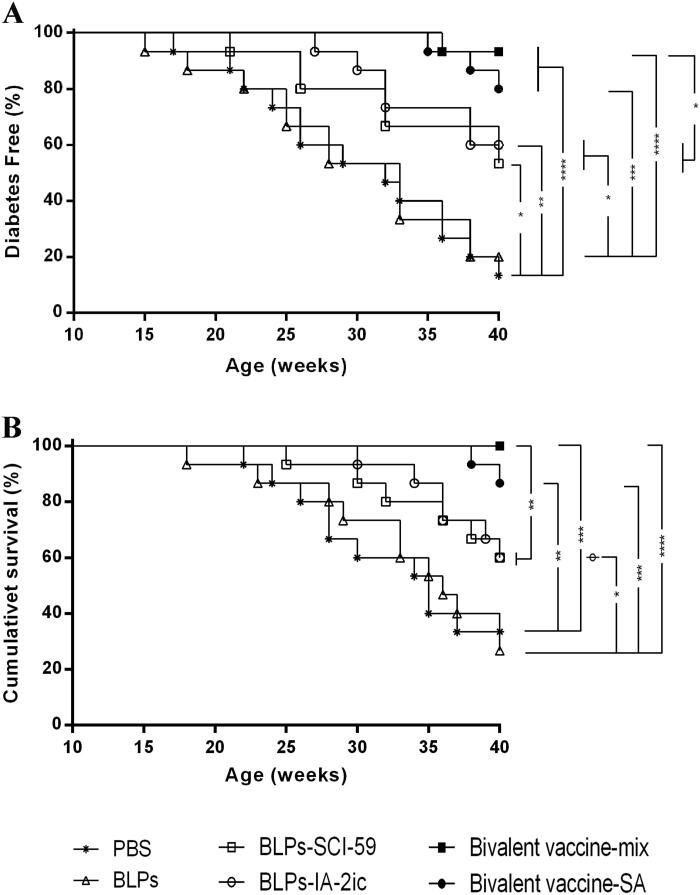
Induction of oral tolerance by vaccination with type 1 diabetes mellitus (T1DM)-associated autoantigens exhibits great potential in preventing and treating this autoimmune disease. However, antigen degradation in the gastrointestinal tract (GIT) limits the delivery efficiency of oral antigens. Previously, bacterium-like particles (BLPs) have been used to deliver a single-chain insulin (SCI-59) analog (BLPs-SCI-59) or the intracellular domain of insulinoma-associated protein 2 (IA-2ic) (BLPs-IA-2ic). Both monovalent BLPs vaccines can suppress T1DM in NOD mice by stimulating the corresponding antigen-specific oral tolerance, respectively. Here, we constructed two bivalent BLPs vaccines which simultaneously deliver SCI-59 and IA-2ic (Bivalent vaccine-mix or Bivalent vaccine-SA), and evaluated whether there is an additive beneficial effect on tolerance induction and suppression of T1DM by treatment with BLPs-delivered bi-autoantigens. Compared to the monovalent BLPs vaccines, oral administration of the Bivalent vaccine-mix could significantly reduce morbidity and mortality in T1DM. Treatment with the bivalent BLPs vaccines (especially Bivalent vaccine-mix) endowed the mice with a stronger ability to regulate blood glucose and protect the integrity and function of pancreatic islets than the monovalent BLPs vaccines treatment. This additive effect of BLPs-delivered bi-autoantigens on T1DM prevention may be related to that SCI-59- and IA-2-specific Th2-like immune responses could be induced, which was more beneficial for the correction of Th1/Th2 imbalance. In addition, more CD4CD25Foxp3 regulatory T cells (Tregs) were induced by treatment with the bivalent BLPs vaccines than did the monovalent BLPs vaccines. Therefore, multiple autoantigens delivered by BLPs maybe a promising strategy to prevent T1DM by efficiently inducing antigen-specific immune tolerance.
通过接种 1 型糖尿病(T1DM)相关自身抗原诱导口服耐受,在预防和治疗这种自身免疫性疾病方面具有巨大潜力。然而,胃肠道(GIT)中的抗原降解限制了口服抗原的递送效率。以前,细菌样颗粒(BLPs)已被用于递送单链胰岛素(SCI-59)类似物(BLPs-SCI-59)或胰岛相关蛋白 2(IA-2ic)的细胞内结构域(BLPs-IA-2ic)。单价 BLPs 疫苗均可通过刺激相应的抗原特异性口服耐受分别抑制 NOD 小鼠的 T1DM。在这里,我们构建了两种二价 BLPs 疫苗,其同时递送电 SCI-59 和 IA-2ic(双价疫苗混合或双价疫苗-SA),并评估了通过用 BLPs 递送电生物抗原治疗对诱导耐受和抑制 T1DM 是否有附加的有益作用。与单价 BLPs 疫苗相比,口服给予双价疫苗混合物可显着降低 T1DM 的发病率和死亡率。与单价 BLPs 疫苗治疗相比,用双价 BLPs 疫苗(特别是双价疫苗混合物)治疗可使小鼠具有更强的调节血糖和保护胰岛完整性和功能的能力。BLPs 递送电生物抗原对 T1DM 预防的这种附加作用可能与诱导 SCI-59 和 IA-2 特异性 Th2 样免疫反应有关,这更有利于纠正 Th1/Th2 失衡。此外,与单价 BLPs 疫苗治疗相比,用双价 BLPs 疫苗治疗可诱导更多的 CD4CD25Foxp3 调节性 T 细胞(Tregs)。因此,通过 BLPs 递送电多种自身抗原可能是通过有效诱导抗原特异性免疫耐受来预防 T1DM 的一种有前途的策略。