di Vito Raffaella, Levorato Sara, Fatigoni Cristina, Acito Mattia, Sancineto Luca, Traina Giovanna, Villarini Milena, Santi Claudio, Moretti Massimo
Department of Pharmaceutical Sciences (Unit of Public Health), University of Perugia, Via del Giochetto, 06122 Perugia, Italy.
Department of Pharmaceutical Sciences (Unit of Physiology), University of Perugia, Via San Costanzo, 06126 Perugia, Italy.
Toxicol Res. 2022 Sep 8;39(1):105-114. doi: 10.1007/s43188-022-00148-y. eCollection 2023 Jan.
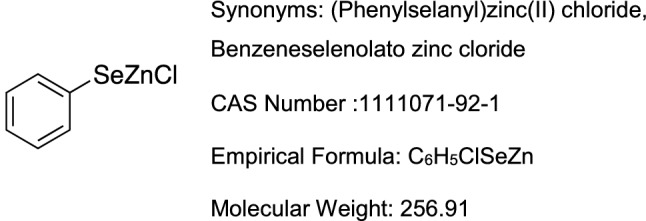
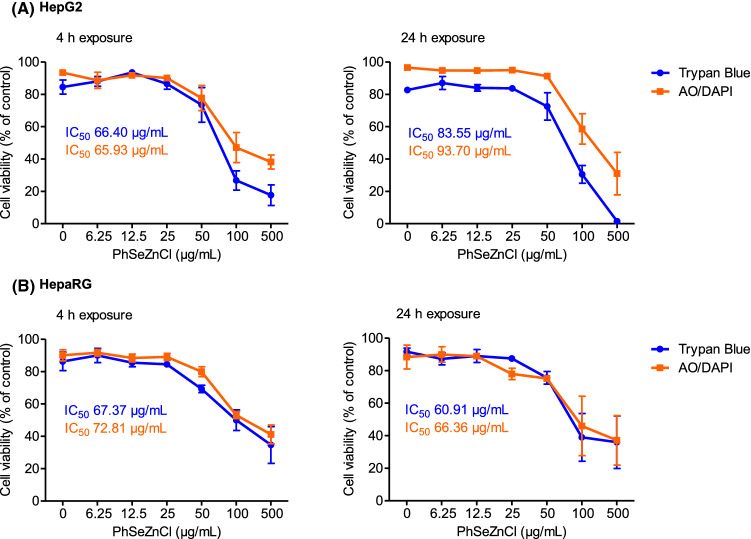
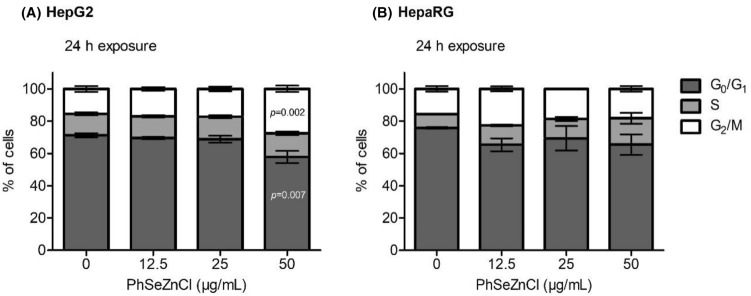
Phenylselenenylzinc chloride (PhSeZnCl) is an air-stable selenolate, easily synthesizable through oxidative insertion of elemental zinc into the Se-halogen bond of the commercially available phenylselenyl chloride. PhSeZnCl was shown to possess a marked GPx-like activity both in NMR and in vitro tests, and to effectively react with cellular thiols, and was supposed for a potential use in the chemotherapy of drug-resistant cancers. However, activity of PhSeZnCl in hepatic cells has never been tested before now. In this in vitro approach, we evaluated the cytotoxic, genotoxic, and apoptotic activities, as well as the effects on cell cycle of PhSeZnCl in two preclinical hepatic models, namely HepG2 and HepaRG cells. Results showed that cell viability of HepG2 and HepaRG cells decreased in a dose-dependent manner, with a more marked effect in HepG2 tumour cells. Moreover, treatment with 50 µg/mL PhSeZnCl caused an increase of primary DNA damage (4 h) and a statistically significant increase of HepG2 cells arrested in G/M phase. In addition, it altered mitochondrial membrane potential and induced chromosomal DNA fragmentation (24 h). In HepaRG cells, PhSeZnCl was able to determine a cell cycle-independent induction of apoptosis. Particularly, 50 µg/mL induced mitochondrial membrane depolarization after 24 h and apoptosis after 4 h treatment. Futhermore, all PhSeZnCl concentrations tested determined a significant increase of apoptotic cells after 24 h. Apoptosis was also highlighted by the detection of active Caspase-3 by Western Blot analysis after 24 h exposure. In conclusion, this first toxicological assessment provides new insights into the biological activity of PhSeZnCl in preclinical hepatic models that will be useful in future safety assessment investigation of this compound as a potential pharmaceutical.
The online version contains supplementary material available at 10.1007/s43188-022-00148-y.
苯基硒基氯化锌(PhSeZnCl)是一种空气稳定的硒醇盐,可通过将元素锌氧化插入市售苯基硒基氯的Se-卤键中轻松合成。在核磁共振(NMR)和体外试验中,PhSeZnCl均显示出显著的谷胱甘肽过氧化物酶(GPx)样活性,能与细胞硫醇有效反应,并被认为在耐药性癌症的化疗中有潜在用途。然而,此前从未测试过PhSeZnCl在肝细胞中的活性。在本体外研究中,我们评估了PhSeZnCl在两种临床前肝脏模型,即HepG2和HepaRG细胞中的细胞毒性、遗传毒性和凋亡活性,以及对细胞周期的影响。结果表明,HepG2和HepaRG细胞的活力呈剂量依赖性下降,对HepG2肿瘤细胞的影响更为显著。此外,用50μg/mL PhSeZnCl处理导致原发性DNA损伤增加(4小时),且G/M期停滞 的HepG2细胞有统计学意义的增加。此外,它改变了线粒体膜电位并诱导染色体DNA片段化(24小时)。在HepaRG细胞中,PhSeZnCl能够诱导与细胞周期无关的凋亡。特别是,50μg/mL在处理24小时后诱导线粒体膜去极化,处理4小时后诱导凋亡。此外,所有测试的PhSeZnCl浓度在24小时后均导致凋亡细胞显著增加。24小时暴露后通过蛋白质免疫印迹分析检测活性半胱天冬酶-3也突出了凋亡。总之,这首次毒理学评估为PhSeZnCl在临床前肝脏模型中的生物活性提供了新见解,这将有助于该化合物作为潜在药物的未来安全性评估研究。
在线版本包含可在10.1007/s43188-022-00148-y获取的补充材料。