Department of Physics and Astronomy, University of Rochester, Rochester, NY, USA.
Department of Physics and Astronomy, York University, Toronto, Ontario, Canada.
Nature. 2023 Feb;614(7946):48-53. doi: 10.1038/s41586-022-05478-3. Epub 2023 Feb 1.
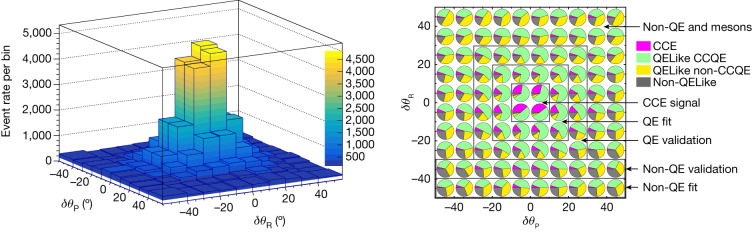
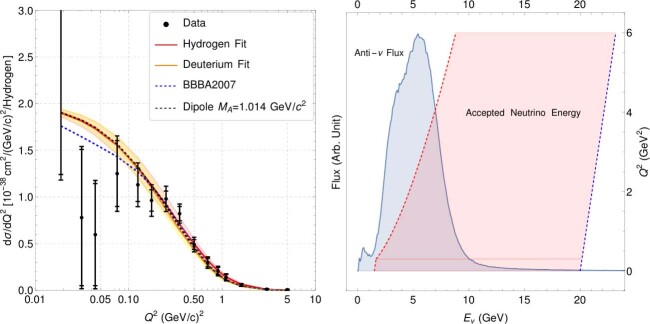
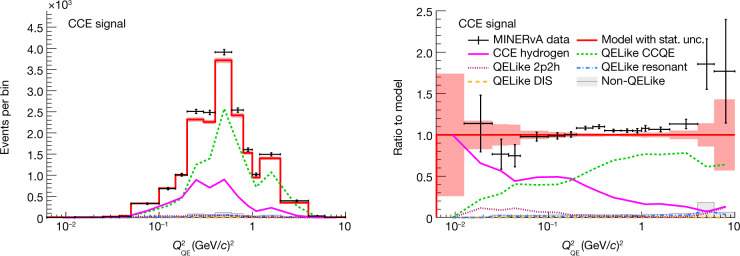
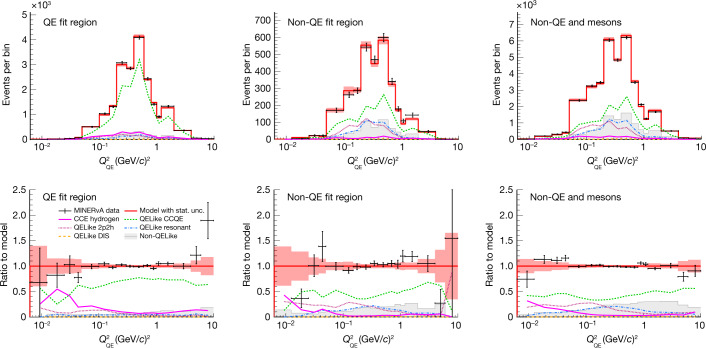
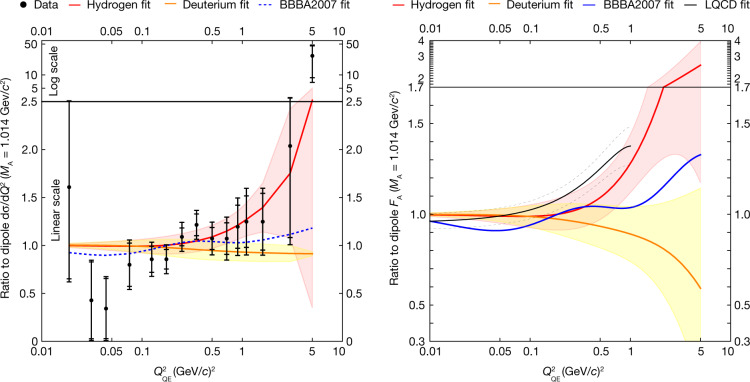
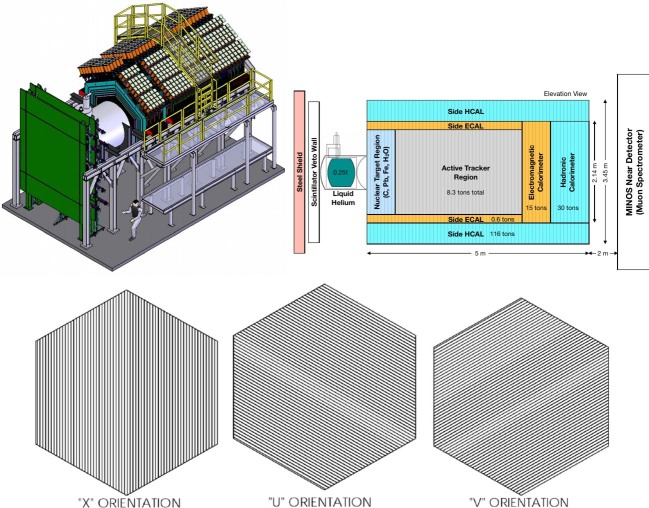
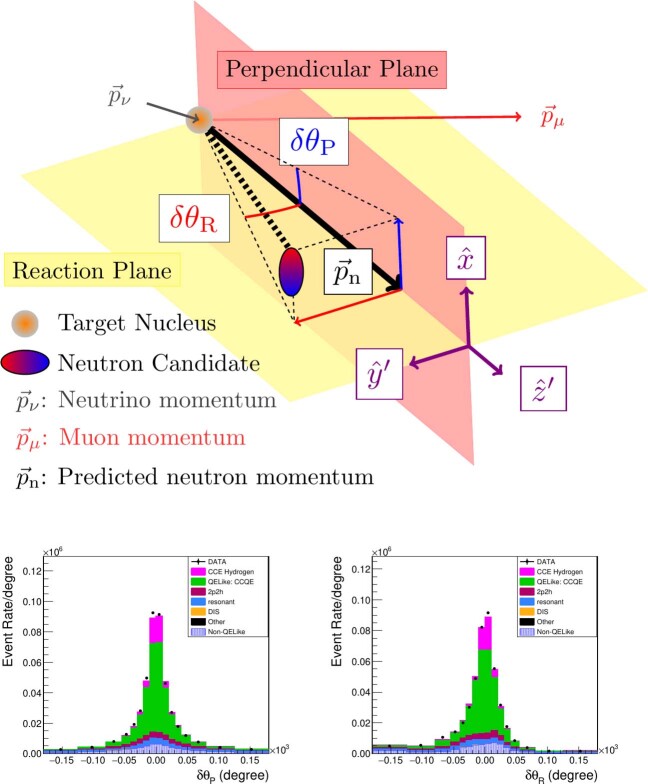
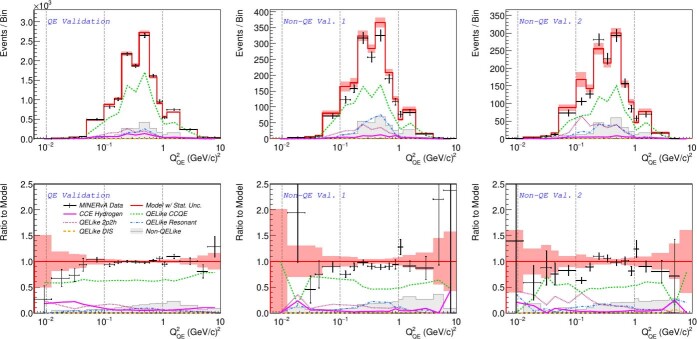
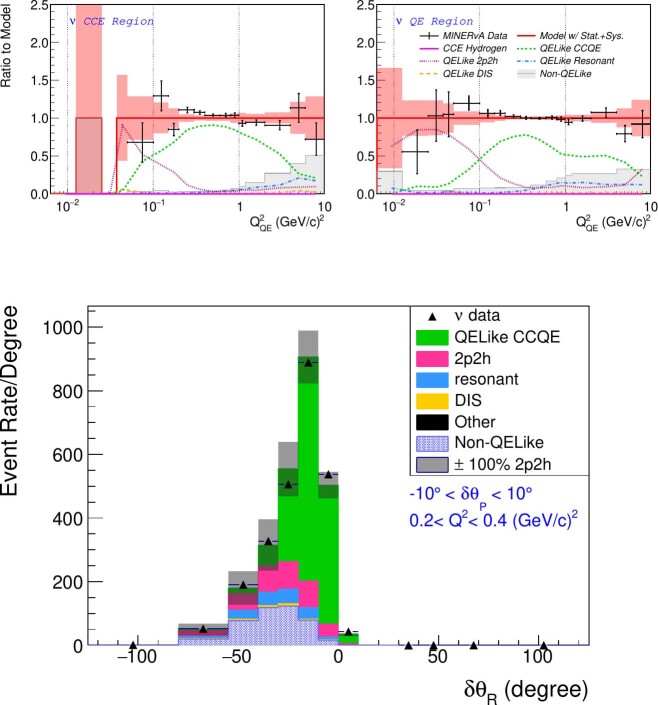
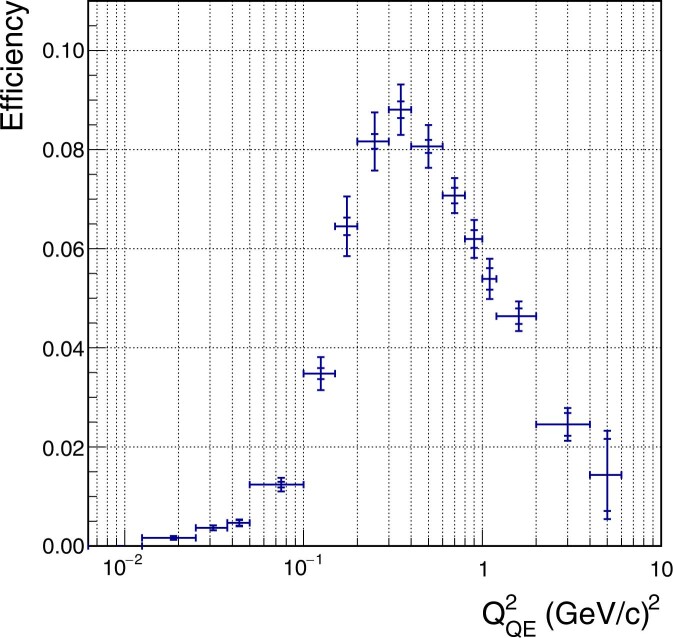
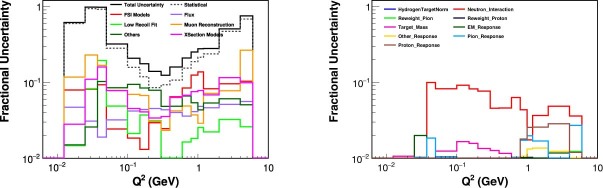
Scattering of high energy particles from nucleons probes their structure, as was done in the experiments that established the non-zero size of the proton using electron beams. The use of charged leptons as scattering probes enables measuring the distribution of electric charges, which is encoded in the vector form factors of the nucleon. Scattering weakly interacting neutrinos gives the opportunity to measure both vector and axial vector form factors of the nucleon, providing an additional, complementary probe of their structure. The nucleon transition axial form factor, F, can be measured from neutrino scattering from free nucleons, νn → μp and [Formula: see text], as a function of the negative four-momentum transfer squared (Q). Up to now, F(Q) has been extracted from the bound nucleons in neutrino-deuterium scattering, which requires uncertain nuclear corrections. Here we report the first high-statistics measurement, to our knowledge, of the [Formula: see text] cross-section from the hydrogen atom, using the plastic scintillator target of the MINERvA experiment, extracting F from free proton targets and measuring the nucleon axial charge radius, r, to be 0.73 ± 0.17 fm. The antineutrino-hydrogen scattering presented here can access the axial form factor without the need for nuclear theory corrections, and enables direct comparisons with the increasingly precise lattice quantum chromodynamics computations. Finally, the tools developed for this analysis and the result presented are substantial advancements in our capabilities to understand the nucleon structure in the weak sector, and also help the current and future neutrino oscillation experiments to better constrain neutrino interaction models.
高能粒子对核子的散射探测了它们的结构,这在使用电子束的实验中得到了证实,这些实验确立了质子的非零大小。使用带电轻子作为散射探针可以测量电荷分布,电荷分布编码在核子的矢量形式因子中。弱相互作用中微子的散射提供了测量核子矢量和轴矢形式因子的机会,为它们的结构提供了另一种补充的探针。核子跃迁轴矢形式因子 F 可以通过从自由核子散射的中微子 νn→μp 和 [Formula: see text]来测量,作为负四维动量转移平方(Q)的函数。到目前为止,F(Q)是从中微子氘散射中的束缚核子中提取的,这需要不确定的核修正。在这里,我们报告了迄今为止首次在氢原子中测量 [Formula: see text] 截面的高统计量测量,使用 MINERvA 实验的塑料闪烁体靶,从自由质子靶中提取 F,并测量核子轴向电荷半径 r 为 0.73±0.17fm。这里呈现的反中微子-氢散射不需要核理论修正就可以访问轴矢形式因子,并可以与越来越精确的格点量子色动力学计算进行直接比较。最后,为这项分析开发的工具和呈现的结果是我们在理解弱相互作用中核子结构方面的能力的重大进展,也有助于当前和未来的中微子振荡实验更好地约束中微子相互作用模型。