SAMRC/Wits Developmental Pathways for Health Research Unit, School of Clinical Medicine, Faculty of Health Sciences, University of the Witwatersrand, Johannesburg, South Africa.
Biomedical Research and Training Institute, Harare, Zimbabwe.
J Bone Miner Res. 2023 May;38(5):619-630. doi: 10.1002/jbmr.4765. Epub 2023 Feb 1.
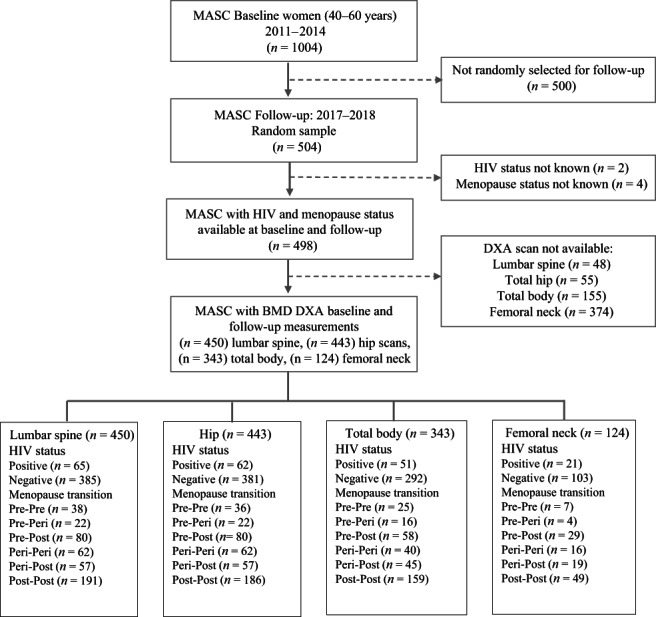
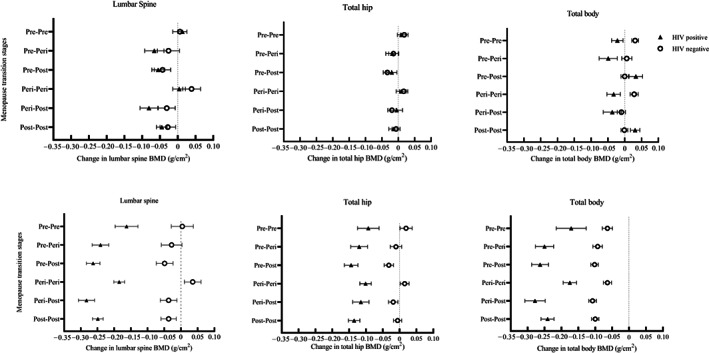
An estimated 25% of South African women live with human immunodeficiency virus (HIV). Antiretroviral therapy roll-out has improved life expectancy, so many more women now reach menopause. We aimed to quantify changes in bone mineral density (BMD) during the menopausal transition in urban-dwelling South African women with and without HIV and determine whether HIV infection modified the effect of menopause on BMD changes. A 5-year population-based longitudinal study recruited women aged 40-60 years residing in Soweto and collected demographic and clinical data, including HIV status, anthropometry, and BMD, at baseline and at 5-year follow-up. All women were staged as pre-, peri-, or postmenopausal at both time points. Multivariable linear regression assessed relationships and interactions between HIV infection, menopause, and change in BMD. At baseline, 450 women had mean age 49.5 (SD 5.7) years, 65 (14.4%) had HIV, and 140 (31.1%), 119 (26.4%), and 191 (42.4%) were pre-, peri-, and postmenopausal, respectively; 34/205 (13.6%) women ≥50 years had a total hip (TH) or lumbar spine (LS) T-score ≤ -2.5. At follow-up 38 (8.4%), 84 (18.7%), and 328 (72.9%) were pre-, peri-, and postmenopausal. Those with HIV at baseline lost more total body (TB) BMD (mean difference -0.013 [95% confidence interval -0.026, -0.001] g/cm , p = 0.040) and gained more weight 1.96 [0.32, 3.60] kg; p = 0.019 than HIV-uninfected women. After adjusting for age, baseline weight, weight change, and follow-up time, the transition from pre- to postmenopause was associated with greater TB BMD losses in women with HIV (-0.092 [-0.042, -0.142] g/cm ; p = 0.001) than without HIV (-0.038 [-0.016, -0.060] g/cm , p = 0.001; interaction p = 0.034). Similarly, in women who were postmenopausal at both time points, those with HIV lost more TB BMD (-0.070 [-0.031, -0.108], p = 0.001) than women without HIV (-0.036 [-0.015, -0.057], p = 0.001, interaction p = 0.049). Findings were consistent but weaker at the LS and TH. Menopause-related bone loss is greater in women with HIV, suggesting women with HIV may be at greater risk of osteoporotic fractures. HIV services should consider routine bone health assessment in midlife women as part of long-term HIV care delivery. © 2023 The Authors. Journal of Bone and Mineral Research published by Wiley Periodicals LLC on behalf of American Society for Bone and Mineral Research (ASBMR).
据估计,25%的南非女性携带人类免疫缺陷病毒(HIV)。抗逆转录病毒疗法的推出提高了预期寿命,因此现在有更多的女性进入绝经期。我们旨在定量研究在城市居住的南非 HIV 阳性和阴性女性绝经过渡期间骨密度(BMD)的变化,并确定 HIV 感染是否改变了绝经对 BMD 变化的影响。一项为期 5 年的基于人群的纵向研究招募了居住在索韦托的 40-60 岁女性,在基线和 5 年随访时收集人口统计学和临床数据,包括 HIV 状况、人体测量学和 BMD。所有女性在两个时间点均分为绝经前、绝经中和绝经后。多变量线性回归评估了 HIV 感染、绝经和 BMD 变化之间的关系和相互作用。在基线时,450 名女性的平均年龄为 49.5(SD 5.7)岁,65 名(14.4%)患有 HIV,140 名(31.1%)、119 名(26.4%)和 191 名(42.4%)分别处于绝经前、绝经中和绝经后;34/205(13.6%)≥50 岁的女性全髋(TH)或腰椎(LS)T 评分≤-2.5。在随访时,38 名(8.4%)、84 名(18.7%)和 328 名(72.9%)处于绝经前、绝经中和绝经后。基线时携带 HIV 的女性全身骨密度(TB)丢失更多(平均差异-0.013 [95%置信区间-0.026,-0.001] g/cm ,p=0.040),体重增加 1.96 [0.32,3.60] kg;p=0.019,而 HIV 阴性女性则没有。在调整年龄、基线体重、体重变化和随访时间后,与未感染 HIV 的女性相比,从绝经前到绝经后的过渡与 HIV 阳性女性的 TB BMD 损失更大(-0.092 [-0.042,-0.142] g/cm ;p=0.001)。在两个时间点均处于绝经后状态的女性中,与未感染 HIV 的女性相比,感染 HIV 的女性 TB BMD 丢失更多(-0.070 [-0.031,-0.108],p=0.001)。发现结果在 LS 和 TH 上是一致的,但强度较弱。HIV 阳性女性的绝经相关性骨丢失更大,这表明 HIV 阳性女性可能面临更大的骨质疏松性骨折风险。HIV 服务应考虑在中年女性中常规进行骨骼健康评估,作为长期 HIV 护理的一部分。