Bruera Sebastian, Chavula Thandiwe, Madan Riya, Agarwal Sandeep K
Section of Immunology, Allergy and Rheumatology, Department of Medicine, Baylor College of Medicine, Houston, TX, United States.
Section of General Internal Medicine, Department of Medicine, Baylor College of Medicine, Houston, TX, United States.
Front Pharmacol. 2023 Jan 16;13:1046687. doi: 10.3389/fphar.2022.1046687. eCollection 2022.
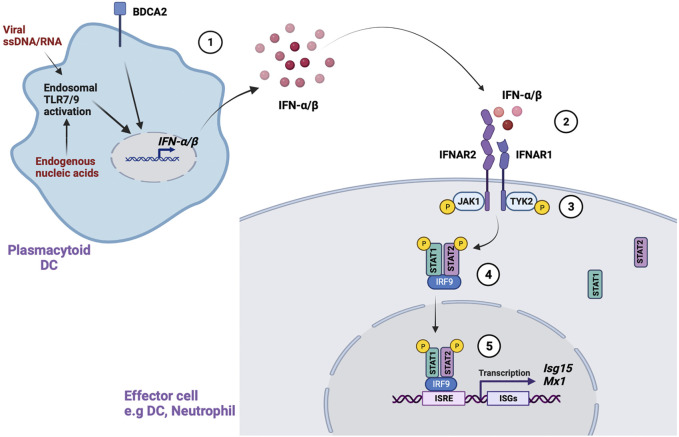
Systemic lupus erythematosus (SLE) is a complex autoimmune disease with systemic clinical manifestations including, but not limited to, rash, inflammatory arthritis, serositis, glomerulonephritis, and cerebritis. Treatment options for SLE are expanding and the increase in our understanding of the immune pathogenesis is leading to the development of new therapeutics. Autoantibody formation and immune complex formation are important mediators in lupus pathogenesis, but an important role of the type I interferon (IFN) pathway has been identified in SLE patients and mouse models of lupus. These studies have led to the development of therapeutics targeting type I IFN and related pathways for the treatment of certain manifestations of SLE. In the current narrative review, we will discuss the role of type I IFN in SLE pathogenesis and the potential translation of these data into strategies using type I IFN as a biomarker and therapeutic target for patients with SLE.
系统性红斑狼疮(SLE)是一种复杂的自身免疫性疾病,具有全身性临床表现,包括但不限于皮疹、炎性关节炎、浆膜炎、肾小球肾炎和脑炎。SLE的治疗选择正在不断扩展,我们对免疫发病机制认识的增加正促使新疗法的开发。自身抗体形成和免疫复合物形成是狼疮发病机制中的重要介质,但在SLE患者和狼疮小鼠模型中已确定I型干扰素(IFN)途径起重要作用。这些研究已促成针对I型IFN及相关途径的疗法开发,用于治疗SLE的某些表现。在当前的叙述性综述中,我们将讨论I型IFN在SLE发病机制中的作用,以及将这些数据转化为以I型IFN作为SLE患者生物标志物和治疗靶点的策略的可能性。