Rollins School of Public Health, Emory University, Atlanta, GA.
Emory University School of Medicine, Atlanta, GA.
J Acquir Immune Defic Syndr. 2023 Mar 1;92(3):189-196. doi: 10.1097/QAI.0000000000003123. Epub 2022 Nov 2.
Estimating HIV incidence is essential to monitoring progress in sub-Saharan African nations toward global epidemic control. One method for incidence estimation is to test nationally representative samples using laboratory-based incidence assays. An alternative method based on reported HIV testing history and the proportion of undiagnosed infections has recently been described.
We applied an HIV incidence estimation method which uses history of testing to nationally representative cross-sectional survey data from 12 sub-Saharan African nations with varying country-specific HIV prevalence. We compared these estimates with those derived from laboratory-based incidence assays. Participants were tested for HIV using the national rapid test algorithm and asked about prior HIV testing, date and result of their most recent test, and date of antiretroviral therapy initiation.
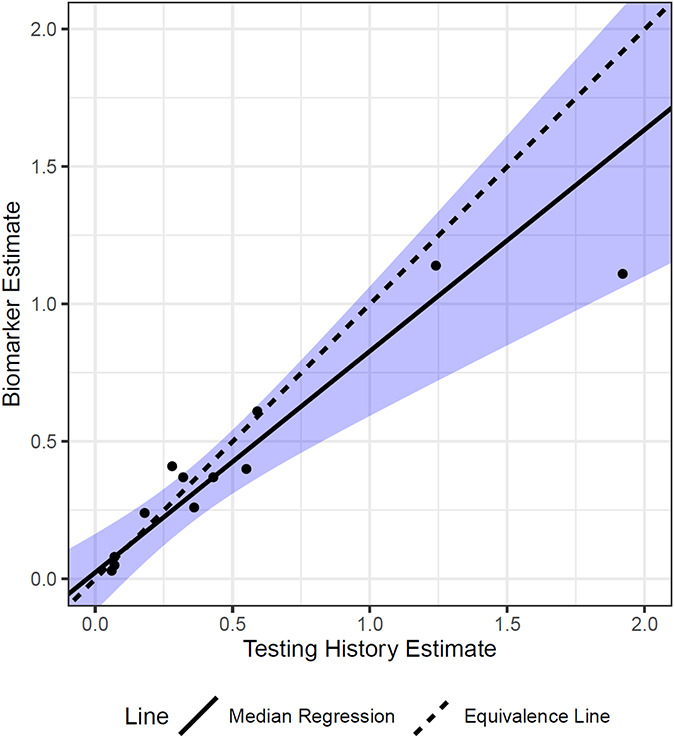
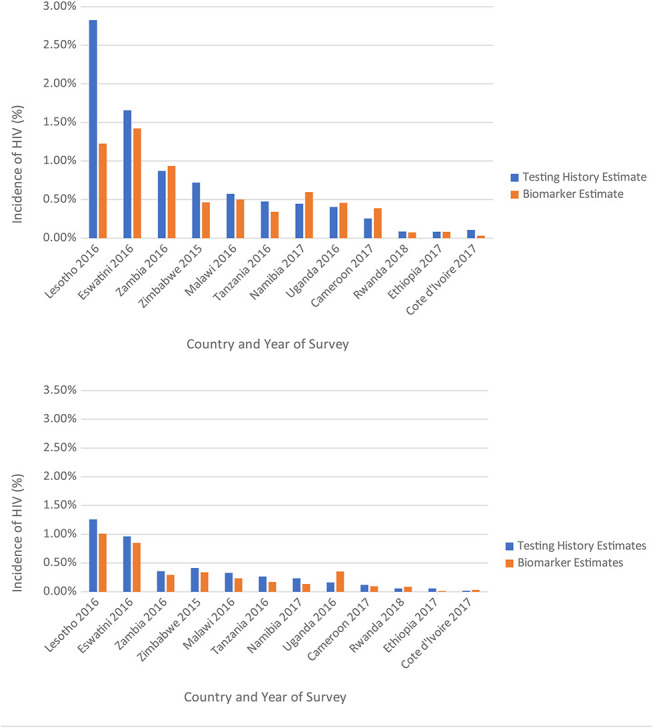
The testing history-based method consistently produced results that are comparable and strongly correlated with estimates produced using a laboratory-based HIV incidence assay (ρ = 0.85). The testing history-based method produced incidence estimates that were more precise compared with the biomarker-based method. The testing history-based method identified sex-, age-, and geographic location-specific differences in incidence that were not detected using the biomarker-based method.
The testing history-based method estimates are more precise and can produce age-specific and sex-specific incidence estimates that are informative for programmatic decisions. The method also allows for comparisons of the HIV transmission rate and other components of HIV incidence among and within countries. The testing history-based method is a useful tool for estimating and validating HIV incidence from cross-sectional survey data.
在撒哈拉以南非洲国家,估计艾滋病毒发病率对于监测在实现全球艾滋病防控目标方面的进展至关重要。一种发病率估计方法是使用基于实验室的发病率检测方法对具有全国代表性的样本进行检测。最近还描述了一种基于报告的艾滋病毒检测史和未确诊感染比例的替代方法。
我们应用了一种基于检测史的艾滋病毒发病率估计方法,该方法使用了来自撒哈拉以南非洲 12 个国家的具有不同国家特定艾滋病毒流行率的全国代表性横断面调查数据。我们将这些估计值与基于实验室的发病率检测方法得出的估计值进行了比较。参与者使用国家快速检测算法进行了艾滋病毒检测,并被问及他们之前的艾滋病毒检测情况、最近一次检测的日期和结果以及抗逆转录病毒疗法的开始日期。
基于检测史的方法产生的结果始终与使用基于实验室的艾滋病毒发病率检测方法得出的估计值具有可比性且相关性很强(ρ=0.85)。与基于生物标志物的方法相比,基于检测史的方法产生的发病率估计值更为准确。基于检测史的方法确定了基于生物标志物的方法未检测到的与性别的年龄和地理位置相关的发病率差异。
基于检测史的方法的估计值更为准确,可以生成年龄和性别特异性的发病率估计值,为决策提供信息。该方法还允许在国家之间和国家内部比较艾滋病毒传播率和艾滋病毒发病率的其他组成部分。基于检测史的方法是从横断面调查数据估计和验证艾滋病毒发病率的有用工具。