Department of Orthopaedics and Rehabilitation, Yale School of Medicine, New Haven, CT.
J Am Acad Orthop Surg Glob Res Rev. 2022 Dec 8;6(12). doi: 10.5435/JAAOSGlobal-D-22-00228. eCollection 2022 Dec 1.
Although the use of venous thromboembolism (VTE) chemoprophylaxis has markedly reduced VTE rates after hip fracture surgery, few studies have directly compared the efficacy of different anticoagulant agents in this setting. The purpose of this study was to compare outcomes of Lovenox, Eliquis, or Coumadin as VTE prophylaxis after hip fracture surgery.
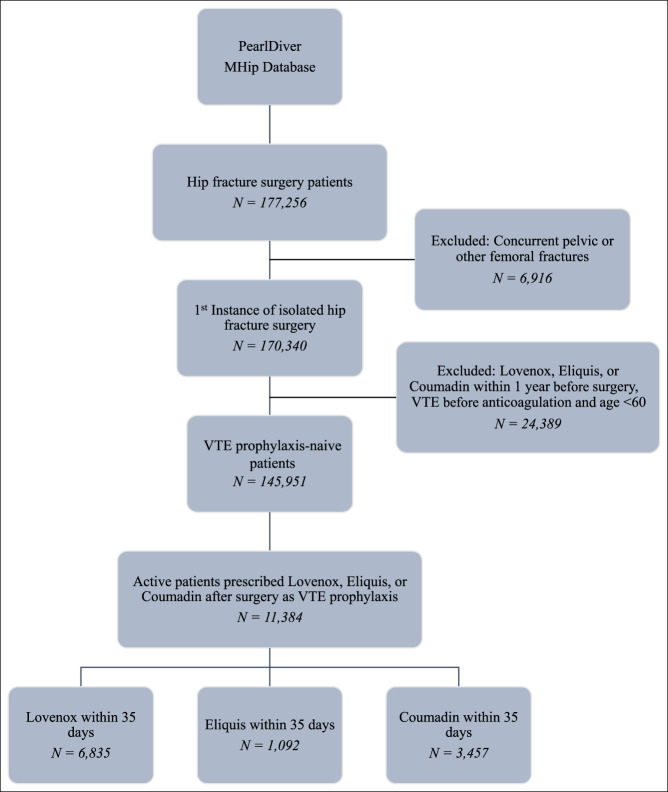
The PearlDiver MHip national database was queried for patients older than 60 years undergoing first-time hip fracture surgery with no concurrent pelvic or distal femoral fractures. Prescriptions for Lovenox, Eliquis, or Coumadin were identified. Univariate and multivariate analyses of patient characteristics, 90-day incidences of VTE, adverse events, and readmissions were compared. Odds ratios (ORs) were calculated, and significance was set at P < 0.01 based on Bonferroni adjustment.
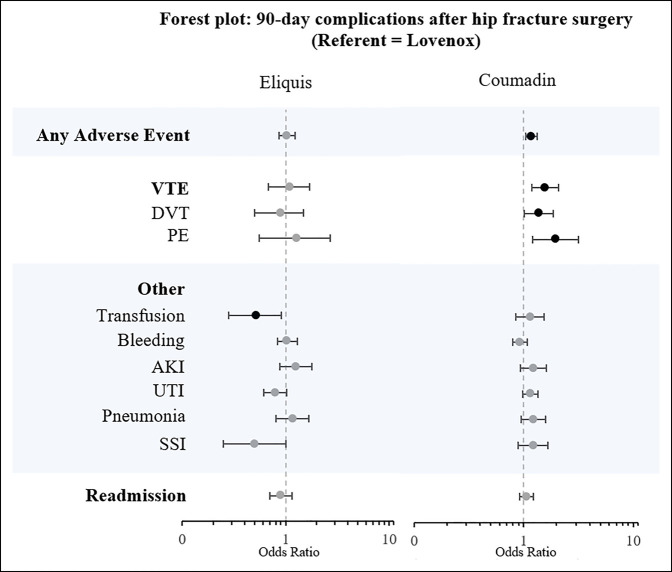
A total of 11,384 patients were identified, with the Lovenox used for 6835 patients (60.0%), Eliquis for 1092 patients (9.6%), and Coumadin for 3457 patients (30.4%). The prevalence of 90-day VTE in the Lovenox, Eliquis, and Coumadin groups was 3.1%, 3.8%, and 5.0%, respectively (P < 0.001). Multivariate analyses adjusting for demographic and comorbidity profiles were conducted with Lovenox as the referent. Those on Eliquis had significantly lower transfusions (OR 0.52, P = 0.005), but similar rates of other outcomes including VTE (P > 0.01). Conversely, patients on Coumadin had significantly greater odds of any adverse event (OR 1.18, P < 0.001) and VTE (OR 1.58, P < 0.001).
In evaluating Lovenox, Eliquis, and Coumadin as VTE chemoprophylactic agents after hip fracture surgery in anticoagulant-naïve patients, Lovenox and Eliquis had similar 90-day VTE, whereas patients on Coumadin had greater odds of 90-day VTE. Interestingly, patients on Eliquis had nearly two-fold lower odds of transfusions compared with patients on Lovenox. Although consensus on the optimal VTE prophylactic agent after hip fracture surgery does not exist, Eliquis and Lovenox may be comparable options and seem to be more effective than Coumadin.
尽管静脉血栓栓塞症(VTE)的化学预防显著降低了髋部骨折手术后的 VTE 发生率,但很少有研究直接比较不同抗凝药物在该环境下的疗效。本研究旨在比较利伐沙班、依度沙班和华法林作为髋部骨折手术后 VTE 预防的效果。
通过 PearlDiver MHip 国家数据库,对 60 岁以上首次接受髋部骨折手术且无骨盆或股骨远端骨折的患者进行了检索。确定了使用利伐沙班、依度沙班或华法林的患者。对患者特征、90 天内 VTE、不良事件和再入院的发生率进行了单变量和多变量分析。计算了比值比(OR),并根据 Bonferroni 调整,将显著性设为 P < 0.01。
共纳入 11384 例患者,其中利伐沙班组 6835 例(60.0%),依度沙班组 1092 例(9.6%),华法林组 3457 例(30.4%)。利伐沙班、依度沙班和华法林组 90 天 VTE 的发生率分别为 3.1%、3.8%和 5.0%(P < 0.001)。多变量分析调整了人口统计学和合并症特征,以利伐沙班为参照。依度沙班组输血的发生率显著降低(OR 0.52,P = 0.005),但其他结局(包括 VTE)的发生率相似(P > 0.01)。相反,华法林组发生任何不良事件(OR 1.18,P < 0.001)和 VTE(OR 1.58,P < 0.001)的几率显著更高。
在评估髋部骨折手术后抗凝素初治患者中利伐沙班、依度沙班和华法林作为 VTE 化学预防药物时,利伐沙班和依度沙班 90 天 VTE 发生率相似,而华法林组 90 天 VTE 发生率更高。有趣的是,依度沙班组输血的几率比利伐沙班组低近两倍。尽管对于髋部骨折手术后的最佳 VTE 预防药物尚未达成共识,但依度沙班和利伐沙班可能是可比较的选择,并且似乎比华法林更有效。