Department of Cardiovascular Surgery, General Hospital of Western Theater Command (Chengdu Military General Hospital), No. 270, Rongdu Rd, Jinniu District, Chengdu, 610036, China.
College of Medicine, Southwest Jiaotong University, Chengdu, 610036, China.
J Cardiothorac Surg. 2023 Feb 2;18(1):56. doi: 10.1186/s13019-023-02175-8.
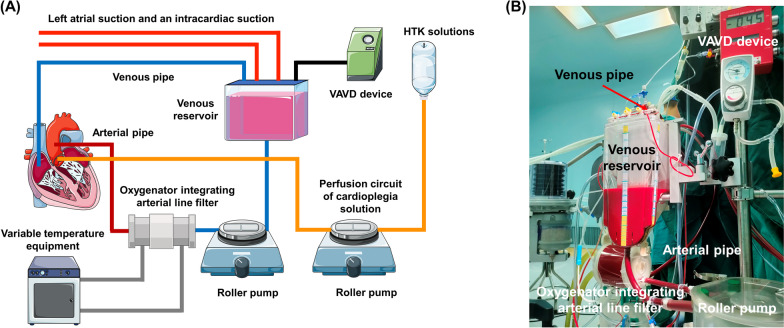
The adverse effects of cardiopulmonary bypass during open cardiac surgery, including hemodilution, seem to be inevitable, especially for patients who generally have a relatively lower BMI with relatively small blood volumes. This study reports the modification and use of a cardiopulmonary bypass (CPB) system to reduce priming volume and hemodilution.
This is a retrospective study of 462 adult patients who underwent cardiac valve replacement surgery from January 2019 to September 2021 at the General Hospital of Western Theater Command. The modified group consisted of 212 patients undergoing modified CPB. The control group included 250 patients receiving conventional CPB. Evaluated indices included fluid intake and output volumes during CPB, intraoperative indices related to CPB operation, usage of blood products during the peri-CPB period, and postoperative outcomes.
The modified group displayed a significant reduction in the crystalloid (200 mL vs. 600 mL, P < 0.05) and colloid priming volumes (450 mL vs. 1100 mL, P < 0.05), and ultrafiltration solution volume (750 mL vs. 1200 mL, P < 0.05). Furthermore, the modified group had a significantly lower rate of defibrillation (30.2% vs. 41.2%, P < 0.05). The intraoperative urine volume (650 mL vs. 500 mL, P < 0.05) and intraoperative hematocrit (Hct) (26% vs. 24%, P < 0.05) of the modified CPB group were also higher than in the control group. The modified group required a lower infusion volume of packed red blood cells (250 mL vs. 400 mL, P < 0.05) and lower infusion rates of packed red blood cells (17.9% vs. 25.2%, P < 0.05) and fresh frozen plasma (1.41% vs. 5.2%, P < 0.05). In addition, the modified group showed significantly improved indices related to postoperative recovery.
The modified CPB system effectively conserves blood and shows noteworthy potential for application in cardiac valve replacement surgery.
体外循环在心脏直视手术中的不利影响,包括血液稀释,似乎是不可避免的,特别是对于一般 BMI 较低、血容量相对较小的患者。本研究报告了一种体外循环(CPB)系统的改良和使用,以减少预充量和血液稀释。
这是一项回顾性研究,纳入了 2019 年 1 月至 2021 年 9 月在西部战区总医院接受心脏瓣膜置换术的 462 例成年患者。改良组包括 212 例接受改良 CPB 的患者。对照组包括 250 例接受常规 CPB 的患者。评估指标包括 CPB 期间的液体输入和输出量、与 CPB 操作相关的术中指标、围 CPB 期间血液制品的使用以及术后结果。
改良组晶体液(200ml vs. 600ml,P<0.05)和胶体预充量(450ml vs. 1100ml,P<0.05)以及超滤溶液量(750ml vs. 1200ml,P<0.05)明显减少。此外,改良组除颤率(30.2% vs. 41.2%,P<0.05)明显较低。改良 CPB 组术中尿量(650ml vs. 500ml,P<0.05)和术中血细胞比容(Hct)(26% vs. 24%,P<0.05)也高于对照组。改良组需要输注更少的浓缩红细胞(250ml vs. 400ml,P<0.05),输注浓缩红细胞的速度(17.9% vs. 25.2%,P<0.05)和新鲜冰冻血浆(1.41% vs. 5.2%,P<0.05)也更低。此外,改良组术后恢复相关指标明显改善。
改良 CPB 系统能有效节约血液,在心脏瓣膜置换术中具有应用潜力。