Krogh Helle B, Vinberg Maj, Mortensen Gitte Lee, Skakke Ditte, Nielsen Dorthe, Giraldi Annamaria
Sexological Clinic, Mental Health Center Copenhagen, Copenhagen University Hospital, Ole Maaloes 14, 2100, Copenhagen, Denmark.
Mental Health Center, Northern Zealand, Copenhagen University Hospital, Mental Health Services CPH, Hillerød, Denmark.
Int J Bipolar Disord. 2023 Feb 3;11(1):5. doi: 10.1186/s40345-023-00285-9.
Individuals with mental health disorders have a higher risk of sexual problems impacting intimate relations and quality of life. For individuals with bipolar disorder (BD) the mood shifts might to a particular degree affect their sexual function with possible hypersexual interest during manic episodes and low sexual interest during depressive episodes. The diagnosis is often given in late adolescence, which may impact sexual identity and development. Only a few studies have looked at BD and sexual life, with no qualitative research on the topic. We conducted a qualitative pilot study exploring sexuality in connection to mood swings in five participants with BD.
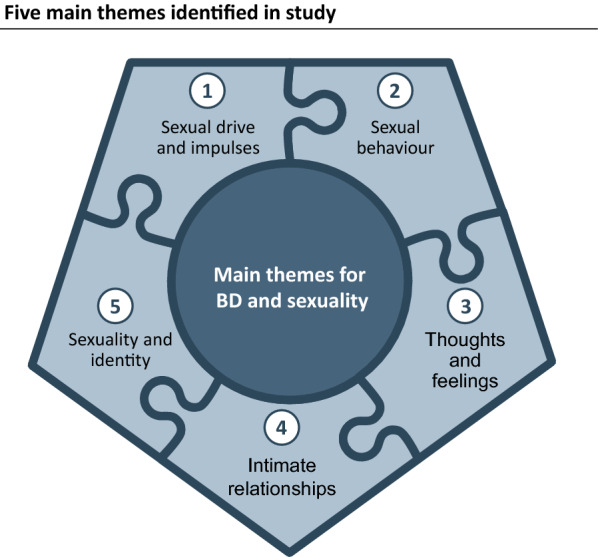
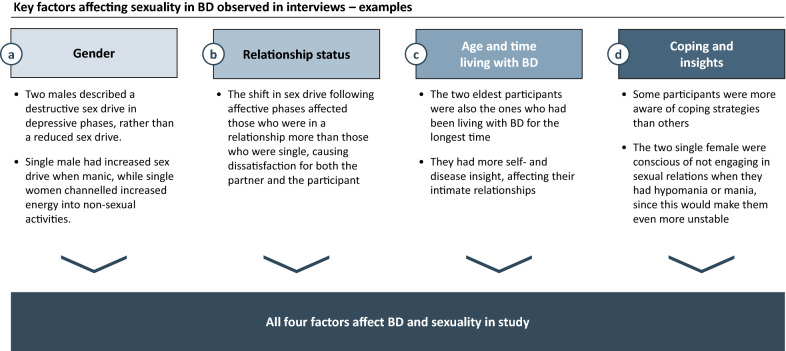
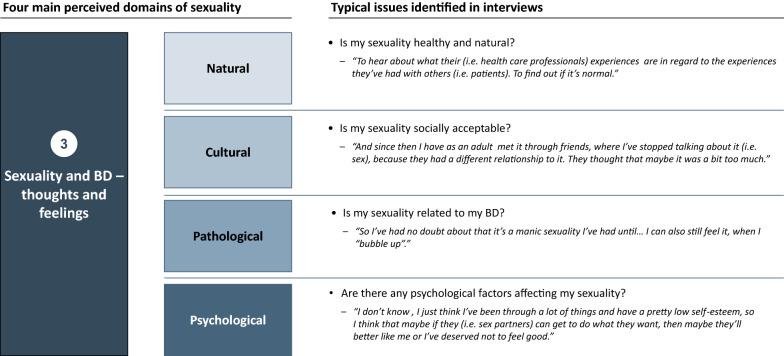
Thematic content analysis revealed five themes: (1) sexual drive and impulses, (2) sexual behavior, (3) thoughts and feelings in relation to sexual issues, (4) intimate relationships, and (5) sexuality and identity. During manic episodes the participants described having a higher sexual drive, leading for some to more sexual interactions. During depressed episodes, the sexual drive in the three female participants was low, however, in the two men, rather than a reduced sexual drive, a more self-destructive way of engaging in sex prevailed. The sexual outgoing behavior during manic phases was described as joyful, with no feelings of shame connected to it. However, the shifts in sexual drive connected to mood shifts affected the participants' relationships negatively. Further, all the participants described having outgoing sexual behavior in their youth.
Overall, changes in sexual drive may act as a trigger or early warning symptoms of new episodes, pinpointing the clinical relevance of addressing sexuality in individuals with BD. In general, sexual drive followed affective episodes. However, during depressive episodes sex could be, instead of reduced drive, associated with negative feelings. All participants described having an outgoing sexual behavior in their youth before the onset of BD, which might be essential to consider if there is a clinical suspension of BD in an individual.
患有精神健康障碍的个体出现影响亲密关系和生活质量的性问题的风险更高。对于双相情感障碍(BD)患者而言,情绪波动可能在一定程度上影响其性功能,在躁狂发作期间可能出现性欲亢进,而在抑郁发作期间则性欲低落。该疾病的诊断通常在青春期后期做出,这可能会影响性身份认同和性发育。仅有少数研究关注双相情感障碍与性生活的关系,且尚无关于该主题的定性研究。我们开展了一项定性试点研究,探讨了五名双相情感障碍患者的性与情绪波动之间的联系。
主题内容分析揭示了五个主题:(1)性驱力和冲动;(2)性行为;(3)与性问题相关的想法和感受;(4)亲密关系;(5)性与身份认同。在躁狂发作期间,参与者表示性驱力增强,导致一些人有更多的性互动。在抑郁发作期间,三名女性参与者的性驱力较低,然而,两名男性并非性驱力降低,而是普遍存在一种更具自我毁灭性质的性行为方式。躁狂阶段的外向性行为被描述为愉悦的,且没有与之相关的羞耻感。然而,与情绪波动相关的性驱力变化对参与者的关系产生了负面影响。此外,所有参与者都描述自己在年轻时有外向性行为。
总体而言,性驱力的变化可能是新发作的触发因素或早期预警症状,凸显了在双相情感障碍患者中关注性问题的临床相关性。一般来说,性驱力随情感发作而变化。然而,在抑郁发作期间,性行为可能并非与性驱力降低相关,而是与负面情绪相关。所有参与者都描述自己在双相情感障碍发病前的青年时期有外向性行为,如果个体出现双相情感障碍的临床缓解,这一点可能至关重要。