Department of Biology, Colorado State University, Fort Collins, CO, United States.
Computational Ecology Lab, School of Public and Community Health Sciences, University of Montana, Missoula, MT, United States.
J Hered. 2023 Jun 22;114(4):341-353. doi: 10.1093/jhered/esac067.
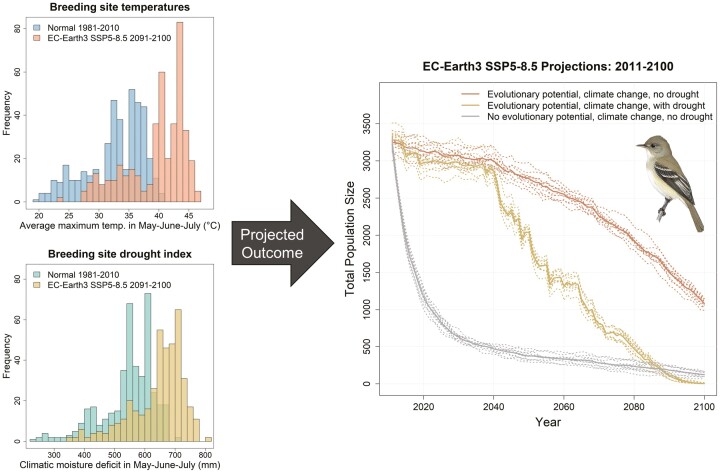
The complexity of global anthropogenic change makes forecasting species responses and planning effective conservation actions challenging. Additionally, important components of a species' adaptive capacity, such as evolutionary potential, are often not included in quantitative risk assessments due to lack of data. While genomic proxies for evolutionary potential in at-risk species are increasingly available, they have not yet been included in extinction risk assessments at a species-wide scale. In this study, we used an individual-based, spatially explicit, dynamic eco-evolutionary simulation model to evaluate the extinction risk of an endangered desert songbird, the southwestern willow flycatcher (Empidonax traillii extimus), in response to climate change. Using data from long-term demographic and habitat studies in conjunction with genome-wide ecological genomics research, we parameterized simulations that include 418 sites across the breeding range, genomic data from 225 individuals, and climate change forecasts spanning 3 generalized circulation models and 3 emissions scenarios. We evaluated how evolutionary potential, and the lack of it, impacted population trajectories in response to climate change. We then investigated the compounding impact of drought and warming temperatures on extinction risk through the mechanism of increased nest failure. Finally, we evaluated how rapid action to reverse greenhouse gas emissions would influence population responses and species extinction risk. Our results illustrate the value of incorporating evolutionary, demographic, and dispersal processes in a spatially explicit framework to more comprehensively evaluate the extinction risk of threatened and endangered species and conservation actions to promote their recovery.
全球人为变化的复杂性使得预测物种反应和规划有效的保护行动具有挑战性。此外,由于缺乏数据,物种适应能力的重要组成部分,如进化潜力,通常不包括在定量风险评估中。虽然濒危物种进化潜力的基因组替代物越来越多,但它们尚未在物种范围内的灭绝风险评估中得到应用。在这项研究中,我们使用基于个体、空间显式、动态生态进化模拟模型来评估受气候变化影响的濒危沙漠鸣禽——西南柳莺(Empidonax traillii extimus)的灭绝风险。我们利用长期的种群和栖息地研究数据,以及全基因组生态基因组学研究,对模拟进行了参数化,这些模拟包括繁殖范围内的 418 个地点、225 个个体的基因组数据,以及跨越 3 个通用环流模型和 3 个排放情景的气候变化预测。我们评估了进化潜力及其缺乏对气候变化响应的种群轨迹的影响。然后,我们通过增加巢失败的机制,研究了干旱和变暖温度对灭绝风险的复合影响。最后,我们评估了迅速采取行动逆转温室气体排放将如何影响种群反应和物种灭绝风险。我们的研究结果说明了在空间显式框架中纳入进化、种群动态和扩散过程来更全面地评估受威胁和濒危物种的灭绝风险以及促进其恢复的保护行动的价值。