National Clinical Research Center of Kidney Diseases, Jinling Hospital, Nanjing University School of Medicine, 305 East Zhongshan Road, Nanjing, 210016, Jiangsu, China.
Int Urol Nephrol. 2023 Jul;55(7):1757-1765. doi: 10.1007/s11255-023-03479-3. Epub 2023 Feb 5.
To evaluate the clinical characteristics and prognosis of systemic lupus erythematosus (SLE) with persistent inflammation-immunosuppression-catabolism syndrome (PICS).
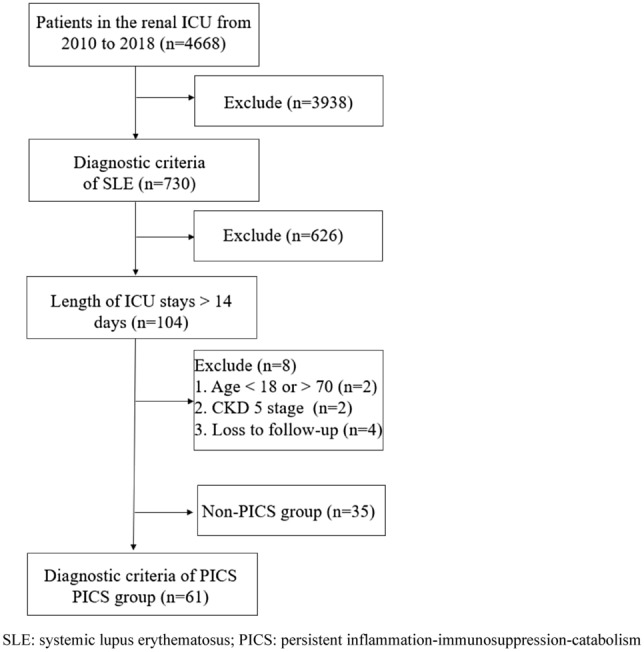
We retrospectively analyzed patients with SLE who were admitted to the renal intensive care unit (ICU) for over 14 days at Jinling Hospital from July 2010 to July 2018. According to the diagnostic criteria of PICS, we divided the SLE patients into a PICS group and a non-PICS group. We performed a multivariate Cox regression analysis on the risk factors for death in these two groups by comparing the clinical features and prognosis.
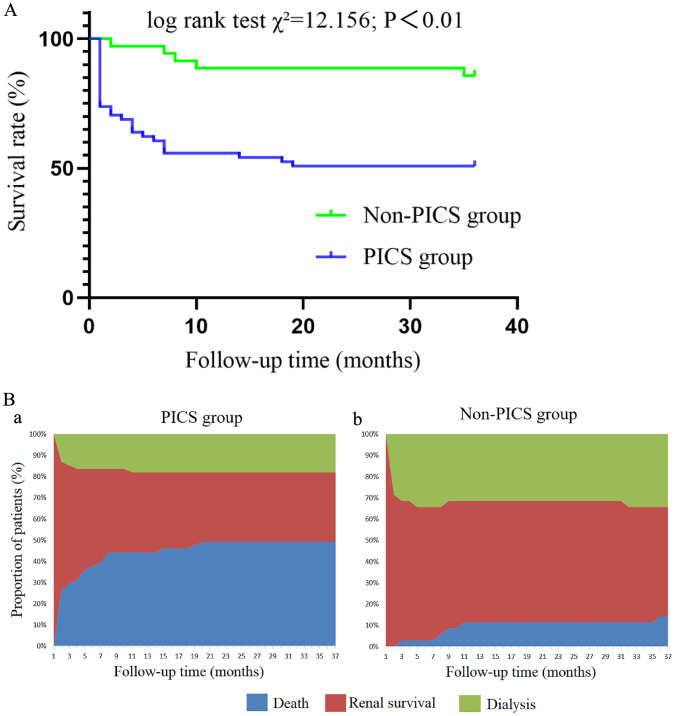
A total of 96 SLE patients met the inclusion and exclusion criteria of this study, including 61 patients in the PICS group and 35 patients in the non-PICS group. The PICS group patients required a longer length of stay in ICU with higher inflammatory indicators (such as C-reactive protein, procalcitonin and interleukin-6) and lower immune levels (such as total, CD3 + , CD4 + , CD8 + and CD20 + lymphocytes) compared to the non-PICS group patients (P < 0.01). Hemoglobin, platelets, serum creatinine, serum blood urea nitrogen and SLE Disease Activity Index (SLE-DAI) score in the PICS group were lower than those in the non-PICS group (P < 0.05), suggesting severe hematological injury in the PICS group and relatively severe renal damage in the non-PICS group. The rates of PICS combined with sepsis, acute respiratory distress syndrome, mechanical ventilation, gram-positive bacteria, gram-negative bacteria, fungi and double infections were higher than those in the non-PICS group (P < 0.05). The 3-year survival rate was 50.82% in the PICS group and 85.71% in the non-PICS group. The 3-year renal survival rate was 32.79% in the PICS group and 51.43% in the non-PICS group. Multivariate Cox regression found that the total lymphocyte count during ICU admission was an independent risk factor for death in SLE patients with PICS.
Patients with SLE complicated with PICS had longer ICU stays, a lower level of SLE activity, a higher risk of secondary infection and a significantly lower survival rate than non-PICS patients.
评估持续炎症-免疫抑制-消耗综合征(PICS)的系统性红斑狼疮(SLE)的临床特征和预后。
我们回顾性分析了 2010 年 7 月至 2018 年 7 月在南京金陵医院肾重症监护病房(ICU)住院超过 14 天的 SLE 患者。根据 PICS 的诊断标准,我们将 SLE 患者分为 PICS 组和非 PICS 组。通过比较两组的临床特征和预后,对两组患者死亡的危险因素进行多变量 Cox 回归分析。
共纳入 96 例 SLE 患者,其中 61 例为 PICS 组,35 例为非 PICS 组。与非 PICS 组相比,PICS 组患者 ICU 住院时间更长,炎症指标(如 C 反应蛋白、降钙素原和白细胞介素 6)更高,免疫水平(如总淋巴细胞、CD3+、CD4+、CD8+和 CD20+淋巴细胞)更低(P<0.01)。PICS 组血红蛋白、血小板、血清肌酐、血清尿素氮和 SLE 疾病活动指数(SLE-DAI)评分均低于非 PICS 组(P<0.05),提示 PICS 组存在严重的血液学损伤,而非 PICS 组存在相对严重的肾脏损伤。PICS 组合并脓毒症、急性呼吸窘迫综合征、机械通气、革兰阳性菌、革兰阴性菌、真菌和双重感染的发生率高于非 PICS 组(P<0.05)。PICS 组 3 年生存率为 50.82%,非 PICS 组为 85.71%。PICS 组 3 年肾脏生存率为 32.79%,非 PICS 组为 51.43%。多变量 Cox 回归发现,ICU 住院期间总淋巴细胞计数是 PICS 患者死亡的独立危险因素。
与非 PICS 患者相比,SLE 合并 PICS 的患者 ICU 住院时间更长,SLE 活动水平更低,继发感染风险更高,生存率显著降低。