Pellegrini Manuel J, Mombello Franco, Cortes Aaron, Chaparro Felipe, Ortiz Cristian, Carcuro Giovanni
Hospital Clinico Universidad de Chile, Santiago, Chile.
Clinica Universidad de Los Andes, Santiago, Chile.
Foot Ankle Orthop. 2023 Jan 27;8(1):24730114221148172. doi: 10.1177/24730114221148172. eCollection 2023 Jan.
Ankle hemiarthroplasty is a 1-piece implant system replacing the talar side of the tibiotalar joint. Hemiarthroplasty offers limited bone resection and may provide easier revision options than joint-ablating procedures.
Prospective, multicenter, noncomparative, nonrandomized clinical study with short term follow-up on patients undergoing hemiarthroplasty of the ankle. Radiologic and functional outcomes (Foot and Ankle Outcome Score FAOS, Foot and Ankle Ability Measure [FAAM], Short Form-36 Health Survey [SF-36], Short Musculoskeletal Functional Assessment [SMFA], and visual analog scale [VAS] pain scores) were obtained at 3 and 12 months and the last follow-up (mean 31.9 months).
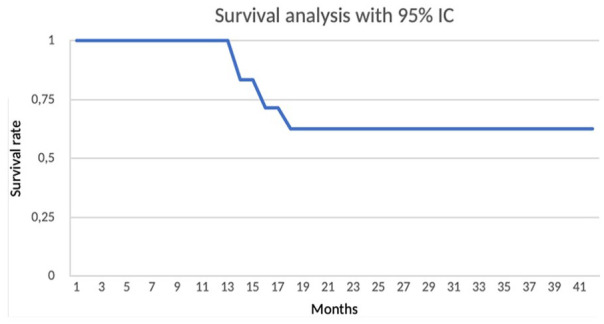
Ten patients met the inclusion criteria. Three were converted to total ankle replacement at 14, 16, and 18 months. Pain VAS scores improved on average from 6.8 to 4.8 ( = .044) of the remaining 7 at a mean of 31.9 months' follow-up. For these 7 in the Survival Group, we found that SF-36 physical health component improved from 25.03 to 42.25 ( = .030), SMFA dysfunction and bother indexes improved from 46.36 to 32.28 ( = .001), and from 55.21 to 30.14 ( = .002) in the Survival Group, and FAAM sports improved from 12.5 to 34.5 ( = .023).
Patients undergoing hemiarthroplasty of the ankle joint for talar-sided lesions had a 30% failure rate by 18 months. Those who did not have an early failure exhibited modest pain reduction, functional improvements, and better quality of life in short-term follow-up. This procedure offers a possible alternative for isolated talar ankle cartilage cases.
Level IV, prospective case series.
踝关节半关节置换术是一种一体式植入系统,用于替换胫距关节的距骨侧。半关节置换术的骨切除量有限,与关节切除手术相比,可能提供更简便的翻修选择。
对接受踝关节半关节置换术的患者进行前瞻性、多中心、非对照、非随机的临床研究,并进行短期随访。在术后3个月、12个月以及最后一次随访(平均31.9个月)时获取影像学和功能结局(足踝结局评分[FAOS]、足踝能力测量[FAAM]、简短健康调查简表[SF-36]、简短肌肉骨骼功能评估[SMFA]以及视觉模拟量表[VAS]疼痛评分)。
10例患者符合纳入标准。3例分别在14个月、16个月和18个月时转为全踝关节置换。在平均31.9个月的随访中,其余7例患者的疼痛VAS评分平均从6.8改善至4.8(P = 0.044)。对于生存组中的这7例患者,我们发现SF-36身体健康分量表从25.03提高至42.25(P = 0.030),生存组中SMFA功能障碍和困扰指数分别从46.36改善至32.28(P = 0.001)以及从55.21改善至30.14(P = 0.002),FAAM运动功能从12.5提高至34.5(P = 0.023)。
因距骨侧病变接受踝关节半关节置换术的患者在18个月时失败率为30%。那些未早期失败的患者在短期随访中疼痛有所减轻,功能得到改善,生活质量提高。该手术为孤立性距骨踝关节软骨病例提供了一种可能的替代方案。
IV级,前瞻性病例系列。