Zang Dongyu, Liu Chunli
School of Health Management, China Medical University, Shenyang, China.
Library, China Medical University, Shenyang, China.
Scientometrics. 2023;128(4):2371-2416. doi: 10.1007/s11192-023-04634-4. Epub 2023 Jan 30.
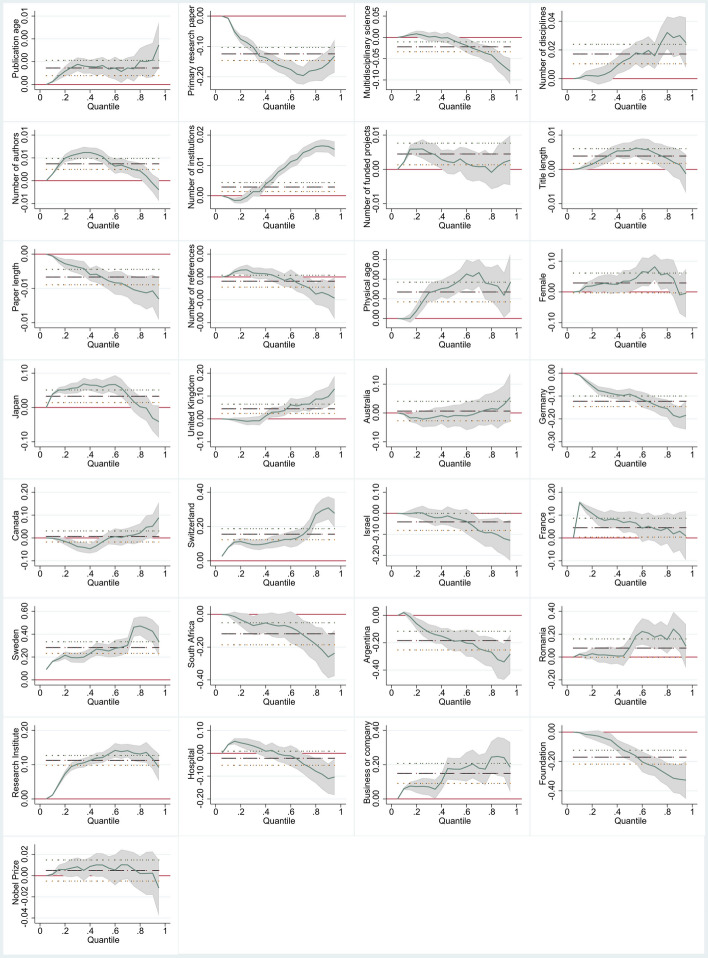
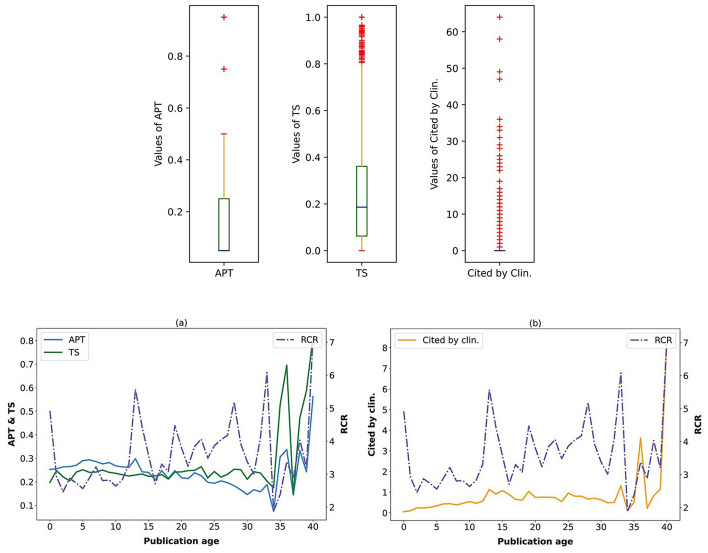
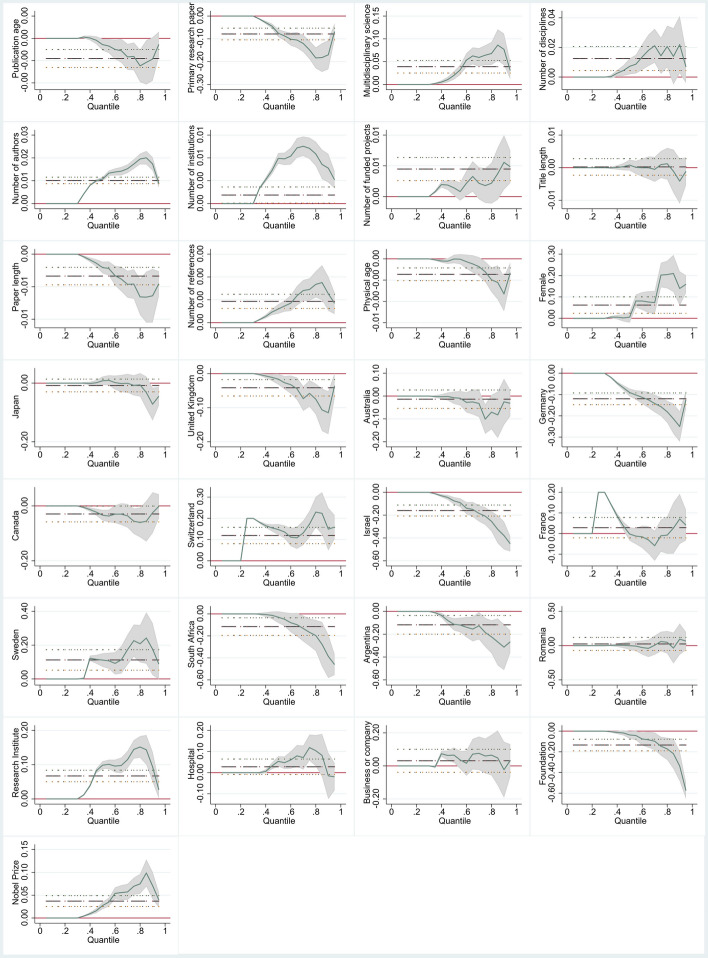
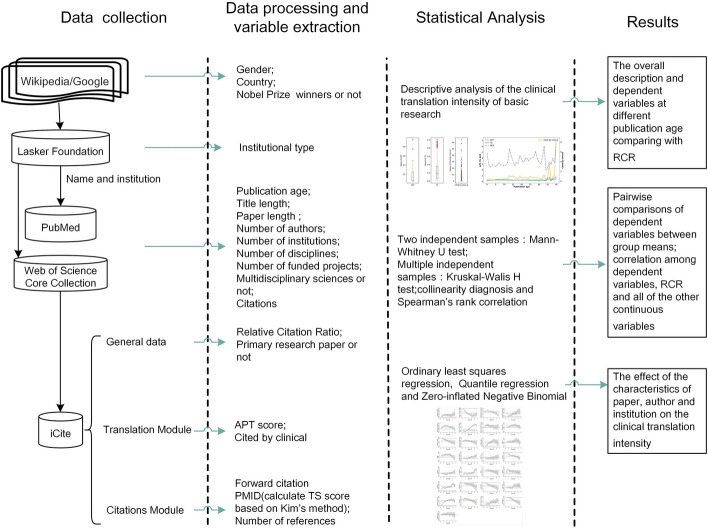
The extent to which basic medical research is translated into clinical practice is a topic of interest to all stakeholders. In this study, we assessed the clinical translation intensity of papers published by scientists who have made outstanding contributions to the field of basic medicine (Lasker Prize winners for Basic Medical Research). Approximate Potential for Translation (APT), Translational science scores (TS), and Citations by clinical research (Cited by Clin.) were analyzed as dependent variables. A traditional citation indicator was used as a reference (relative citation ratio, RCR). In order to examine the correlation between these different indicators and the characteristics of the paper, the author, and the institution. we used nonparametric tests, Spearman correlations, ordinal least squares regressions (OLS), quantile regressions, and zero-inflated negative binomial regression methods. We found that among the basic medical research papers published by Lasker Basic Medicine Award winners, (1) 20% are cited by clinical research; 11.6% of the papers were more valuable for clinical research than basic research; 12.8% have a probability of more than 50% to be cited in future clinical studies; (2) Spearman correlations were conducted among APT, TS, Cited by Clin., RCR, and all of the other continuous variables. There is a significant, positive, low to moderate correlation between APT, TS, and Cited by Clin (APT and TS: = 0.549, < 0.01; APT and Cited by Clin: = 0.530, < 0.01; TS and Cited by Clin: = 0.383, < 0.01). However, the relationship between RCR and the three indicators of clinical translation intensity was not consistent. APT was positively correlated with RCR ( = 0.553, < 0.01). Cited by Clin. is weakly positively correlated with RCR ( = 0.381, < 0.01). There is almost no correlation between TS and RCR ( = 0.184, < 0.01). (3) Publication age, primary research paper, multidisciplinary science, number of disciplines, authors, institutions, funded projects, references, length of the title, length of paper, physical age, gender, nationality, institutional type, Nobel Prize have a significant relationship with 1 to 3 types of clinical translation intensity measures. In a sample of basic medical research papers published by the world's top scientists in basic medicine, we came to the following conclusions: the three indicators, APT, TS and Cited by Clin., measured the clinical translation intensity of the papers from different perspectives. They are both related to each other and have their own characteristics. In a sample of basic medical research papers published by the world's top scientists in basic medicine, characteristics at the paper, winner, and institution level significantly correlated with the measures of clinical translation intensity. Gender effect on the clinical translation intensity of papers was confirmed. Traditional citation-based indicators and translational-focused indicators measure academic impact and clinical impact respectively. There is a certain degree of disconnect between them. Two types of indicators should be used in combination in future assessments of basic medical research.
The online version contains supplementary material available at 10.1007/s11192-023-04634-4.
基础医学研究转化为临床实践的程度是所有利益相关者感兴趣的话题。在本研究中,我们评估了在基础医学领域做出杰出贡献的科学家(基础医学研究拉斯克奖获得者)发表论文的临床转化强度。将近似翻译潜力(APT)、转化科学得分(TS)和临床研究引用次数(Clin.引用)作为因变量进行分析。使用传统的引用指标作为参考(相对引用率,RCR)。为了检验这些不同指标与论文、作者和机构特征之间的相关性,我们使用了非参数检验、Spearman相关性分析、有序最小二乘回归(OLS)、分位数回归和零膨胀负二项回归方法。我们发现,在拉斯克基础医学奖获得者发表的基础医学研究论文中,(1)20%被临床研究引用;11.6%的论文对临床研究比基础研究更有价值;12.8%在未来临床研究中有超过50%的被引用概率;(2)对APT、TS、Clin.引用、RCR以及所有其他连续变量进行Spearman相关性分析。APT、TS和Clin.引用之间存在显著的正相关,相关性低至中等(APT与TS:=0.549,<0.01;APT与Clin.引用:=0.530,<0.01;TS与Clin.引用:=0.383,<0.01)。然而,RCR与临床转化强度的三个指标之间的关系并不一致。APT与RCR呈正相关(=0.553,<0.01)。Clin.引用与RCR呈弱正相关(=0.381,<0.01)。TS与RCR之间几乎没有相关性(=0.184,<0.01)。(3)发表年份、原创研究论文、多学科科学、学科数量、作者、机构、资助项目、参考文献、标题长度、论文长度、实际年龄、性别、国籍、机构类型、诺贝尔奖与1至3种临床转化强度测量指标有显著关系。在世界顶尖基础医学科学家发表的基础医学研究论文样本中,我们得出以下结论:APT、TS和Clin.引用这三个指标从不同角度衡量了论文的临床转化强度。它们相互关联且各有特点。在世界顶尖基础医学科学家发表的基础医学研究论文样本中,论文、获奖者和机构层面的特征与临床转化强度测量指标显著相关。证实了性别对论文临床转化强度的影响。基于传统引用的指标和以转化为重点的指标分别衡量学术影响和临床影响。它们之间存在一定程度的脱节。在未来基础医学研究评估中应结合使用这两种指标。
在线版本包含可在10.1007/s11192-023-04634-4获取的补充材料。