Ma Xiao, Iyer Seethalakshmi R, Ma Xiaoyu, Reginauld Shawn H, Chen Yang, Pan Shuchong, Zheng Ye, Moroni Dante, Yu Yue, Zhang Lianwen, Cannone Valentina, Chen Horng H, Ferrario Carlos M, Sangaralingham S Jeson, Burnett John C
Cardiorenal Research Laboratory, Department of Cardiovascular Medicine, Mayo Clinic, Rochester, MN, USA.
Department of Quantitative Health Sciences, Mayo Clinic, Rochester, MN, USA.
bioRxiv. 2023 Jan 27:2023.01.26.525806. doi: 10.1101/2023.01.26.525806.
Natriuretic peptide system (NPS) and renin angiotensin aldosterone system (RAAS) function oppositely at multiple levels. While it has long been suspected that angiotensin II (ANGII) may directly suppress NPS activity, no clear evidence to date support this notion.
This study was designed to systematically investigate ANGII-NPS interaction in humans, in vivo, and in vitro for translational insights.
Circulating atrial, b-type, and c-type natriuretic peptides (ANP, BNP, CNP), cyclic guanosine monophosphate (cGMP), and ANGII were simultaneously investigated in 128 human subjects. Prompted hypothesis was validated in rat model to determine influence of ANGII on ANP actions. Multiple engineered HEK293 cells and surface plasmon resonance (SPR) technology were leveraged for mechanistic exploration.
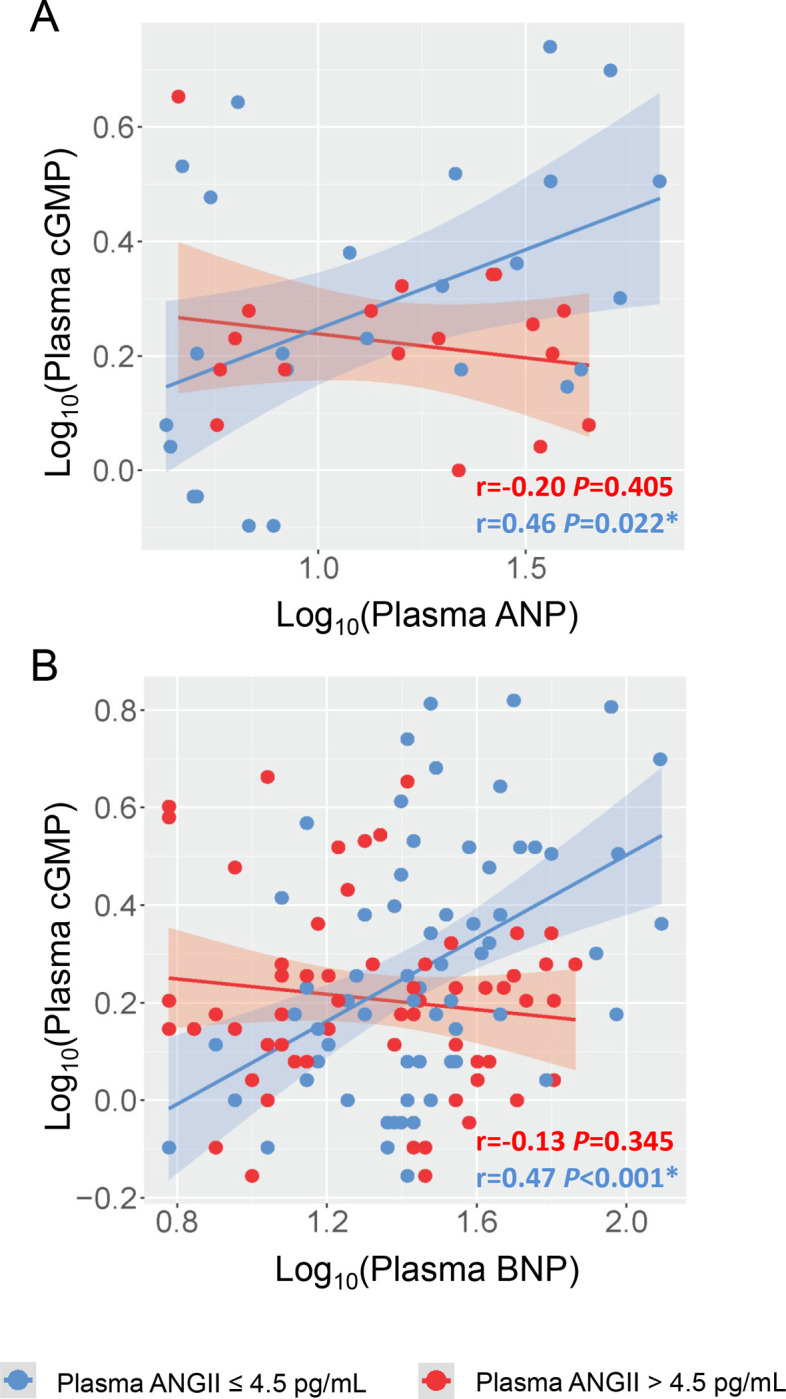
In humans, ANGII showed inverse relationship with ANP, BNP, and cGMP. In regression models predicting cGMP, adding ANGII levels and interaction term between ANGII and natriuretic peptide increased predicting accuracy of base models constructed with either ANP or BNP, but not CNP. Importantly, stratified correlation analysis further revealed positive association between cGMP with ANP or BNP only in subjects with low, but not high, ANGII levels. In rats, co-infusion of ANGII even at physiological dose attenuated blood pressure reduction and cGMP generation triggered by ANP infusion. In vitro, we showed that the suppression effect of ANGII on ANP-stimulated cGMP requires the presence of ANGII type-1 (AT) receptor and mechanistically involves protein kinase C (PKC), which can be substantially rescued by either valsartan (AT blocker) or Go6983 (PKC inhibitor). Using SPR, we showed ANGII has low affinity for particulate guanylyl cyclase A (GC-A) receptor binding compared to ANP or BNP.
Our study reveals ANGII as a natural suppressor for cGMP-generating action of GC-A via AT/PKC dependent manner and highlights importance of dual-targeting RAAS and NPS in maximizing beneficial properties of natriuretic peptides in cardiovascular disease.
利钠肽系统(NPS)和肾素-血管紧张素-醛固酮系统(RAAS)在多个层面发挥相反作用。长期以来人们一直怀疑血管紧张素II(ANGII)可能直接抑制NPS活性,但迄今为止尚无明确证据支持这一观点。
本研究旨在系统地研究人类体内和体外的ANGII-NPS相互作用,以获得转化医学见解。
在128名人类受试者中同时检测循环中的心房钠尿肽、B型钠尿肽和C型钠尿肽(ANP、BNP、CNP)、环磷酸鸟苷(cGMP)和ANGII。在大鼠模型中验证提出的假设,以确定ANGII对ANP作用的影响。利用多种工程化的HEK293细胞和表面等离子体共振(SPR)技术进行机制探索。
在人类中,ANGII与ANP、BNP和cGMP呈负相关。在预测cGMP的回归模型中,加入ANGII水平以及ANGII与利钠肽之间的相互作用项,提高了用ANP或BNP构建的基础模型的预测准确性,但对CNP无效。重要的是,分层相关分析进一步揭示,仅在ANGII水平低而非高的受试者中,cGMP与ANP或BNP呈正相关。在大鼠中,即使以生理剂量共同输注ANGII,也会减弱ANP输注引发的血压降低和cGMP生成。在体外,我们表明ANGII对ANP刺激的cGMP的抑制作用需要1型ANGII(AT)受体的存在,其机制涉及蛋白激酶C(PKC),缬沙坦(AT阻断剂)或Go6983(PKC抑制剂)均可显著挽救这种抑制作用。使用SPR,我们表明与ANP或BNP相比,ANGII对颗粒型鸟苷酸环化酶A(GC-A)受体结合的亲和力较低。
我们的研究揭示ANGII是通过AT/PKC依赖性方式对GC-A产生cGMP的作用的天然抑制剂,并强调双重靶向RAAS和NPS在最大化利钠肽在心血管疾病中的有益特性方面的重要性。