Charaya Ananaya, Chawla Neena, Dhatt Ajmer Singh, Sharma Madhu, Sharma Sanjula, Kaur Inderpal
Department of Biochemistry, Punjab Agricultural University, Ludhiana 141004, India.
Department of Vegetable Science, Punjab Agricultural University, Ludhiana 141004, India.
Heliyon. 2023 Jan 19;9(1):e12995. doi: 10.1016/j.heliyon.2023.e12995. eCollection 2023 Jan.
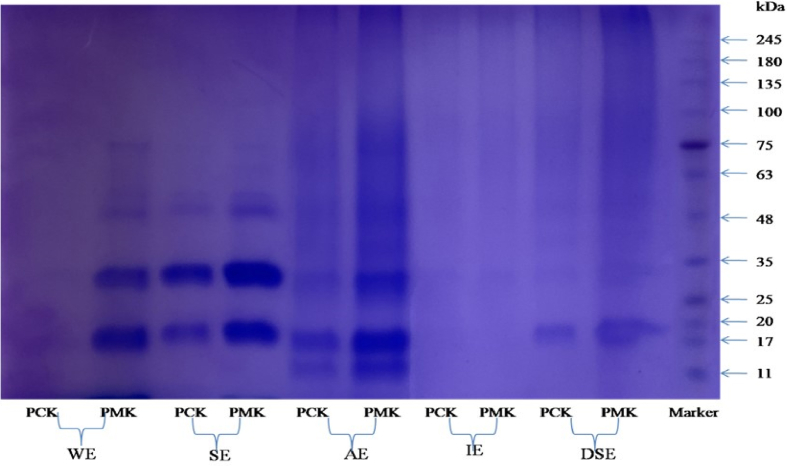
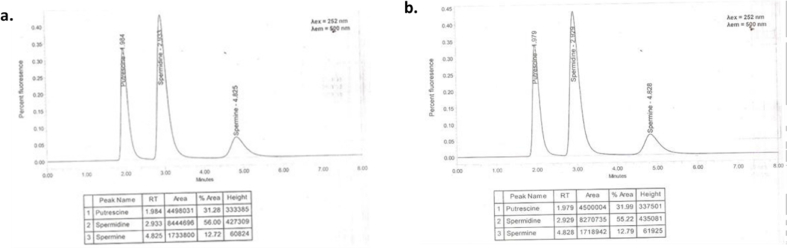
Pumpkin seeds are one of the functional foods with most potential having myriad of uses, and functioning as both edible seeds and oilseeds. Nevertheless, their utilization is restricted to the presence of a thick seed coat (hull) which subjects them to the process of decortication, increasing the farmers' expense as well as limiting their utilization as oilseeds. Therefore, in the present study, characterization of the biochemical composition of the hulled (Punjab Chappan Kadoo-1 abbreviated as PCK-1) and hull-less (PAU Magaz Kadoo-1 abbreviated as PMK-1) genotype of pumpkin seeds was undertaken to assess the nutritional differences and their efficient application; PMK-1 is a new cultivar of pumpkin released by Punjab Agricultural University in 2018. Based on the characterization, the hulled genotype of pumpkin seeds was observed to possess higher content of total soluble proteins (79.62 mg/100 g), total free amino acids (3.48 g/100 g), moisture (6.74%), fibre content (21.1 g/100 g), antioxidant potential (26.15%), polyamines (19.2 mg/100 g), sterols (387.1 mg/100 g), and specific enzymatic activity whereas the hull-less genotype was observed to possess a higher amount of minerals (4.57 g/100 g), tocopherols (15.76 mg/100 g), and oil content (36%) respectively; most of the biochemical parameters do not differ from each other at a greater fold difference except for total free amino acids and fibre, which are nearly four times and three times higher in hulled seeds in comparison to the naked seeds respectively. The two genotypes of seeds do not compete, rather do complement each other in biochemical and nutritional composition.
南瓜籽是最具潜力的功能性食品之一,有多种用途,既可以作为可食用种子,也可作为油籽。然而,由于其种皮(外壳)较厚,需要进行去皮处理,这增加了农民的成本,也限制了它们作为油籽的利用。因此,在本研究中,对去壳(旁遮普查潘卡杜-1,简称为PCK-1)和无壳(旁遮普农业大学马加兹卡杜-1,简称为PMK-1)基因型的南瓜籽进行了生化成分分析,以评估其营养差异及其有效应用;PMK-1是旁遮普农业大学于2018年发布的南瓜新品种。基于该分析,观察到去壳基因型的南瓜籽总可溶性蛋白含量较高(79.62毫克/100克)、总游离氨基酸含量较高(3.48克/100克)、水分含量较高(6.74%)、纤维含量较高(21.1克/100克)、抗氧化能力较高(26.15%)、多胺含量较高(19.2毫克/100克)、甾醇含量较高(387.1毫克/100克)以及具有特定的酶活性,而无壳基因型的南瓜籽矿物质含量较高(4.57克/100克)、生育酚含量较高(15.76毫克/100克)和油含量较高(36%);除了总游离氨基酸和纤维外,大多数生化参数彼此之间的差异倍数不大,与无壳种子相比,去壳种子中的总游离氨基酸和纤维含量分别高出近四倍和三倍。这两种基因型的种子并不相互竞争,而是在生化和营养成分上相互补充。