Wekesa Clara, Parkes-Ratanshi Rosalind, Kirk Gregory D, Ocama Ponsiano
Infectious Diseases Institute, Makerere University, Kampala, Uganda.
Cambridge University, Institute of Public Health, Cambridge, UK.
Int J Hepatol. 2023 Jan 28;2023:6717854. doi: 10.1155/2023/6717854. eCollection 2023.
The evaluation of the patterns of liver injury, derived from liver chemistry panels, often may narrow on probable causes of the liver insult especially when coupled with clinical history, examination, and other diagnostic tests.
Among people living with and without HIV and attending care, we used the ratio to evaluate for liver injury patterns. Liver injury patterns were defined as cholestatic ( < 2), mixed ( = 2-5), and hepatocellular ( > 5).
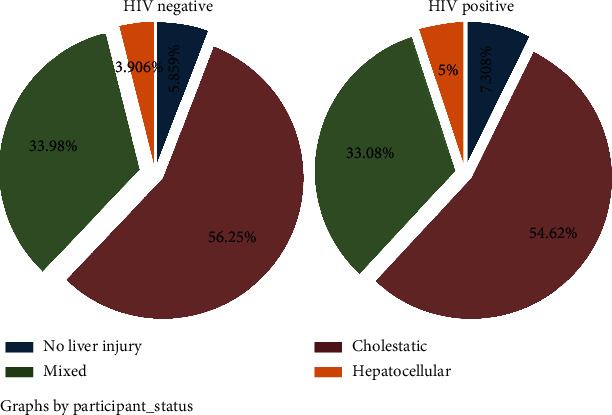
Overall, the proportions of participants with cholestatic liver injury, mixed liver injury, and hepatocellular liver injury were 55%, 34%, and 4%, respectively, with similar distribution when stratified by HIV status. Alcohol use among participants without HIV was associated with all patterns of liver injury (cholestatic liver injury (OR = 4.9 CI (1.0-24.2); = 0.054), mixed liver injury (OR = 5.3 CI (1.1-27.3); = 0.043), and hepatocellular liver injury (OR = 13.2 CI (1.0-167.3); = 0.046)). Increasing age was associated with cholestatic liver injury among participants with HIV (OR = 2.3 CI (1.0-5.3); = 0.038). Despite a high hepatitis B prevalence among participants with HIV, there was no association with liver injury.
Liver injury is prevalent among both people living with and without HIV in care, and cholestatic liver injury is the most common pattern. Alcohol is associated with all patterns of liver injury and increasing age associated with cholestatic liver injury among people living without HIV and people living with HIV, respectively.
通过肝功能检查来评估肝损伤模式,通常有助于缩小肝损伤可能的病因范围,尤其是结合临床病史、体格检查及其他诊断性检查时。
在接受治疗的HIV感染者和非HIV感染者中,我们采用该比值来评估肝损伤模式。肝损伤模式分为胆汁淤积型(<2)、混合型(=2 - 5)和肝细胞型(>5)。
总体而言,胆汁淤积型肝损伤、混合型肝损伤和肝细胞型肝损伤参与者的比例分别为55%、34%和4%,按HIV感染状况分层时分布相似。在非HIV感染者中,饮酒与所有肝损伤模式相关(胆汁淤积型肝损伤(OR = 4.9,CI(1.0 - 24.2);P = 0.054),混合型肝损伤(OR = 5.3,CI(1.1 - 27.3);P = 0.043),肝细胞型肝损伤(OR = 13.2,CI(1.0 - 167.3);P = 0.046))。在HIV感染者中,年龄增长与胆汁淤积型肝损伤相关(OR = 2.3,CI(1.0 - 5.3);P = 0.038)。尽管HIV感染者中乙肝感染率较高,但乙肝与肝损伤无关联。
在接受治疗的HIV感染者和非HIV感染者中,肝损伤均很常见,且胆汁淤积型肝损伤是最常见的模式。饮酒与所有肝损伤模式相关,年龄增长分别与非HIV感染者和HIV感染者中的胆汁淤积型肝损伤相关。