Department of Kidney Transplantation, The First Affiliated Hospital of Zhengzhou University, Zhengzhou, China.
Department of Nephrology, The First Affiliated Hospital of Zhengzhou University, Zhengzhou, China.
Ren Fail. 2023 Dec;45(1):2147083. doi: 10.1080/0886022X.2022.2147083.
Tacrolimus is a potent immunosuppressant, but has various side effects, with nephrotoxicity being the most common. Renal fibrosis is an important process of tacrolimus nephrotoxicity. Therefore, it is important to identify the factors that contribute to renal fibrosis after tacrolimus nephrotoxicity, and control its development.
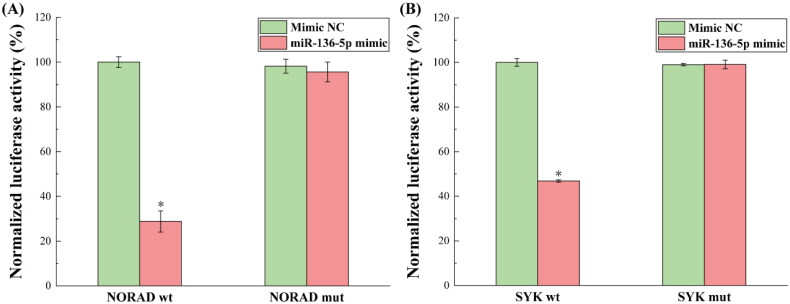
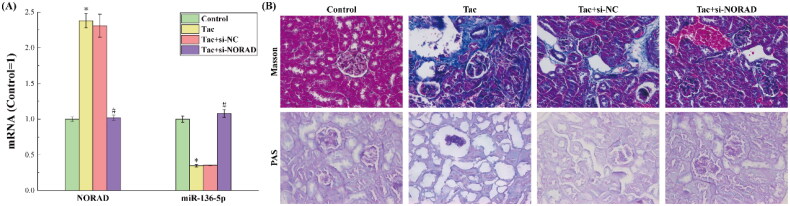
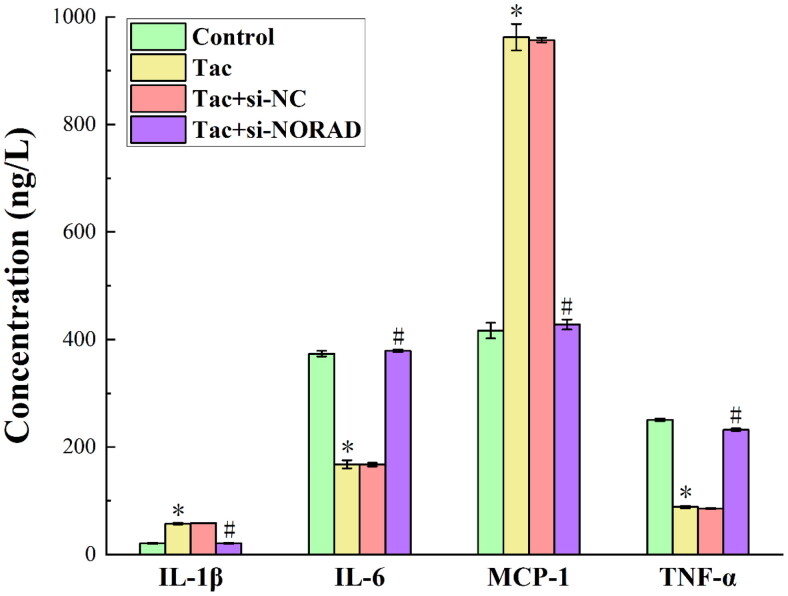
The present study aims to determine whether tacrolimus may speed up the course of renal fibrosis by upregulating noncoding RNA activated by DNA damage (NORAD) to compete with miR-136-5p, and activating the TGF-β1/Smad3 pathway. Furthermore, rat models and cell models were established. Then, the expression levels of NORAD and miR-136-5p were determined by RT-qPCR, while the expression of the TGF-β1/Smad3 pathway was determined by western blot and RT-qPCR. In order to investigate the interaction between NORAD and miR-136-5p, as well as miR-136-5p and SYK, two luciferase reporters were employed. The renal fibrosis of mice was observed using Masson and PAS staining. The expression of inflammatory factors IL-1, IL-6, MCP-1 and TNF-α was detected by ELISA.
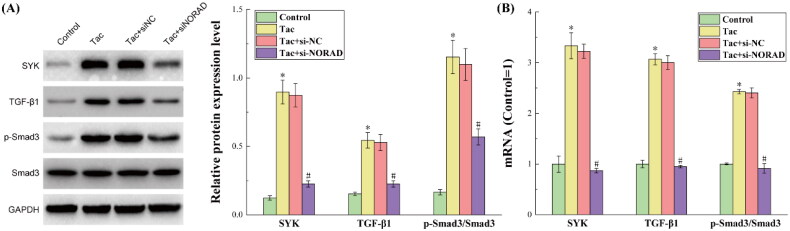
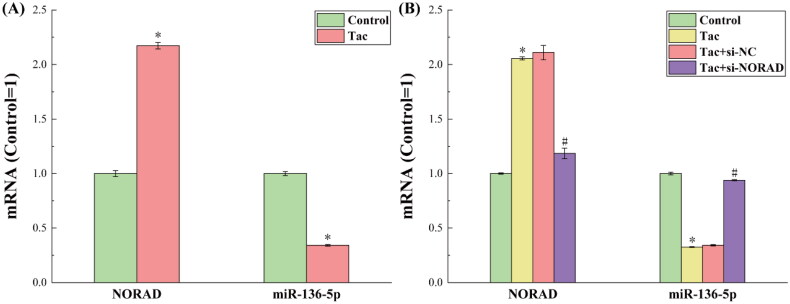
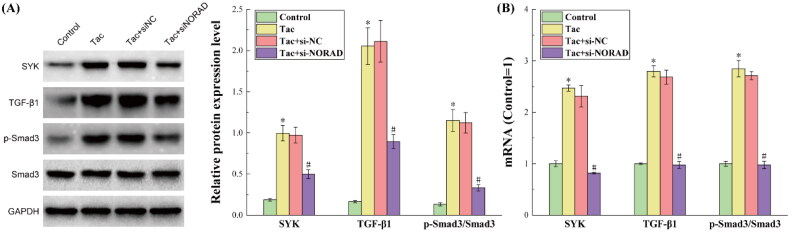
In the experiments, NORAD was upregulated, while miR-136-5p was downregulated after tacrolimus induction. The expression of the TGF-β1/Smad3 pathway correspondingly changed after the induction by tacrolimus. In the experiments, the expression of NORAD and miR-136-5p, and the trend for renal fibrosis were consistent with the results in the experiments. Furthermore, the inflammatory factors correspondingly changed with the severity of renal fibrosis. Moreover, the expression trend of the TGF-β1/Smad3 pathway in tacrolimus-induced rats was consistent with that in the experiments.
Through and experiments, the present study was able to successfully prove that tacrolimus upregulates NORAD to compete with miR-136-5p, resulting in a decrease in miR-136-5p expression, which in turn activates the TGF-β1/smad3 pathway, and finally induces the aggravation of renal fibrosis.
他克莫司是一种强效免疫抑制剂,但具有多种副作用,其中肾毒性最为常见。肾纤维化是他克莫司肾毒性的一个重要过程。因此,确定他克莫司肾毒性后导致肾纤维化的因素,并控制其发展非常重要。
本研究旨在通过上调 DNA 损伤激活的非编码 RNA(NORAD)与 miR-136-5p 竞争,激活 TGF-β1/Smad3 通路,来确定他克莫司是否会加速肾纤维化的进程。此外,建立了大鼠模型和细胞模型。然后,通过 RT-qPCR 测定 NORAD 和 miR-136-5p 的表达水平,通过 Western blot 和 RT-qPCR 测定 TGF-β1/Smad3 通路的表达。为了研究 NORAD 与 miR-136-5p 以及 miR-136-5p 与 SYK 之间的相互作用,使用了两个荧光素酶报告基因。通过 Masson 和 PAS 染色观察小鼠的肾纤维化情况。通过 ELISA 检测炎性因子 IL-1、IL-6、MCP-1 和 TNF-α的表达。
在实验中,他克莫司诱导后 NORAD 上调,miR-136-5p 下调。TGF-β1/Smad3 通路的表达在他克莫司诱导后相应改变。在实验中,NORAD 和 miR-136-5p 的表达以及肾纤维化的趋势与实验结果一致。此外,炎性因子的表达随肾纤维化的严重程度而变化。此外,他克莫司诱导大鼠 TGF-β1/Smad3 通路的表达趋势与实验一致。
通过实验和实验,本研究成功证明,他克莫司上调 NORAD 与 miR-136-5p 竞争,导致 miR-136-5p 表达下调,进而激活 TGF-β1/smad3 通路,最终导致肾纤维化加重。