Institute of Cardiovascular Research Royal Holloway, University of London (ICR2UL), London, United Kingdom.
BARTS and the London NHS Trust/ Royal London Hospital, London, United Kingdom.
PLoS One. 2023 Feb 7;18(2):e0281014. doi: 10.1371/journal.pone.0281014. eCollection 2023.
South Asian diaspora comprise one of the largest ethnic minority groups in the world yet data about atrial fibrillation (AF) in this demographic is understudied. Our aim is to identify differences in AF prevalence and treatment between South Asians and white British stroke patients.
The UK arm of a prospective ongoing large international repository on stroke was analysed. Ethnic differences in AF prevalence and management in those with ischemic stroke were analysed.
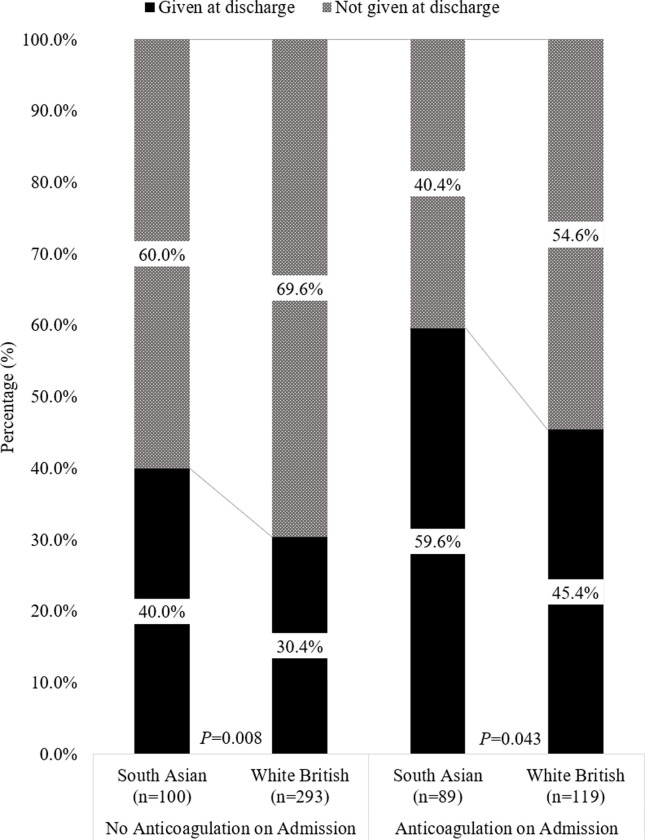
Of the 3515 individuals recruited with ischemic stroke, 1482 (men: 972, women: 510) were South Asian and 2033 (men:1141, women:892) of white British ethnicity. AF was present in 462 white British and 193 South Asians stroke patients, with South Asians displaying a lower prevalence of AF (South Asians: 13.0% vs white British 22.7%, P<0.001). Despite adjustment for traditional AF risk factors, South Asians had a significantly lower OR of AF compared to white British stroke patients (OR: 0.40, 95%CI: 0.33:0.49, P<0.001). Among confirmed AF cases, 31.8% of South Asians and 41.4% of white British were untreated at admission (P = 0.02). Antiplatelet treatment was significantly higher among South Asians at both admission (South Asian: 47.4% vs. white British: 29.9%, P<0.001) and discharge (South Asian: 49.5% vs. white British: 34.7%, P = 0.001), although anticoagulation treatment was similar across both ethnic groups at admission (South Asian: 28.5% vs white British: 28.1%, P = 0.93), and discharge (South Asian: 45.1% vs white British: 43.1%, P = 0.64).
Stroke patients of South Asian descent are at significantly lower risk of AF but more likely to be on antiplatelet treatment compared to their white British counterparts.
南亚侨民是世界上最大的少数民族群体之一,但针对这一人群的房颤(AF)数据研究不足。我们的目的是确定南亚人和英国白人中风患者之间房颤患病率和治疗方法的差异。
分析了正在进行的一项针对中风的大型国际前瞻性存储库的英国部分。分析了缺血性中风患者中房颤患病率和管理方面的种族差异。
在招募的 3515 名缺血性中风患者中,1482 名(男性:972 名,女性:510 名)为南亚人,2033 名(男性:1141 名,女性:892 名)为英国白人。462 名英国白人中风患者和 193 名南亚人中风患者存在房颤,南亚人房颤患病率较低(南亚人:13.0%,英国白人:22.7%,P<0.001)。尽管调整了房颤的传统危险因素,但南亚人患房颤的比值比(OR)明显低于英国白人中风患者(OR:0.40,95%CI:0.33:0.49,P<0.001)。在确诊的房颤病例中,31.8%的南亚人和 41.4%的英国白人在入院时未接受治疗(P=0.02)。抗血小板治疗在入院时(南亚人:47.4%,英国白人:29.9%,P<0.001)和出院时(南亚人:49.5%,英国白人:34.7%,P=0.001)均明显高于南亚人,尽管两组在入院时(南亚人:28.5%,英国白人:28.1%,P=0.93)和出院时(南亚人:45.1%,英国白人:43.1%,P=0.64)的抗凝治疗相似。
与英国白人相比,南亚裔中风患者患房颤的风险明显较低,但更有可能接受抗血小板治疗。