Du Sujie, Ye Fuyu, Xu Shiyun, Liang Yongxuan, Wan Fanghao, Guo Jianyang, Liu Wanxue
State Key Laboratory for Biology of Plant Diseases and Insect Pests, Institute of Plant Protection, Chinese Academy of Agricultural Sciences, Beijing, China.
College of Life Sciences, Hunan Normal University, Changsha, Hunan, China.
Front Genet. 2023 Jan 23;13:1061100. doi: 10.3389/fgene.2022.1061100. eCollection 2022.
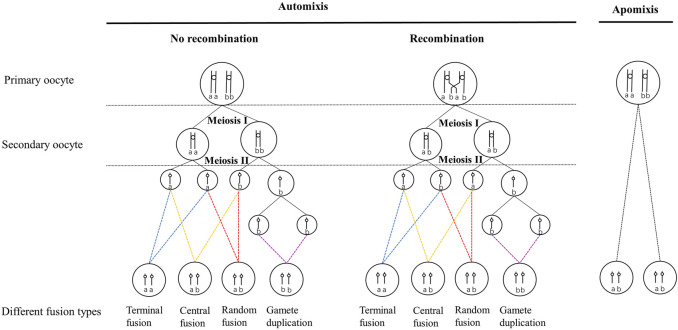
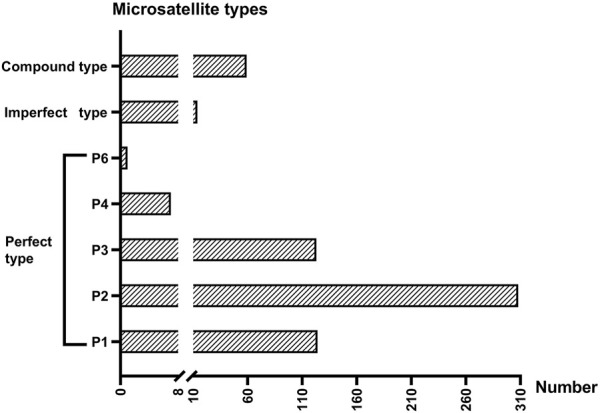
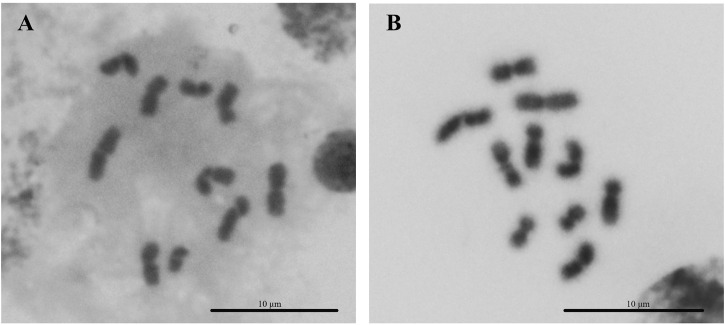
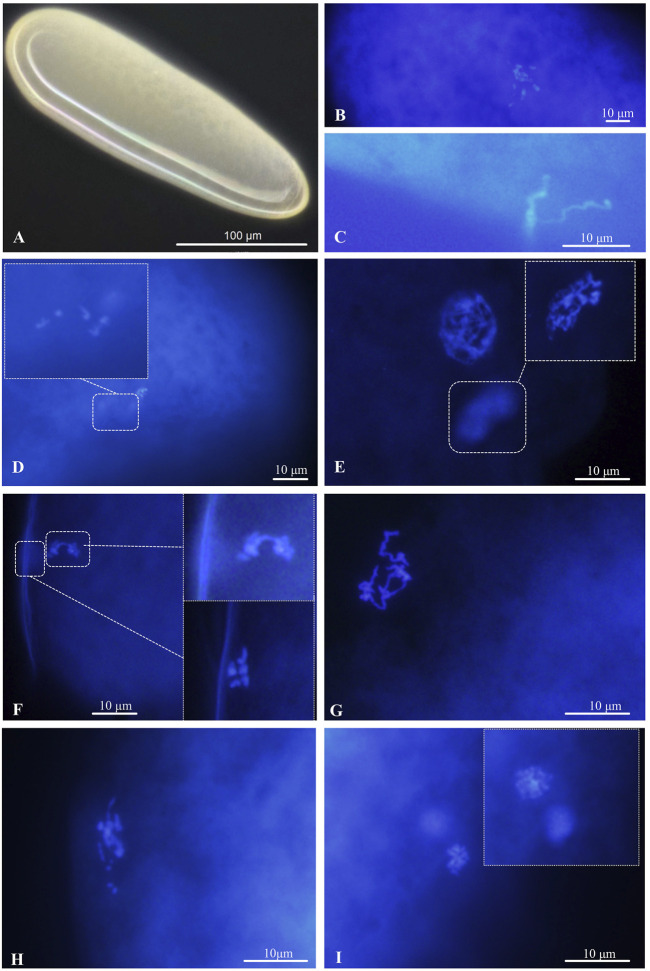
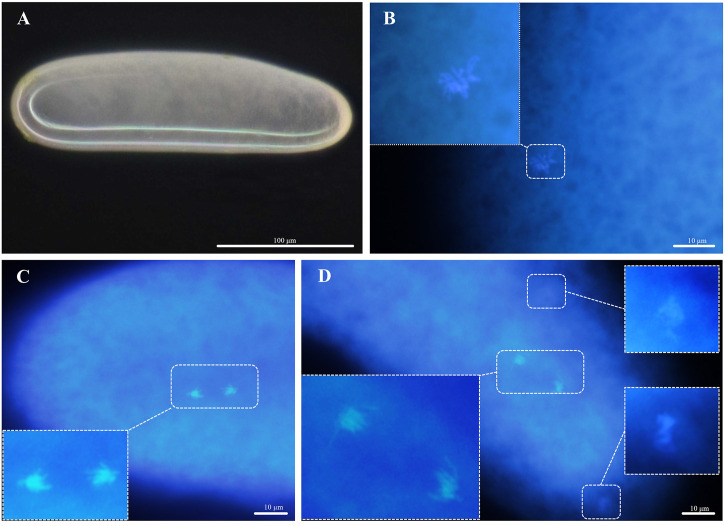
In Hymenoptera species, the reproductive mode is usually arrhenotoky, where haploid males arise from unfertilized eggs and diploid females from fertilized eggs. In addition, a few species reproduce by thelytoky, where diploid females arise from unfertilized eggs. Diploid females can be derived through various cytological mechanisms in thelytokous Hymenoptera species. Hitherto, these mechanisms were revealed mainly in endosymbiont-induced thelytokous Hymenoptera species. In contrast, thelytokous Hymenoptera species in which a reproductive manipulator has not been verified or several common endosymbionts have been excluded were paid less attention in their cytological mechanisms, for instance, (Hymenoptera: Eulophidae). Here, we investigated the cytological mechanism of . using cytological methods and genetic markers. Our observations indicated that the diploid karyotypes of two strains of . consist of four pairs of relatively large metacentric chromosomes and one pair of short submetacentric chromosomes (2 = 10). The arrhenotokous strains could complete normal meiosis, whereas the thelytokous strain lacked meiosis and did not expulse any polar bodies. This reproductive type of lacking meiosis is classified as apomictic thelytoky. Moreover, a total of 636 microsatellite sequences were obtained from thelytokous . , dominated by dinucleotide repeats. Genetic markers results showed all three generations of offspring from thelytokous strain maintained the same genotype as their parents. Our results revealed that . is the first eulophid parasitoid wasp in Hymenoptera whose thelytoky was not induced by bacteria to form an apomictic thelytoky. These findings provide a baseline for future inner molecular genetic studies of ameiotic thelytoky.
在膜翅目物种中,生殖方式通常为产雄孤雌生殖,即单倍体雄性由未受精卵发育而来,二倍体雌性由受精卵发育而来。此外,少数物种通过产雌孤雌生殖进行繁殖,即二倍体雌性由未受精卵发育而来。在产雌孤雌生殖的膜翅目物种中,二倍体雌性可通过多种细胞学机制产生。迄今为止,这些机制主要在共生菌诱导的产雌孤雌生殖的膜翅目物种中被揭示。相比之下,在那些生殖操纵者未得到证实或几种常见共生菌已被排除的产雌孤雌生殖的膜翅目物种中,其细胞学机制较少受到关注,例如(膜翅目:姬小蜂科)。在这里,我们使用细胞学方法和遗传标记研究了[物种名称]的细胞学机制。我们的观察结果表明,[物种名称]两个品系的二倍体核型由四对相对较大的中着丝粒染色体和一对短的亚中着丝粒染色体组成(2n = 10)。产雄孤雌生殖品系能够完成正常减数分裂,而产雌孤雌生殖品系缺乏减数分裂且不排出任何极体。这种缺乏减数分裂的生殖类型被归类为无融合产雌孤雌生殖。此外,从产雌孤雌生殖的[物种名称]中总共获得了636个微卫星序列,以二核苷酸重复为主。遗传标记结果显示,产雌孤雌生殖品系的三代后代均保持与其亲本相同的基因型。我们的结果表明,[物种名称]是膜翅目中第一种其产雌孤雌生殖不是由细菌诱导形成无融合产雌孤雌生殖的姬小蜂科寄生蜂。这些发现为未来无减数分裂产雌孤雌生殖的内部分子遗传学研究提供了基线。