Department of Internal Medicine, University of Michigan, Ann Arbor, Michigan, USA.
Division of Gastroenterology and Hepatology, Department of Internal Medicine, University of Michigan, Ann Arbor, Michigan, USA.
Hepatol Commun. 2023 Feb 9;7(3):e0044. doi: 10.1097/HC9.0000000000000044. eCollection 2023 Mar 1.
Weight loss is the mainstay of treatment of NAFLD, but longitudinal data on weight changes and their impact on liver disease are limited. We aimed to characterize weight trajectory up to 5 years of follow-up, effects of weight loss on liver enzyme levels, and predictors of weight loss in NAFLD.
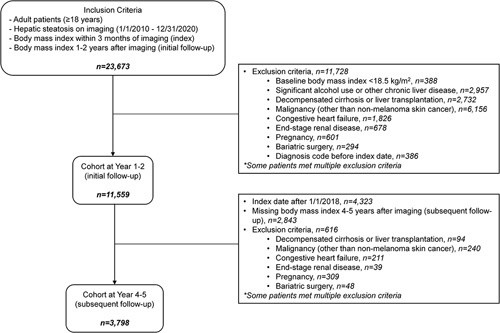
This was a single-center retrospective study of consecutive patients with hepatic steatosis diagnosed on imaging, liver biopsy, or transient elastography between 2010 and 2020. The primary outcome was ≥5% weight change at 1-2 years. Secondary outcomes were weight change at 4-5 years and alanine aminotransferase level at 1-2 and 4-5 years. We conducted multivariable logistic regression to identify predictors of ≥5% weight loss at 1-2 years.
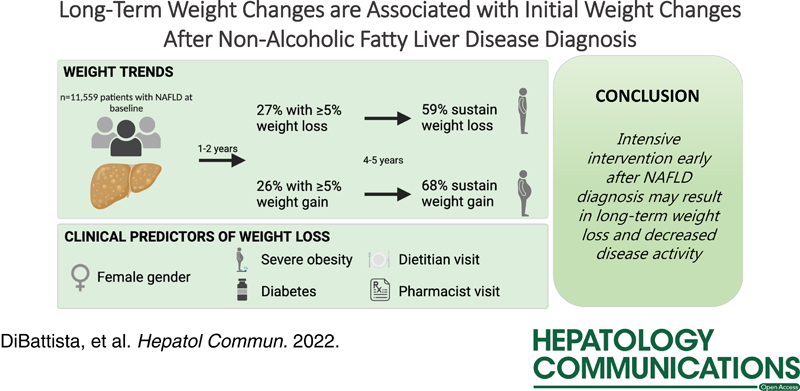
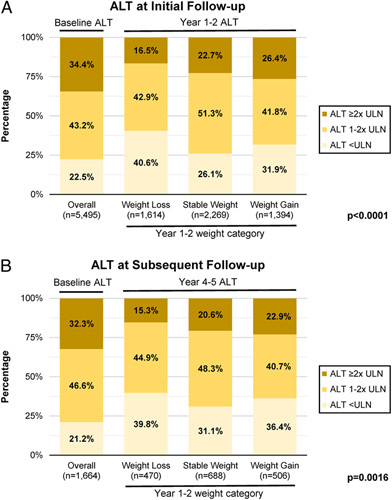
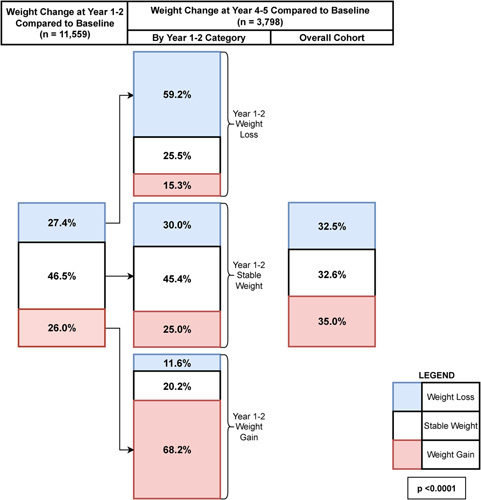
We included 11,559 patients with NAFLD. At year 1-2, 27% had ≥5% weight loss, whereas 26% had ≥5% weight gain. Total 59% and 68% of patients with weight loss and gain, respectively, sustained their weight change by year 4-5. Patients with weight loss at year 1-2 had lower alanine aminotransferase levels at year 1-2 and 4-5. Predictors of ≥5% weight loss included female sex, severe obesity, diabetes, and consultation with a dietitian or pharmacist.
Over half of patients with NAFLD had ≥5% weight loss or gain within 1-2 years, and these changes were usually sustained at 4-5 years. Intensive intervention early after NAFLD diagnosis may result in long-term weight loss and decreased NAFLD disease activity.
减肥是治疗非酒精性脂肪性肝病(NAFLD)的主要方法,但关于体重变化及其对肝病影响的纵向数据有限。我们旨在描述随访 5 年内的体重变化轨迹,减肥对肝酶水平的影响,以及预测 NAFLD 患者减肥的因素。
这是一项回顾性的单中心研究,纳入了 2010 年至 2020 年间通过影像学、肝活检或瞬时弹性成像诊断为肝脂肪变性的连续患者。主要结局是 1-2 年内体重变化≥5%。次要结局是 4-5 年内体重变化和 1-2 年及 4-5 年内丙氨酸氨基转移酶水平。我们进行了多变量逻辑回归分析,以确定 1-2 年内体重减轻≥5%的预测因素。
我们纳入了 11559 例 NAFLD 患者。在 1-2 年内,27%的患者体重减轻≥5%,而 26%的患者体重增加≥5%。分别有 59%和 68%的体重减轻和增加患者在 4-5 年内保持了体重变化。在 1-2 年内体重减轻的患者,其丙氨酸氨基转移酶水平在 1-2 年和 4-5 年内均较低。体重减轻≥5%的预测因素包括女性、严重肥胖、糖尿病,以及咨询营养师或药剂师。
超过一半的 NAFLD 患者在 1-2 年内体重减轻或增加≥5%,这些变化在 4-5 年内通常持续存在。在 NAFLD 诊断后早期进行强化干预可能会导致长期减肥和降低 NAFLD 疾病活动度。