Melbourne School of Population and Global Health, The University of Melbourne, Parkville, Victoria 3010, Australia.
Centre for Mental Health, Melbourne School of Population and Global Health, The University of Melbourne, Parkville, Victoria 3010, Australia.
J Affect Disord. 2023 May 1;328:13-21. doi: 10.1016/j.jad.2023.02.014. Epub 2023 Feb 7.
During the COVID-19 pandemic Chinese international students were reported to experience racism, food security issues and social isolation. However, no study has investigated the prevalence of these issues and the potential for worsening mental health in this population group during the pandemic. Therefore, this study aimed to examine the effect of this pandemic on the mental health of Chinese international students living in Australia and China, and the protective effect of social support.
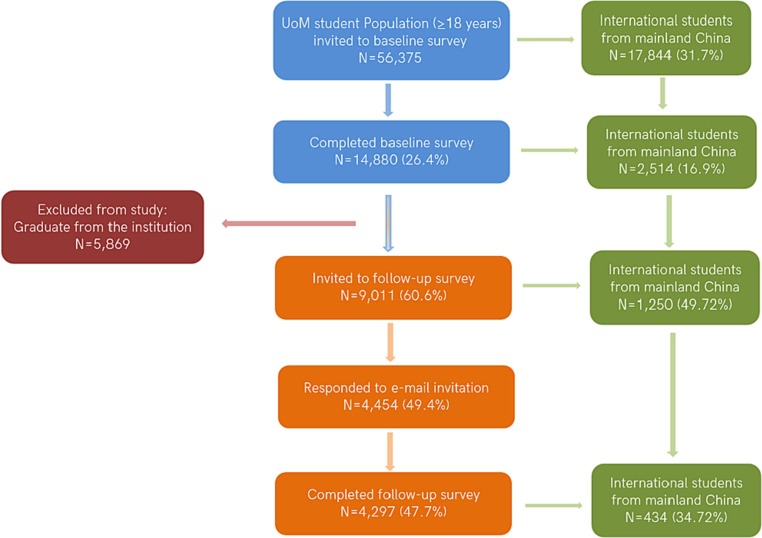
Data were extracted from a survey of Australian university students (April-June 2019) and follow-up during the pandemic (Sept-Oct 2020). The prevalence of anxiety, major depression and pandemic-related stressors was reported. Multivariable logistic regression was used to assess the association between country of residence, social support (baseline/follow-up), and follow-up self-reported mental health.
With the pandemic, there was a substantial increase in the prevalence of anxiety (24.7 % vs 45.7 %) and major depression (22.1 % vs 43.8 %). Major depression was less likely to be reported by international students in China (34.8 %) than in Australia (46.3 %). Students with high social support during the pandemic were less likely to report major depression (Adjusted OR:0.15 [95 % CI 0.06,0.34]), although this effect was not observed longitudinally (Adjusted OR:1.03 [95 % CI 0.58,1.83]).
Post pandemic improvement in mental health cannot be assessed.
The pandemic appeared to have had a strong negative effect on Chinese international university students' mental health. Those living in Australia were more likely to experience poorer mental health, highlighting the need for increased support to this group.
在 COVID-19 大流行期间,有报道称中国留学生遭遇种族主义、食品安全问题和社会孤立。然而,尚无研究调查过在大流行期间这些问题的普遍程度以及对这一人群心理健康的潜在恶化影响。因此,本研究旨在调查此次大流行对居住在澳大利亚和中国的中国留学生心理健康的影响,以及社会支持的保护作用。
数据来自于对澳大利亚大学生的一项调查(2019 年 4 月至 6 月)以及大流行期间的随访(2020 年 9 月至 10 月)。报告了焦虑症、重度抑郁症和与大流行相关的应激源的患病率。采用多变量逻辑回归评估居住地、社会支持(基线/随访)和随访时自我报告的心理健康之间的关联。
随着大流行,焦虑症(24.7%比 45.7%)和重度抑郁症(22.1%比 43.8%)的患病率显著增加。中国留学生重度抑郁症的报告率(34.8%)低于澳大利亚留学生(46.3%)。在大流行期间社会支持较高的学生报告重度抑郁症的可能性较小(调整后的比值比:0.15[95%可信区间 0.06,0.34]),尽管这种影响在纵向研究中并未观察到(调整后的比值比:1.03[95%可信区间 0.58,1.83])。
无法评估大流行后心理健康的改善情况。
大流行似乎对中国留学生的心理健康产生了强烈的负面影响。居住在澳大利亚的学生更有可能出现较差的心理健康状况,这凸显了需要增加对这一群体的支持。