Cardiology Department, Faculty of Medicine, Ain Shams University, EG.
Cardiology Department, Nasser Institute, Cairo, EG.
Glob Heart. 2023 Jan 23;18(1):2. doi: 10.5334/gh.1182. eCollection 2023.
Regional ST-segment-elevation myocardial infarction (STEMI) networks facilitate timely performance of primary percutaneous coronary intervention (PPCI), reduce mortality and improve outcomes. Few data exist on the feasibility and impact of regional STEMI networks in developing countries.
The aim of this study was to examine the feasibility and impact of establishing a regional STEMI network on the management and outcomes of STEMI patients in north Cairo.
A prospective observational study conducted on 352 patients presenting in North Cairo with confirmed diagnosis of STEMI within 48 hours of symptoms. Patients were divided into group I (n = 140) before and group II (n = 212) after establishment of the STEMI network. Both groups were compared as regards patients' demographics, presentation, management and short-term outcomes. The north Cairo regional STEMI network was established among four governmental hospitals and the governmental ambulance was used for interhospital transfer. WhatsApp® was used for trans-network team communication.
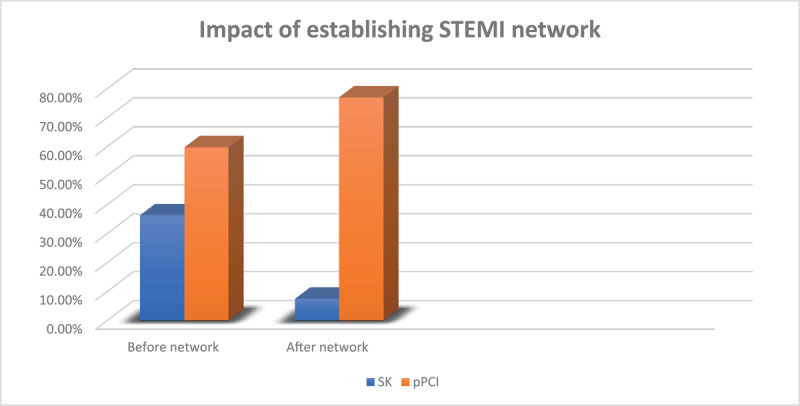
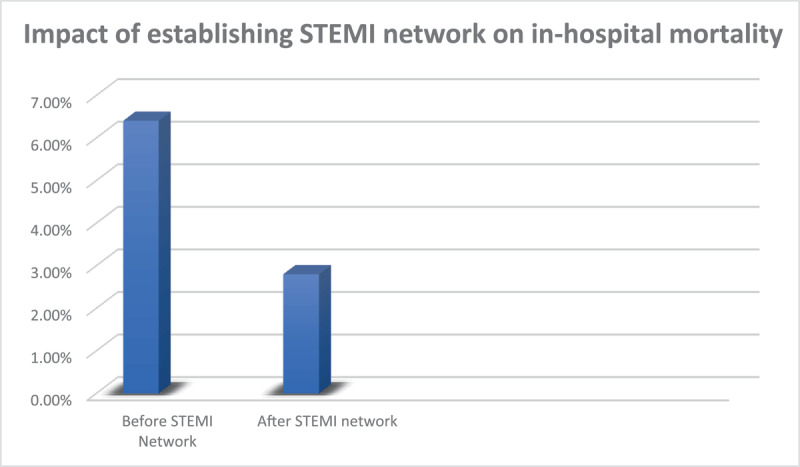
Mean age of the study population was 55.4 ± 11.02 years and 286 (81.3%) were males. Mean time from chest pain to first medical contact did not change between the two groups (240 minutes; P = 0.36) while door to balloon mean time was reduced (from 54.3 to 44.1 minutes: P = 0.01). Use of thrombolytic therapy declined from 51 (36.4%) to 16 (7.5%) (P < 0.001) while primary PCI increased from 59.8% to 77.1% (p < 0.001). Left ventricular ejection fraction improved from 51.3 ± 10.7 to 55.4 ± 9.1 (P < 0.001), the mean time of CCU stay was reduced from a mean of 3.0 to 2.0 days (P < 0.001) and in-hospital mortality improved from 6.4% to 2.8% (P = 0.10).
The establishment of the STEMI network in north Cairo was feasible and improved patients' outcomes. Use of primary PCI increased and in-hospital mortality improved from after establishment of STEMI network.
区域 ST 段抬高型心肌梗死(STEMI)网络有助于及时进行经皮冠状动脉介入治疗(PPCI),降低死亡率并改善预后。关于发展中国家建立区域 STEMI 网络的可行性和影响的数据很少。
本研究旨在探讨在北开罗建立区域 STEMI 网络对 STEMI 患者管理和结局的可行性和影响。
对 352 例在北开罗就诊且在症状出现 48 小时内确诊为 STEMI 的患者进行前瞻性观察性研究。患者分为组 I(n = 140)和组 II(n = 212),组 I 为 STEMI 网络建立前,组 II 为建立后。比较两组患者的人口统计学、临床表现、管理和短期结局。北开罗区域 STEMI 网络由四家政府医院建立,政府救护车用于医院间转运。WhatsApp®用于跨网络团队沟通。
研究人群的平均年龄为 55.4 ± 11.02 岁,286 例(81.3%)为男性。两组患者从胸痛到首次医疗接触的中位时间无变化(240 分钟;P = 0.36),但门球时间缩短(从 54.3 分钟降至 44.1 分钟:P = 0.01)。溶栓治疗使用率从 51 例(36.4%)降至 16 例(7.5%)(P < 0.001),而直接经皮冠状动脉介入治疗率从 59.8%增至 77.1%(p < 0.001)。左心室射血分数从 51.3 ± 10.7 提高至 55.4 ± 9.1(P < 0.001),CCU 停留时间从 3.0 天缩短至 2.0 天(P < 0.001),住院死亡率从 6.4%降至 2.8%(P = 0.10)。
在北开罗建立 STEMI 网络是可行的,并改善了患者的结局。直接经皮冠状动脉介入治疗的应用增加,STEMI 网络建立后住院死亡率降低。