Fernandez-Montero Alejandro, Zuaznabar Jon, Pina-Sanchez Manuel, Maestro Sheila, Martin-Navarro Loreto, Muñoz-Rodríguez Natalia, Olagüe Cristina, Pastrana Marta, Martínez-Fernández Maria, Camps Gracian, Rodriguez Jose Antonio, Marchese Francesco P, Zazpe Jon, Pozuelo Marta, Del Pozo José Luis, Quiroga Jorge, Pineda-Lucena Antonio, Reina Gabriel, Kolenda Jack, Moreno-Galarraga Laura, Gonzalez-Aseguinolaza Gloria, Rua Marta, Smerdou Cristian, Carmona-Torre Francisco, Argemi Josepmaria
Department of Occupational Medicine, University of Navarra, Pamplona, Spain.
COVID19 Unit, Clinica Universidad de Navarra, Pamplona, Spain.
Front Cell Infect Microbiol. 2023 Jan 25;13:1110467. doi: 10.3389/fcimb.2023.1110467. eCollection 2023.
The main objective was to evaluate the efficacy of intranasal photodynamic therapy (PDT) in SARS-CoV-2 mildly symptomatic carriers on decreasing the infectivity period. SARS-CoV-2-specific immune-stimulating effects and safety were also analysed.
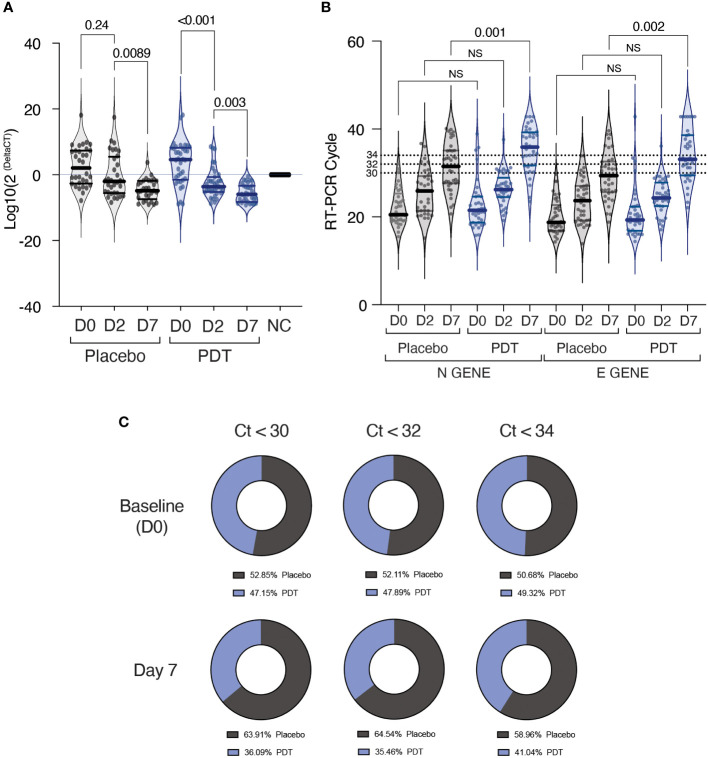
We performed a randomized, placebo-controlled, clinical trial in a tertiary hospital (NCT05184205). Patients with a positive SARS-CoV-2 PCR in the last 48 hours were recruited and aleatorily assigned to PDT or placebo. Patients with pneumonia were excluded. Participants and investigators were masked to group assignment. The primary outcome was the reduction in infectivity of nasopharyngeal samples at days 3 and 7. Additional outcomes included safety assessment and quantification of humoral and T-cell immune-responses.
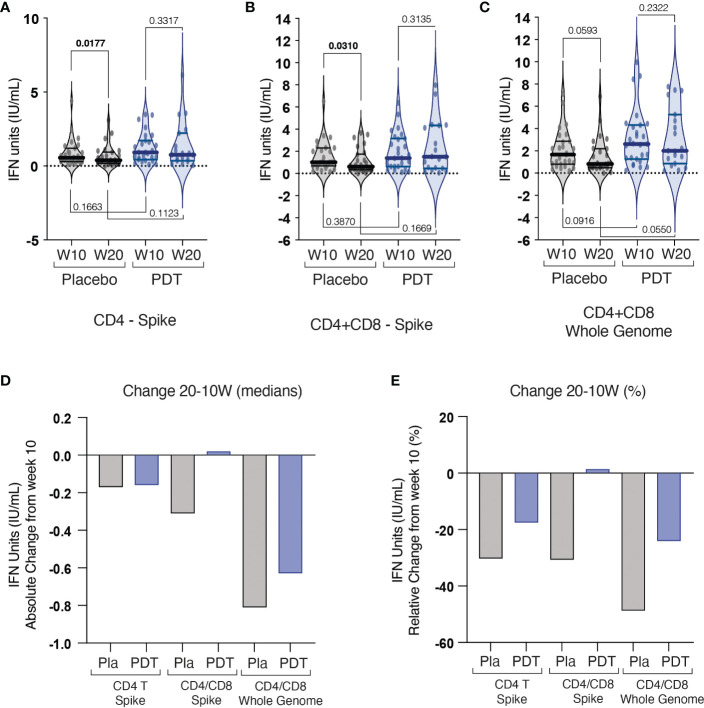
Patients were recruited between December 2021 and February 2022. Most were previously healthy adults vaccinated against COVID-19 and most carried Omicron variant. 38 patients were assigned to placebo and 37 to PDT. Intranasal PDT reduced infectivity at day 3 post-treatment when compared to placebo with a β-coefficient of -812.2 (CI95%= -478660 - -1.3, p<0.05) infectivity arbitrary units. The probability of becoming PCR negative (ct>34) at day 7 was higher on the PDT-group, with an OR of 0.15 (CI95%=0.04-0.58). There was a decay in anti-Spike titre and specific SARS-CoV-2 T cell immunity in the placebo group 10 and 20 weeks after infection, but not in the PDT-group. No serious adverse events were reported.
Intranasal-PDT is safe in pauci-symptomatic COVID-19 patients, it reduces SARS-CoV-2 infectivity and decelerates the decline SARS-CoV-2 specific immune-responses.
主要目的是评估鼻内光动力疗法(PDT)对新冠病毒(SARS-CoV-2)轻症携带者缩短感染期的疗效。同时分析了SARS-CoV-2特异性免疫刺激作用和安全性。
我们在一家三级医院进行了一项随机、安慰剂对照临床试验(NCT05184205)。招募过去48小时内SARS-CoV-2 PCR检测呈阳性的患者,并随机分配至PDT组或安慰剂组。排除患有肺炎的患者。参与者和研究者均对分组情况不知情。主要结局是第3天和第7天鼻咽样本传染性的降低。其他结局包括安全性评估以及体液和T细胞免疫反应的定量分析。
患者于2021年12月至2022年2月招募。大多数为先前健康且接种过新冠疫苗的成年人,多数携带奥密克戎变异株。38例患者分配至安慰剂组,37例分配至PDT组。与安慰剂相比,鼻内PDT在治疗后第3天降低了传染性,β系数为-812.2(95%CI = -478660 - -1.3,p<0.05)传染性任意单位。PDT组在第7天PCR转为阴性(ct>34)的概率更高,比值比为0.15(95%CI = 0.04 - 0.58)。感染后10周和20周,安慰剂组抗刺突蛋白滴度和SARS-CoV-2特异性T细胞免疫出现下降,但PDT组未出现。未报告严重不良事件。
鼻内PDT对新冠轻症患者安全,可以降低SARS-CoV-2传染性,并减缓SARS-CoV-2特异性免疫反应的下降。