Friedrich-Loeffler-Institut, Institute of Animal Welfare and Animal Husbandry, Celle, Germany.
Friedrich-Loeffler-Institut, Institute of Animal Welfare and Animal Husbandry, Celle, Germany.
Poult Sci. 2023 Apr;102(4):102489. doi: 10.1016/j.psj.2023.102489. Epub 2023 Jan 11.
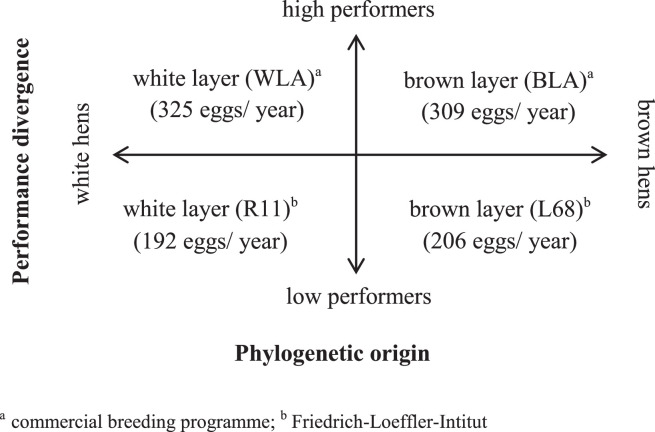
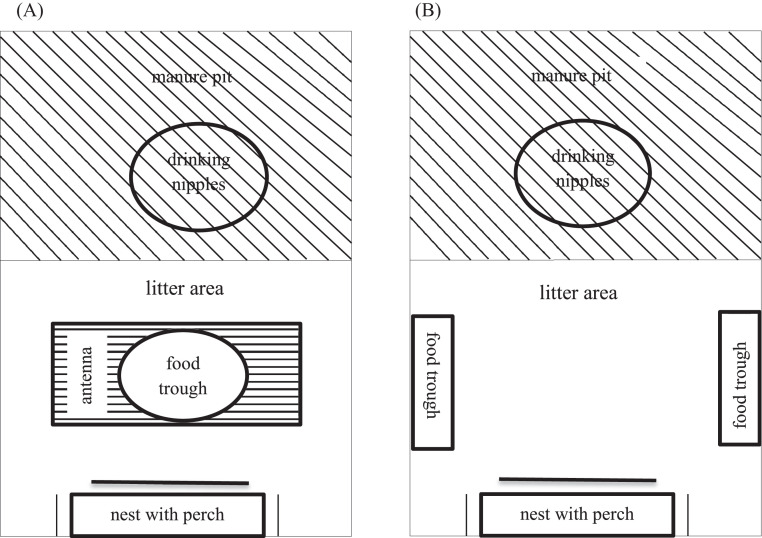
Different breeds of domestic and junglefowl differ in foraging strategies indicating that domestication resulted in modified energy saving behavioral strategies. In the present study we investigated foraging strategies and foraging-related behavior in 4 lines of laying hens differing in phylogenetic origin and laying performance to analyze a possible relationship between foraging and the level of egg production. High performing brown and white pure bred lines were compared with their low performing brown and white counterparts. To control possible effects on behavior other than genetic effects, all hens were reared and kept in an identical environment. A total of 72 hens from each line were kept in 6 compartments with 12 hens per compartment, respectively. Observations were done for 3 times during one laying period. Foraging strategy was tested by a contrafreeloading (CFL) paradigm. CFL describes a behavior in which animals prefer food that requires effort to obtain, although at the same time food is freely available. The hens were offered a commercial standard diet in one trough and a mixture of wood shavings and commercial standard diet in another trough. The behavior of hens was video recorded and the activity level of individual hens in the litter area was recorded by an antenna-transponder system. The high performing layers showed less CFL and foraging-related behavior compared with their low performing counterparts in both the white and brown layers. Despite differences in CFL, all hens showed a preference for the commercial standard diet compared to the mixture of wood-shavings. Our results show an association between foraging strategy and level of egg production. This suggests that a high level of egg production is accompanied by behaviors enabling the hens to satisfy their higher energy demand more efficiently. Saving energy by reduced activity probably allows them to reallocate energy into reproduction, that is, laying performance.
不同品种的家禽和野生鸡在觅食策略上存在差异,这表明驯化导致了节能行为策略的改变。在本研究中,我们调查了 4 个产蛋鸡系的觅食策略和与觅食相关的行为,这些鸡系在系统发生起源和产蛋性能上存在差异,以分析觅食与产蛋水平之间可能存在的关系。我们将高生产性能的棕色和白色纯系鸡与低生产性能的棕色和白色鸡进行了比较。为了控制除遗传效应以外的可能对行为产生影响的因素,所有母鸡均在相同的环境中饲养和饲养。每个系的总共 72 只母鸡分别饲养在 6 个隔间中,每个隔间中有 12 只母鸡。在一个产蛋期内,我们进行了 3 次观察。通过 contrafreeloading(CFL)范式测试了觅食策略。CFL 描述了一种行为,即动物更喜欢需要努力才能获得的食物,尽管同时食物是自由可得的。母鸡在一个食槽中被提供商业标准饲料,而在另一个食槽中提供木屑和商业标准饲料的混合物。母鸡的行为被视频记录,个体母鸡在垫料区的活动水平通过天线应答器系统记录。与低产母鸡相比,高产母鸡在白色和棕色母鸡中表现出更少的 CFL 和与觅食相关的行为。尽管在 CFL 上存在差异,但与木屑混合物相比,所有母鸡都表现出对商业标准饲料的偏好。我们的研究结果表明觅食策略与产蛋水平之间存在关联。这表明高的产蛋水平伴随着使母鸡能够更有效地满足其更高能量需求的行为。通过减少活动来节省能量可能使它们能够将能量重新分配到繁殖中,即产蛋性能。