Department of Animal Biosciences,University of Guelph,50 Stone Road E,Guelph,Ontario,CanadaN1G 2W1.
Animal. 2019 Feb;13(2):367-373. doi: 10.1017/S1751731118001143. Epub 2018 May 28.
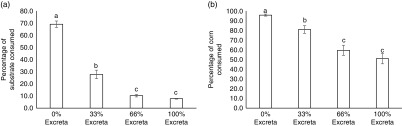
Worldwide, farm animals are kept on litter or foraging substrate that becomes increasingly soiled throughout the production cycle. For animals like laying hens, this means that it is likely they would scratch, forage and consume portions of excreta found in the litter or foraging substrate. However, no study has investigated the relative preference of laying hens for foraging and consumption of feed mixed with different percentages of excreta. A total of 48 White Leghorn laying hens of two strains, a commercial strain (Lohmann LSL-Lite (LSL), n=24) and UCD-003 strain (susceptible to liver damage, n=24), were individually housed and given access to feed mixed with increasing percentages of hen excreta (0%, 33%, 66% and 100% excreta diets) and corn as a luxury food reward (four corn kernels per diet daily). The amount of substrate and number of corn kernels consumed from each diet was recorded for a period of 3 weeks. Both LSL and UCD-003 hens preferred to consume and forage in diets with 0% excreta, followed by 33% and finally diets containing 66% and 100% excreta. Despite the presence of excreta-free diets, birds consumed on average 61.3 g per day of the diets containing excreta. Neither physical health, measured by plasma enzyme activity levels, nor cognitive differences, assessed by recalling a visual discrimination task, was associated with relative feeding or foraging preference. In conclusion, this study demonstrated a clear preference for feeding and foraging on substrate without excreta in laying hens. However, considering the amount of excreta diets consumed, further studies are needed to understand the causes and consequences of excreta consumption on physiological and psychological functioning, and how this information can be used to allow adjustments in the management of foraging substrates in farmed birds.
在全球范围内,农场动物被饲养在垫料或觅食基质上,这些垫料或基质在整个生产周期中会变得越来越脏。对于像蛋鸡这样的动物来说,它们很可能会在垫料或觅食基质中抓挠、觅食和消耗部分粪便。然而,目前还没有研究调查蛋鸡对觅食和消耗不同比例粪便与饲料混合物的相对偏好。共有 48 只白来航蛋鸡,两个品系,一个商业品系(Lohmann LSL-Lite(LSL),n=24)和 UCD-003 品系(易患肝损伤,n=24),单独饲养并给予含有不同比例鸡粪的饲料(0%、33%、66%和 100%粪便饮食)和玉米作为奢侈品食物奖励(每天每饮食四个玉米粒)。记录了每只鸡在三种饮食中的基质和玉米粒的消耗量,为期 3 周。LSL 和 UCD-003 母鸡都更喜欢在不含粪便的饮食中觅食,其次是 33%的饮食,最后是含有 66%和 100%粪便的饮食。尽管存在不含粪便的饮食,但鸟类平均每天仍会消耗含有粪便的饮食 61.3 克。生理健康,通过血浆酶活性水平测量,以及认知差异,通过回忆视觉辨别任务评估,与相对喂养或觅食偏好无关。综上所述,本研究表明蛋鸡在垫料上觅食时明显偏好无粪便的垫料。然而,考虑到所消耗的粪便饮食量,需要进一步研究来了解在农场鸟类中消耗粪便对生理和心理功能的原因和后果,以及如何利用这些信息来调整觅食基质的管理。