D'Aiello Angelica, Miao Emily, Cheng Haiying
Department of Oncology, Montefiore Medical Center, Albert Einstein College of Medicine, Bronx, NY 10461, USA.
Albert Einstein College of Medicine, Bronx, NY 10461, USA.
Cancers (Basel). 2023 Jan 30;15(3):844. doi: 10.3390/cancers15030844.
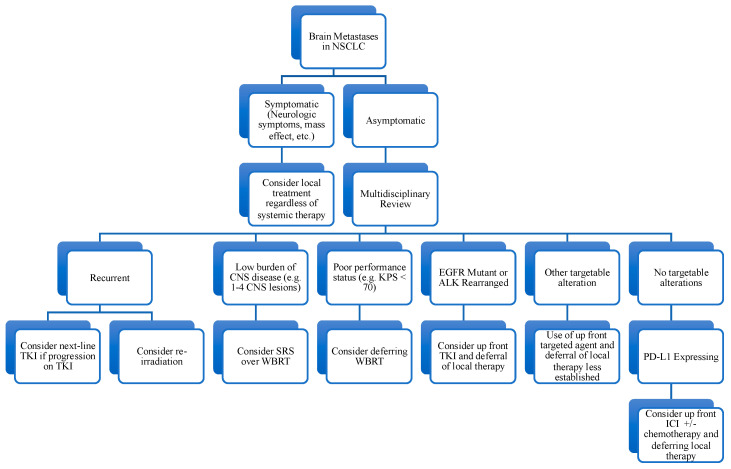
Central nervous system (CNS) metastases are common among patients with non-small cell lung cancer (NSCLC). While the presence of brain metastases has historically portended poor prognosis, recent advances in local and systemic therapies have greatly improved outcomes for NSCLC patients with CNS involvement. Stereotactic radiology surgery (SRS) has emerged as an effective radiotherapy technique with fewer toxicities compared to whole brain radiotherapy (WBRT). Furthermore, multi-generation tyrosine kinase inhibitors (TKIs) with CNS overall response rates (ORR) of up to 70-80% are now an accepted first-line approach for a subset of advanced NSCLC patients with targetable molecular alterations. In addition, while the CNS was once considered an immunologic sanctuary site, growing evidence shows that immune checkpoint inhibitors (ICIs) can induce durable responses in brain metastases as well. Ongoing efforts to optimize CNS metastases management are necessary to refine multimodal treatment approaches and develop new therapeutics with better CNS penetrance.
中枢神经系统(CNS)转移在非小细胞肺癌(NSCLC)患者中很常见。虽然脑转移的存在历来预示着预后不良,但局部和全身治疗的最新进展极大地改善了CNS受累的NSCLC患者的预后。立体定向放射外科手术(SRS)已成为一种有效的放疗技术,与全脑放疗(WBRT)相比毒性更小。此外,中枢神经系统总体缓解率(ORR)高达70%-80%的多代酪氨酸激酶抑制剂(TKIs)现在是一部分具有可靶向分子改变的晚期NSCLC患者公认的一线治疗方法。此外,虽然中枢神经系统曾被认为是一个免疫庇护部位,但越来越多的证据表明,免疫检查点抑制剂(ICIs)也可以在脑转移中诱导持久反应。持续努力优化CNS转移的管理对于完善多模式治疗方法和开发具有更好CNS渗透性的新疗法是必要的。