Baydar Oğuzhan, Różyło-Kalinowska Ingrid, Futyma-Gąbka Karolina, Sağlam Hande
Department of Oral and Maxillofacial Radiology, Faculty of Dentistry, Ege University, 35040 İzmir, Turkey.
Department of Dental and Maxillofacial Radiodiagnostics, Medical University of Lublin, ul. Doktora Witolda Chodźki 6, 20-093 Lublin, Poland.
Diagnostics (Basel). 2023 Jan 26;13(3):453. doi: 10.3390/diagnostics13030453.
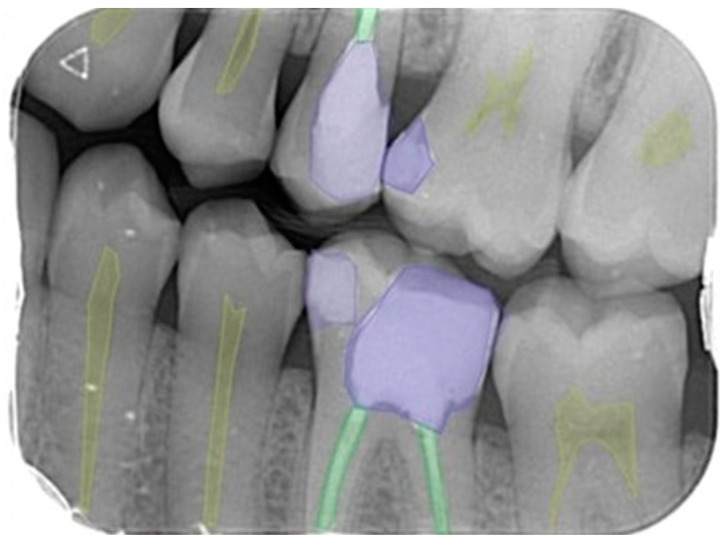
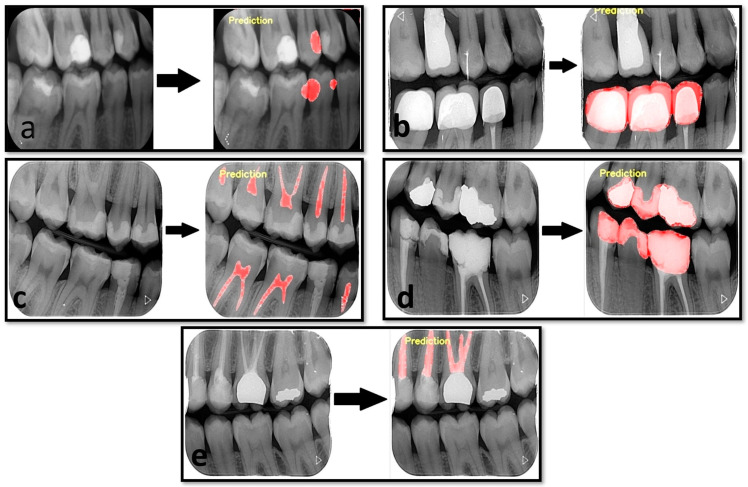
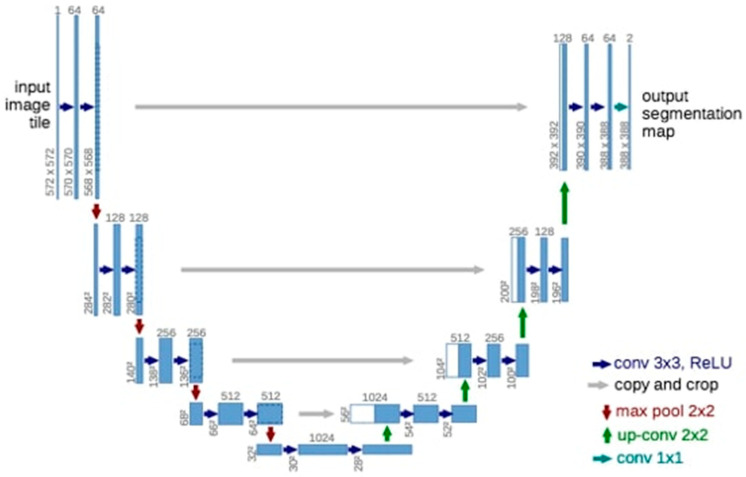
Bite-wing radiographs are one of the most used intraoral radiography techniques in dentistry. AI is extremely important in terms of more efficient patient care in the field of dentistry. The aim of this study was to perform a diagnostic evaluation on bite-wing radiographs with an AI model based on CNNs. In this study, 500 bite-wing radiographs in the radiography archive of Eskişehir Osmangazi University, Faculty of Dentistry, Department of Oral and Maxillofacial Radiology were used. The CranioCatch labeling program (CranioCatch, Eskisehir, Turkey) with tooth decays, crowns, pulp, restoration material, and root-filling material for five different diagnoses were made by labeling the segmentation technique. The U-Net architecture was used to develop the AI model. F1 score, sensitivity, and precision results of the study, respectively, caries 0.8818-0.8235-0.9491, crown; 0.9629-0.9285-1, pulp; 0.9631-0.9843-0.9429, with restoration material; and 0.9714-0.9622-0.9807 was obtained as 0.9722-0.9459-1 for the root filling material. This study has shown that an AI model can be used to automatically evaluate bite-wing radiographs and the results are promising. Owing to these automatically prepared charts, physicians in a clinical intense tempo will be able to work more efficiently and quickly.
咬合翼片是牙科中最常用的口腔内放射摄影技术之一。在牙科领域,人工智能对于更高效地护理患者极为重要。本研究的目的是使用基于卷积神经网络(CNN)的人工智能模型对咬合翼片进行诊断评估。在本研究中,使用了埃斯基谢希尔奥斯曼加齐大学牙科学院口腔颌面放射科放射存档中的500张咬合翼片。通过标记分割技术,使用CranioCatch标记程序(CranioCatch,土耳其埃斯基谢希尔)对龋齿、牙冠、牙髓、修复材料和根充材料进行了五种不同诊断的标记。使用U-Net架构开发人工智能模型。该研究的F1分数、敏感性和精确性结果分别为:龋齿0.8818 - 0.8235 - 0.9491,牙冠0.9629 - 0.9285 - 1,牙髓0.9631 - 0.9843 - 0.9429,修复材料0.9714 - 0.9622 - 0.9807,根充材料0.9722 - 0.9459 - 1。本研究表明,人工智能模型可用于自动评估咬合翼片,结果很有前景。由于这些自动生成的图表,临床工作节奏紧张的医生将能够更高效、快速地工作。