Department of International Health, Johns Hopkins Bloomberg School of Public Health, Baltimore, MD 21205, USA.
Missouri Breaks Industries Research, Cheyenne River Sioux Tribe, Eagle Butte, SD 57625, USA.
Int J Environ Res Public Health. 2023 Feb 2;20(3):2681. doi: 10.3390/ijerph20032681.
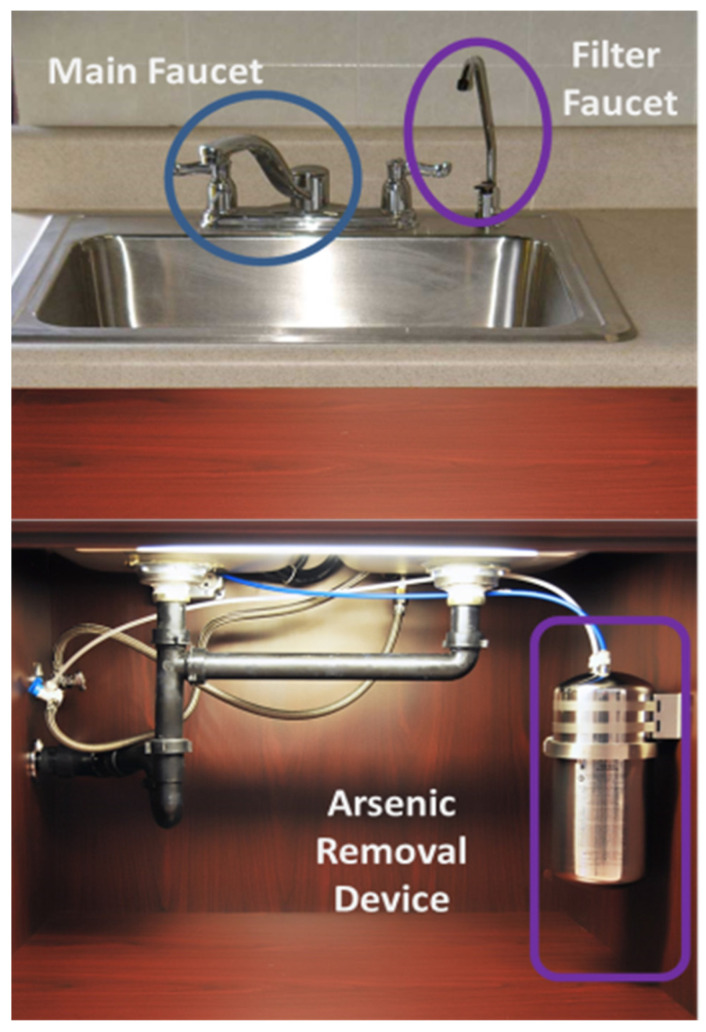
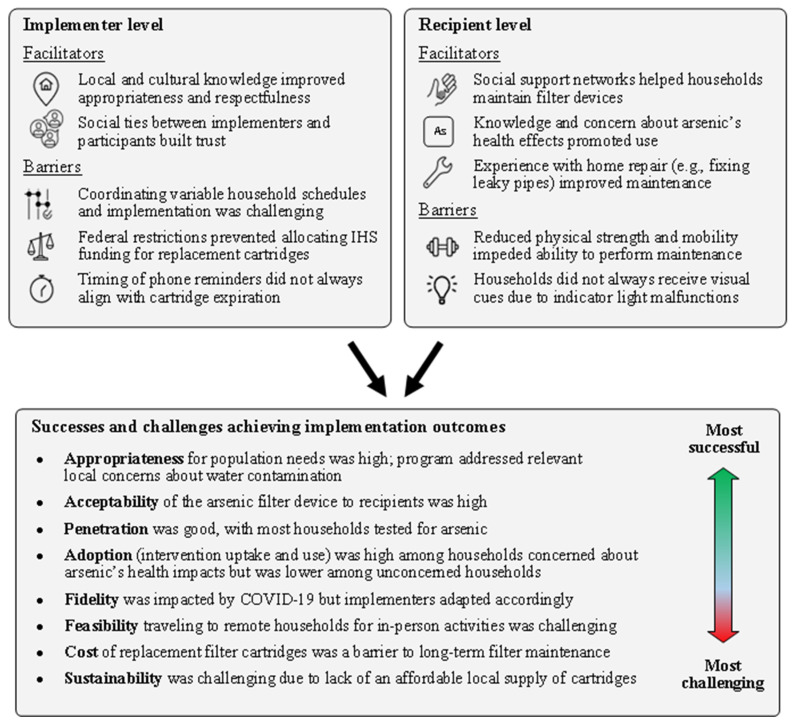
Arsenic is a naturally occurring toxicant in groundwater, which increases cancer and cardiovascular disease risk. American Indian populations are disproportionately exposed to arsenic in drinking water. The Strong Heart Water Study (SHWS), through a community-centered approach for intervention development and implementation, delivered an arsenic mitigation program for private well users in American Indian communities. The SHWS program comprised community-led water arsenic testing, point-of-use arsenic filter installation, and a mobile health program to promote sustained filter use and maintenance (i.e., changing the filter cartridge). Half of enrolled households received additional in-person behavior change communication and videos. Our objectives for this study were to assess successes, barriers, and facilitators in the implementation, use, and maintenance of the program among implementers and recipients. We conducted 45 semi-structured interviews with implementers and SHWS program recipients. We analyzed barriers and facilitators using the Consolidated Framework for Implementation Research and the Risks, Attitudes, Norms, Abilities, and Self-regulation model. At the implementer level, facilitators included building rapport and trust between implementers and participating households. Barriers included the remoteness of households, coordinating with community plumbers for arsenic filter installation, and difficulty securing a local supplier for replacement filter cartridges. At the recipient level, facilitators included knowledge of the arsenic health risks, perceived effectiveness of the filter, and visual cues to promote habit formation. Barriers included attitudes towards water taste and temperature and inability to procure or install replacement filter cartridges. This study offers insights into the successes and challenges of implementing an arsenic mitigation program tailored to American Indian households, which can inform future programs in partnership with these and potentially similar affected communities. Our study suggests that building credibility and trust between implementers and participants is important for the success of arsenic mitigation programs.
砷是一种天然存在于地下水中的有毒物质,会增加癌症和心血管疾病的风险。美洲印第安人人群 disproportionately 暴露于饮用水中的砷。通过以社区为中心的干预措施开发和实施方法,Strong Heart Water Study(SHWS)为美洲印第安人社区的私人水井用户提供了砷缓解计划。SHWS 计划包括社区主导的水质砷检测、使用点砷过滤器安装以及移动健康计划,以促进持续使用和维护过滤器(即更换过滤芯)。一半的注册家庭收到了额外的面对面行为改变沟通和视频。我们的研究目标是评估该计划在实施者和接受者中的实施、使用和维护方面的成功、障碍和促进因素。我们对实施者和 SHWS 计划接受者进行了 45 次半结构化访谈。我们使用实施研究的综合框架和风险、态度、规范、能力和自我调节模型分析了障碍和促进因素。在实施者层面,促进因素包括在实施者和参与家庭之间建立融洽关系和信任。障碍包括家庭的偏远、与社区水管工协调安装砷过滤器以及难以找到当地供应商更换过滤芯。在接受者层面,促进因素包括对砷健康风险的了解、对过滤器有效性的感知以及促进习惯形成的视觉提示。障碍包括对水的味道和温度的态度以及无法采购或安装更换的过滤芯。这项研究深入了解了针对美洲印第安人家庭量身定制的砷缓解计划的成功和挑战,这可以为与这些社区和可能类似受影响社区合作的未来计划提供信息。我们的研究表明,在实施者和参与者之间建立信誉和信任是砷缓解计划成功的关键。