Department of Biomedical Science, Graduate School of Biomedical Science and Engineering, Hanyang University, Seongdong-gu, Seoul 04763, Republic of Korea.
Department of Biological Sciences, Columbia University, New York, NY 10027, USA.
Int J Mol Sci. 2023 Jan 17;24(3):1855. doi: 10.3390/ijms24031855.
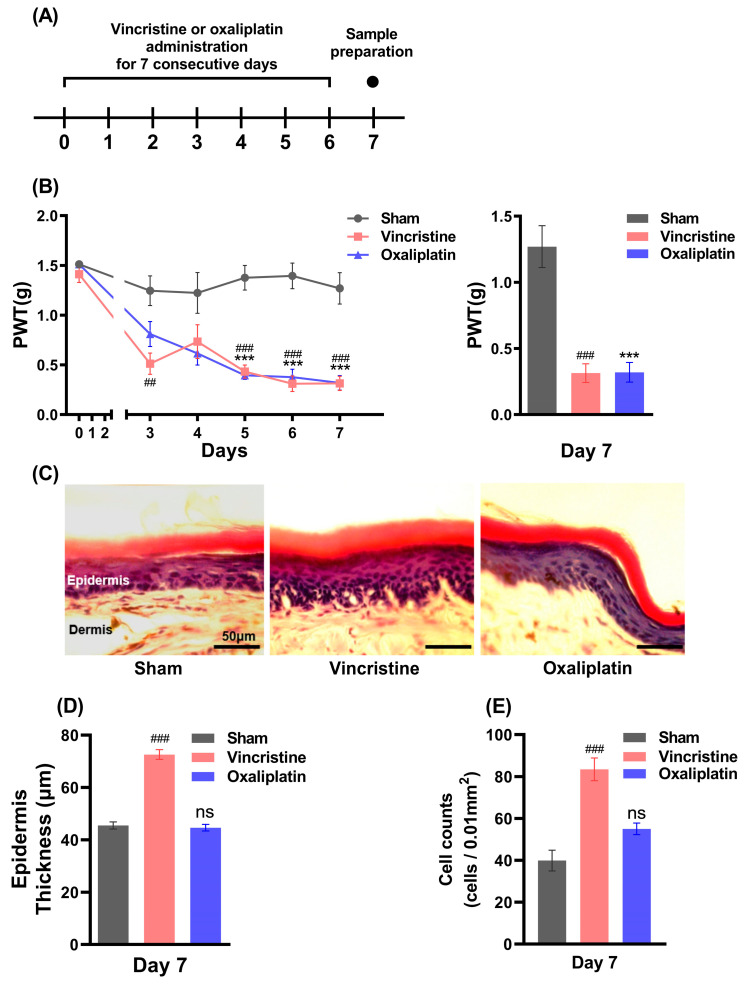
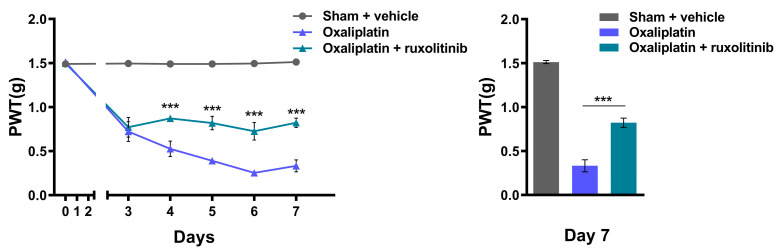
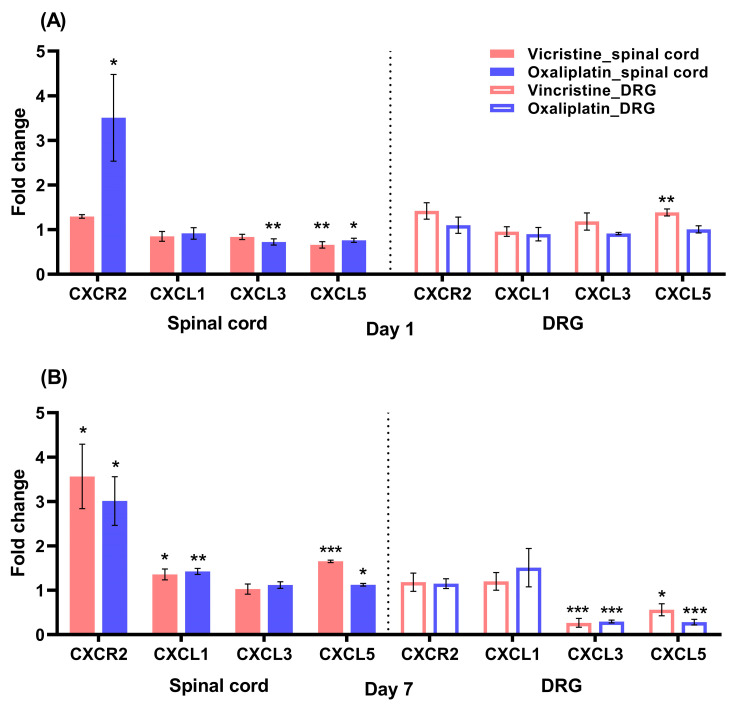
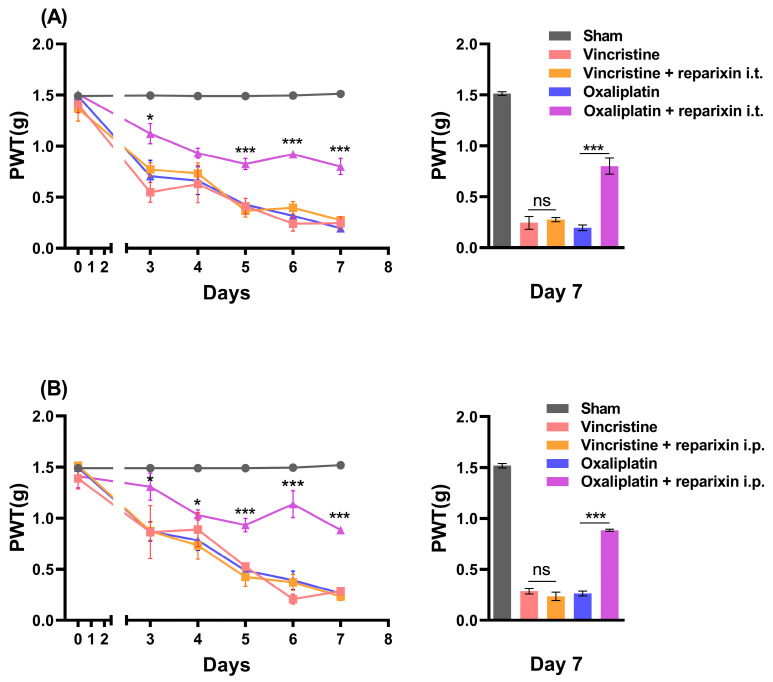
Chemotherapy-induced peripheral neuropathy (CIPN) is a major drawback in the use of chemotherapeutic agents for patients with cancer. Although studies have investigated a broad number of molecules that might be related to CIPN, the differences in the chemokine pathways between various chemotherapeutic agents, such as vincristine and oxaliplatin, which are some of the most widely used treatments, have not been fully elucidated. We confirmed that the administration (intraperitoneal injections for seven days) of vincristine (0.1 mg/kg) and oxaliplatin (3 mg/kg) induced pain by using the von Frey behavioral test. Subsequent applications with vincristine and oxaliplatin led to mechanical allodynia that lasted more than one week from the fifth day. After the induction of mechanical allodynia, the mRNA expression of CXCR2, CXCL1, CXCL3, and CXCL5 was examined in the dorsal root ganglia (DRG) and spinal cord of the CIPN models. As a result, the mRNA expression of CXCR2 robustly increased in the lumbar spinal cord in the oxaliplatin-treated mice. Next, to evaluate the involvement of CXCR2 in CIPN, reparixin, a CXCR1/2 inhibitor, was administered intrathecally or intraperitoneally with vincristine or oxaliplatin and was further verified by treatment with ruxolitinib, which inhibits Janus kinase 2 downstream of the CXCR1/2 pathway. Reparixin and ruxolitinib blocked oxaliplatin-induced allodynia but not vincristine-induced allodynia, which suggests that CXCR2-related pathways are associated with the development of oxaliplatin-induced neuropathy. Together with the above results, this suggests that the prevention of oxaliplatin-induced neuropathy by CXCR2 inhibition can lead to successful chemotherapy, and it is important to provide appropriate countermeasures against CIPN development for each specific chemotherapeutic agent.
化疗引起的周围神经病(CIPN)是癌症患者使用化疗药物的主要障碍。尽管已经研究了许多可能与 CIPN 相关的分子,但不同化疗药物(如长春新碱和奥沙利铂)之间趋化因子途径的差异尚未完全阐明,长春新碱和奥沙利铂是最广泛使用的治疗方法之一。我们通过 von Frey 行为测试证实,长春新碱(0.1mg/kg)和奥沙利铂(3mg/kg)的给药(腹腔注射七天)引起了疼痛。随后,长春新碱和奥沙利铂的应用导致机械性痛觉过敏,从第五天开始持续超过一周。在诱导机械性痛觉过敏后,在 CIPN 模型的背根神经节(DRG)和脊髓中检查了 CXCR2、CXCL1、CXCL3 和 CXCL5 的 mRNA 表达。结果,在奥沙利铂处理的小鼠中,CXCR2 的 mRNA 表达在腰脊髓中强烈增加。接下来,为了评估 CXCR2 在 CIPN 中的参与,CXCR1/2 抑制剂 reparixin 与长春新碱或奥沙利铂一起鞘内或腹腔内给药,并通过抑制 CXCR1/2 途径下游的 Janus 激酶 2 的 ruxolitinib 进一步验证。Reparixin 和 ruxolitinib 阻断了奥沙利铂诱导的痛觉过敏,但不阻断长春新碱诱导的痛觉过敏,这表明 CXCR2 相关途径与奥沙利铂诱导的神经病的发展有关。结合上述结果,这表明通过 CXCR2 抑制预防奥沙利铂诱导的神经病可以导致成功的化疗,为每个特定的化疗药物开发针对 CIPN 发展的适当对策非常重要。