Institute of Fundamental Medicine and Biology, Kazan Federal University, 420008 Kazan, Russia.
Int J Mol Sci. 2023 Jan 26;24(3):2413. doi: 10.3390/ijms24032413.
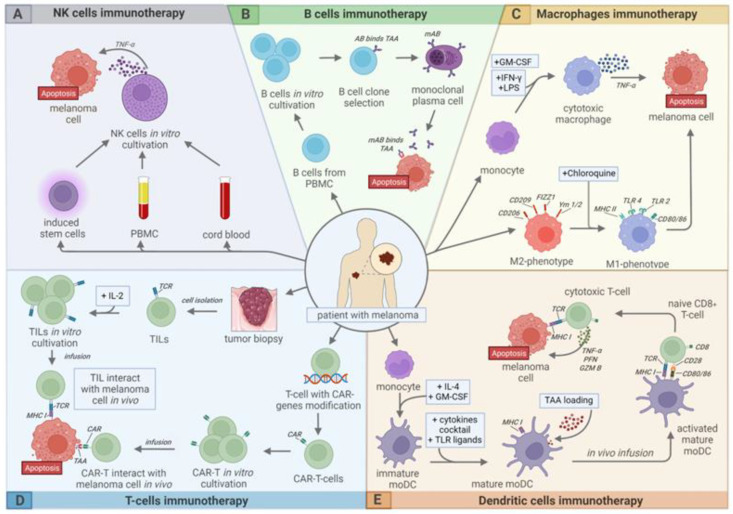
Melanoma is one of the most aggressive and therapy-resistant types of cancer, the incidence rate of which grows every year. However, conventional methods of chemo- and radiotherapy do not allow for completely removing neoplasm, resulting in local, regional, and distant relapses. In this case, adjuvant therapy can be used to reduce the risk of recurrence. One of the types of maintenance cancer therapy is cell-based immunotherapy, in which immune cells, such as T-cells, NKT-cells, B cells, NK cells, macrophages, and dendritic cells are used to recognize and mobilize the immune system to kill cancer cells. These cells can be isolated from the patient's peripheral blood or biopsy material and genetically modified, cultured ex vivo, following infusion back into the patient for powerful induction of an anti-tumor immune response. In this review, the advantages and problems of the most relevant methods of cell-based therapy and ongoing clinical trials of adjuvant therapy of melanoma are discussed.
黑色素瘤是最具侵袭性和耐药性的癌症之一,其发病率每年都在增长。然而,传统的化疗和放疗方法并不能完全切除肿瘤,导致局部、区域和远处复发。在这种情况下,可以使用辅助治疗来降低复发的风险。维持性癌症治疗的一种类型是基于细胞的免疫疗法,其中使用免疫细胞,如 T 细胞、NKT 细胞、B 细胞、NK 细胞、巨噬细胞和树突状细胞来识别和动员免疫系统杀死癌细胞。这些细胞可以从患者的外周血或活检材料中分离出来,并进行基因修饰,在体外培养,然后再输注回患者体内,以强力诱导抗肿瘤免疫反应。在这篇综述中,讨论了基于细胞的治疗最相关方法的优点和问题,以及黑色素瘤辅助治疗的正在进行的临床试验。