Feng Kai, Wang Jiefang, Hao Shiming, Xie Jingpei
School of Physics and Microelectronics, Zhengzhou University, Zhengzhou 450052, China.
School of Physics and Engineering, Henan University of Science and Technology, Luoyang 471023, China.
Nanomaterials (Basel). 2023 Jan 19;13(3):404. doi: 10.3390/nano13030404.
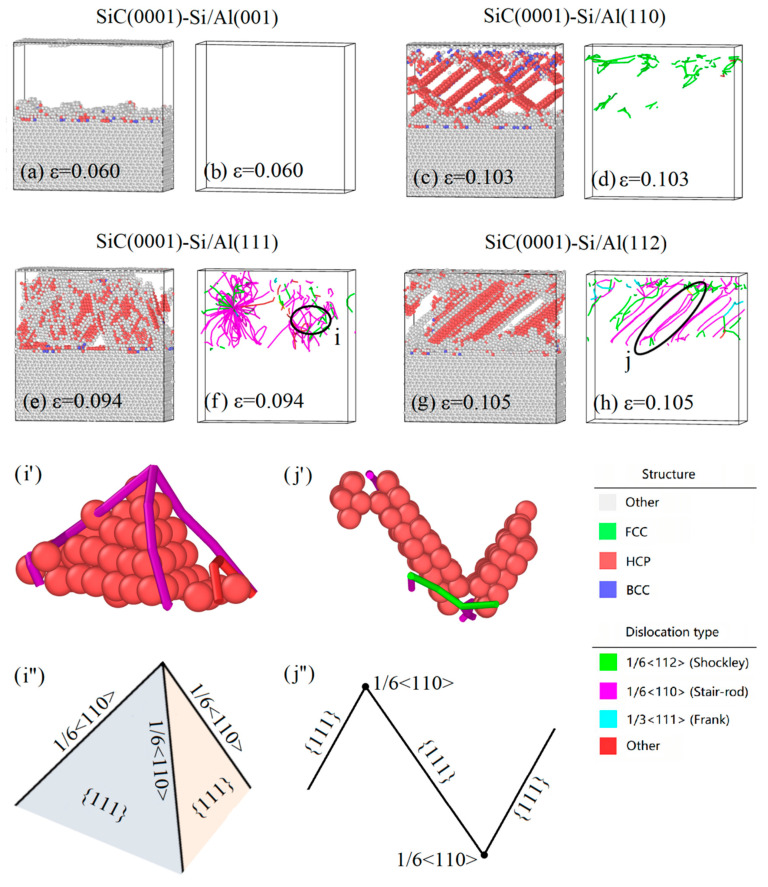
This paper investigated the micromechanical behavior of different 6H-SiC/Al systems during the uniaxial tensile loading by using molecular dynamics simulations. The results showed that the interface models responded diversely to the tensile stress when the four low-index surfaces of the Al were used as the variables of the joint surfaces. In terms of their stress-strain properties, the SiC(0001)/Al(001) models exhibited the highest tensile strength and the smallest elongation, while the other models produced certain deformations to relieve the excessive strain, thus increasing the elongation. The SiC(0001)/Al(110) models exhibited the largest elongations among all the models. From the aspect of their deformation characteristics, the SiC(0001)/Al(001) model performed almost no plastic deformation and dislocations during the tensile process. The deformation of the SiC(0001)/Al(110) model was dominated by the slip of the 1/6 <112> Shockley partial dislocations, which contributed to the intersecting stacking faults in the model. The SiC(0001)/Al(111) model produced a large number of dislocations under the tensile loading. Dislocation entanglement was also found in the model. Meanwhile, a unique defect structure consisting of three 1/6 <110> stair-rod dislocations and three stacking faults were found in the model. The plastic deformation in the SiC(0001)/Al(112) interface model was restricted by the L-C lock and was carried out along the 1/6 <110> stair-rod dislocations' direction. These results reveal the interfacial micromechanical behaviors of the 6H-SiC/Al composites and demonstrate the complexity of the deformation systems of the interfaces under stress.
本文通过分子动力学模拟研究了不同6H-SiC/Al体系在单轴拉伸载荷下的微观力学行为。结果表明,当以铝的四个低指数表面作为结合面变量时,界面模型对拉伸应力的响应各不相同。就其应力-应变特性而言,SiC(0001)/Al(001)模型表现出最高的拉伸强度和最小的伸长率,而其他模型产生了一定的变形以缓解过大的应变,从而增加了伸长率。SiC(0001)/Al(110)模型在所有模型中表现出最大的伸长率。从其变形特性来看,SiC(0001)/Al(001)模型在拉伸过程中几乎没有塑性变形和位错。SiC(0001)/Al(110)模型的变形主要由1/6<112>肖克利不全位错的滑移主导,这导致了模型中的相交堆垛层错。SiC(0001)/Al(111)模型在拉伸载荷下产生了大量位错,模型中还发现了位错缠结。同时,在该模型中发现了一种由三个1/6<110>阶梯杆位错和三个堆垛层错组成的独特缺陷结构。SiC(0001)/Al(112)界面模型中的塑性变形受到L-C锁的限制,并沿1/6<110>阶梯杆位错方向进行。这些结果揭示了6H-SiC/Al复合材料的界面微观力学行为,并证明了应力作用下界面变形体系的复杂性。