
基于多输入 ResNet 编码器的伪激光雷达高效立体深度估计:一种自监督方法。
Efficient Stereo Depth Estimation for Pseudo-LiDAR: A Self-Supervised Approach Based on Multi-Input ResNet Encoder.
机构信息
Faculty of Engineering and Applied Science, Ontario Tech University, Oshawa, ON L1G 0C5, Canada.
出版信息
Sensors (Basel). 2023 Feb 2;23(3):1650. doi: 10.3390/s23031650.
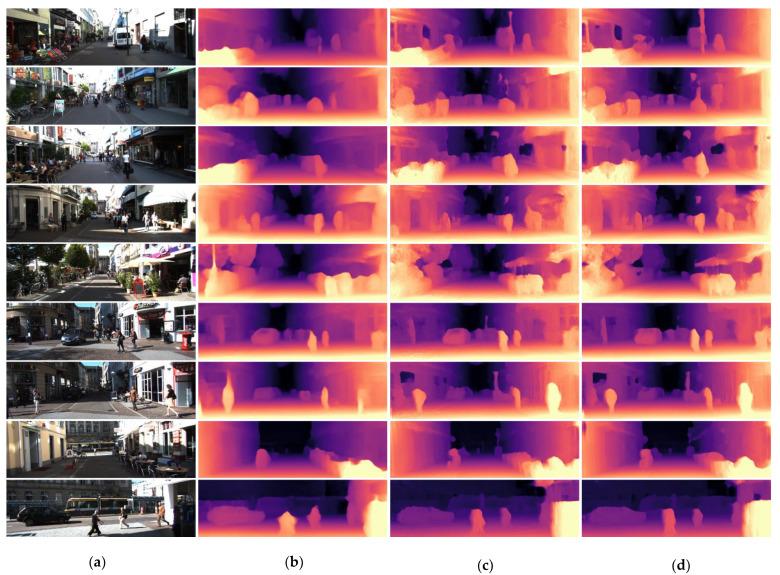
Perception and localization are essential for autonomous delivery vehicles, mostly estimated from 3D LiDAR sensors due to their precise distance measurement capability. This paper presents a strategy to obtain a real-time pseudo point cloud from image sensors (cameras) instead of laser-based sensors (LiDARs). Previous studies (such as PSMNet-based point cloud generation) built the algorithm based on accuracy but failed to operate in real time as LiDAR. We propose an approach to use different depth estimators to obtain pseudo point clouds similar to LiDAR to achieve better performance. Moreover, the depth estimator has used stereo imagery data to achieve more accurate depth estimation as well as point cloud results. Our approach to generating depth maps outperforms other existing approaches on KITTI depth prediction while yielding point clouds significantly faster than other approaches as well. Additionally, the proposed approach is evaluated on the KITTI stereo benchmark, where it shows effectiveness in runtime.
感知和定位对于自动驾驶车辆至关重要,由于其精确的距离测量能力,这些通常是通过 3D LiDAR 传感器来估计的。本文提出了一种从图像传感器(摄像头)而不是基于激光的传感器(LiDAR)获取实时伪点云的策略。以前的研究(例如基于 PSMNet 的点云生成)基于准确性构建了算法,但无法像 LiDAR 那样实时运行。我们提出了一种使用不同深度估计器来获得类似于 LiDAR 的伪点云的方法,以实现更好的性能。此外,深度估计器还使用立体图像数据来实现更准确的深度估计以及点云结果。在 KITTI 深度预测方面,我们的生成深度图的方法优于其他现有方法,同时生成点云的速度也明显快于其他方法。此外,还在 KITTI 立体基准测试上评估了所提出的方法,在该基准测试中,它在运行时表现出有效性。


 Zotero 插件