Comi Giancarlo, Leocani Letizia, Ferini-Strambi Luigi, Radaelli Marta, Costa Gloria D, Lanzillo Roberta, Lus Giacomo, Bianchi Valentina, Traccis Sebastiano, Capone Fioravante, Grimaldi Luigi Me, Salemi Giuseppe, Cardillo Alessandra, Zipoli Valentina
Università Vita Salute San Raffaele, Centro Sclerosi Multipla Ospedale Gallarate, Milan, Italy.
Experimental Neurophysiology Unit, INSPE IRCCS Ospedale San Raffaele, Università Vita Salute San Raffaele, Milan, Italy.
Mult Scler J Exp Transl Clin. 2023 Feb 8;9(1):20552173221144229. doi: 10.1177/20552173221144229. eCollection 2023 Jan-Mar.
Sleep disorders are common in patients with multiple sclerosis and have a bidirectional interplay with fatigue and depression.
To evaluate the effect of treatment with oral dimethyl fumarate on the quality of sleep in relapsing-remitting multiple sclerosis.
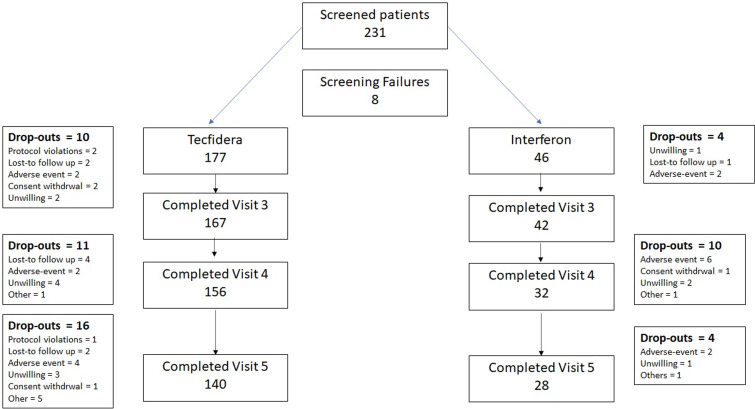
This was a multicentre observational study with 223 relapsing-remitting multiple sclerosis subjects starting treatment with dimethyl fumarate (=177) or beta interferon (=46). All patients underwent subjective (Pittsburgh Sleep Quality Index) and objective (wearable tracker) measurements of quality of sleep. Fatigue, depression, and quality of life were also investigated and physical activity was monitored.
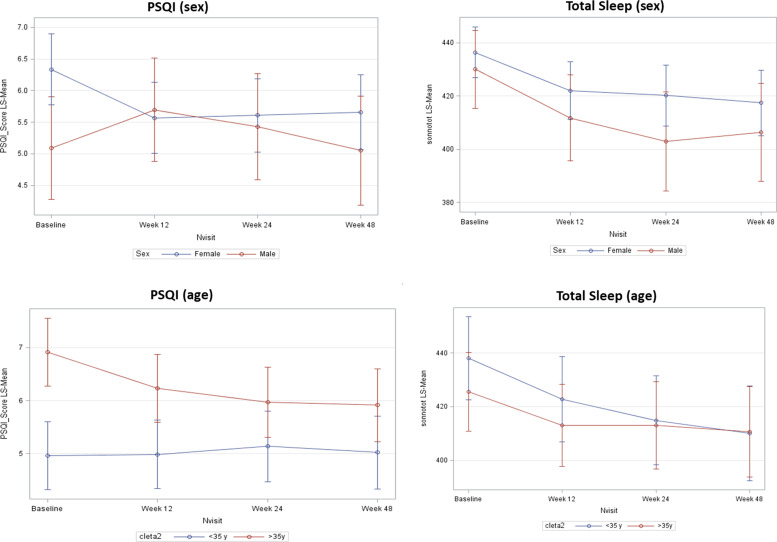
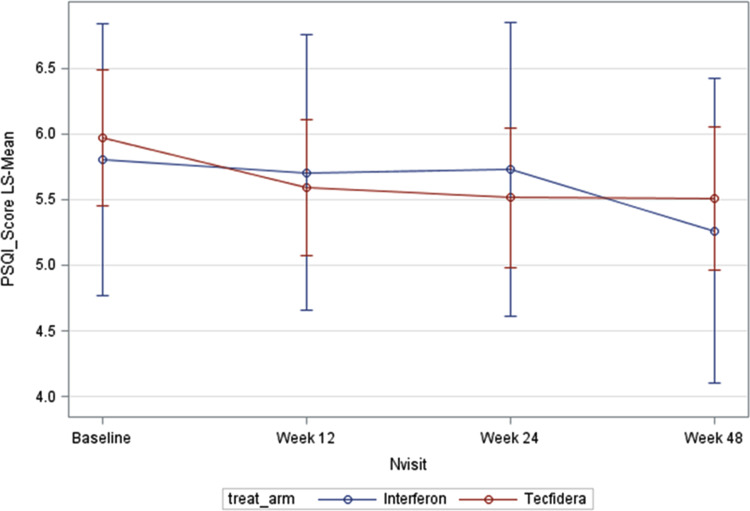
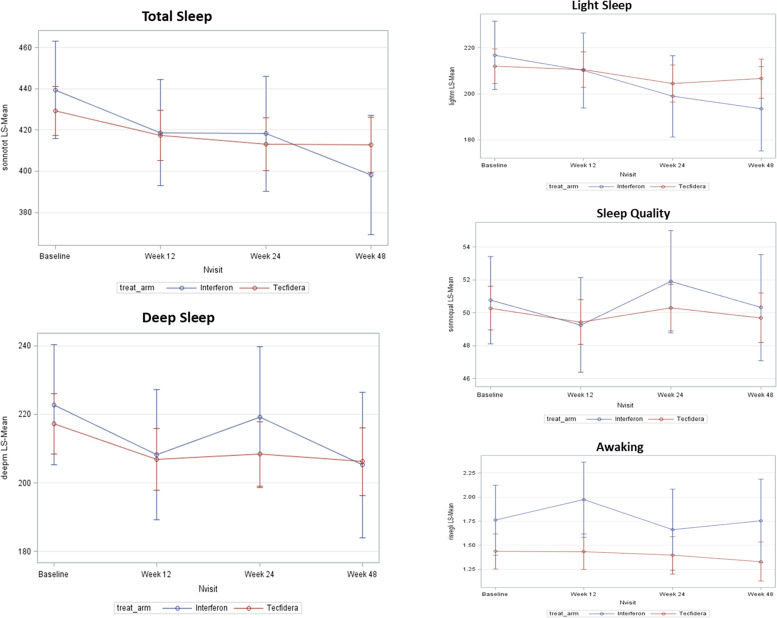
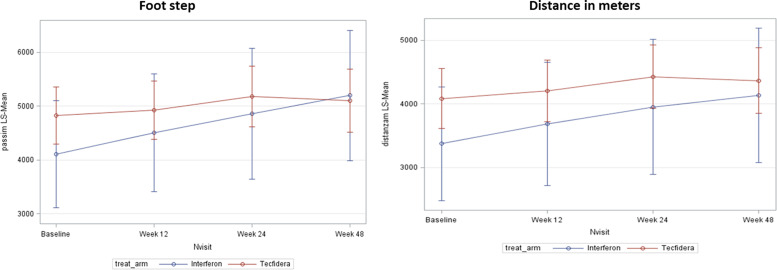
Patients treated with dimethyl fumarate had significant improvement in the quality of sleep as measured with the Pittsburgh Sleep Quality Index (<0.001). At all-time points, no significant changes in Pittsburgh Sleep Quality Index score were observed in the interferon group. Total and deep sleep measured by wearable tracker decreased at week 12 with both treatments, then remained stable for the total study duration. Depression significantly improved in patients treated with dimethyl fumarate. No significant changes were observed in mobility, fatigue and quality of life.
In patients with relapsing-remitting multiple sclerosis, the treatment with dimethyl fumarate was associated with improvements in patient-reported quality of sleep. Further randomised clinical trials are needed to confirm the benefits of long-term treatment with dimethyl fumarate.
睡眠障碍在多发性硬化症患者中很常见,并且与疲劳和抑郁存在双向相互作用。
评估口服富马酸二甲酯治疗对复发缓解型多发性硬化症患者睡眠质量的影响。
这是一项多中心观察性研究,223例复发缓解型多发性硬化症患者开始接受富马酸二甲酯(=177)或β干扰素(=46)治疗。所有患者均接受了睡眠质量的主观(匹兹堡睡眠质量指数)和客观(可穿戴追踪器)测量。还对疲劳、抑郁和生活质量进行了调查,并监测了身体活动情况。
用匹兹堡睡眠质量指数测量,接受富马酸二甲酯治疗的患者睡眠质量有显著改善(<0.001)。在所有时间点,干扰素组的匹兹堡睡眠质量指数评分均未观察到显著变化。两种治疗方法在第12周时,通过可穿戴追踪器测量的总睡眠时间和深度睡眠时间均下降,然后在整个研究期间保持稳定。接受富马酸二甲酯治疗的患者抑郁情况显著改善。在活动能力、疲劳和生活质量方面未观察到显著变化。
在复发缓解型多发性硬化症患者中,富马酸二甲酯治疗与患者报告的睡眠质量改善有关。需要进一步的随机临床试验来证实富马酸二甲酯长期治疗的益处。