Swann Christopher, Kelly Mary
Temple University, Philadelphia, PA USA.
Villanova University, Villanova, PA USA.
Bus Econ. 2023;58(1):42-60. doi: 10.1057/s11369-023-00302-w. Epub 2023 Feb 6.
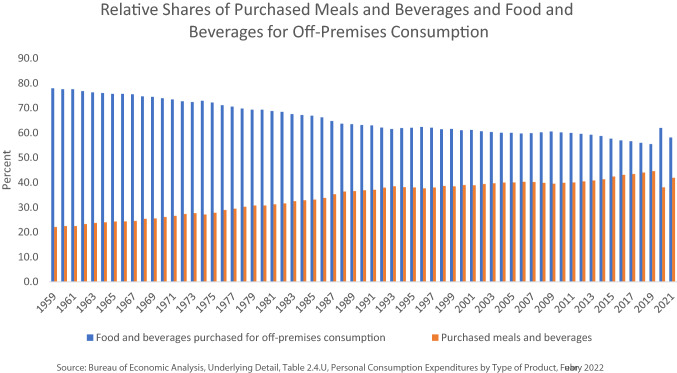
After World War II, consumer patterns of food consumption changed dramatically. Initially, it was mobility, economic evolution, and home appliance technologies that induced a shift toward meals eaten outside of the home and to ready-to-eat foods at home. More recently, health concerns and sustainability issues shifted consumer tastes among meat products and gave rise to a change in attitudes about raising animals for human consumption. On the supply side, new technologies in nonmeat production enabled new producers, most notably Impossible Foods and Beyond Meat, to enter as fringe competitors to vertically integrated, oligopolistic meat processors. Today, these nonmeat products represent a small, but growing, share of consumer expenditures at grocery stores, restaurants, and direct-to-consumer delivery channels. In this paper, we evaluate the disruption of the traditional meat industry through the lens of consumer spending trends and substitution among meat products and find that the development of alternative meat products is market-driven rather than policy-driven. Given these findings, we identify implications for product development and industrial organization.
第二次世界大战后,食品消费模式发生了巨大变化。最初,是流动性、经济发展和家电技术促使人们转向在家庭以外就餐,并在家中食用即食食品。最近,对健康的关注和可持续性问题改变了消费者对肉类产品的喜好,并引发了人们对养殖供人类食用动物的态度转变。在供应方面,非肉类生产的新技术使新的生产商得以进入,最著名的是Impossible Foods和Beyond Meat,它们作为边缘竞争者进入了垂直整合的寡头垄断肉类加工行业。如今,这些非肉类产品在杂货店、餐馆和直接面向消费者的配送渠道中,在消费者支出中所占份额虽小,但却在不断增长。在本文中,我们通过消费者支出趋势以及肉类产品之间的替代这一视角,评估传统肉类行业受到的冲击,并发现替代肉类产品的发展是由市场驱动而非政策驱动的。基于这些发现,我们确定了对产品开发和产业组织的影响。