Pascoal Tharick, Bellaver Bruna, Povala Guilherme, Ferreira Pamela, Ferrari-Souza João Pedro, Leffa Douglas, Lussier Firoza, Benedet Andrea, Ashton Nicholas, Triana-Baltzerz Gallen, Kolbzh Hartmuth, Tissot Cèile, Therriault Joseph, Servaes Stijn, Stevenson Jenna, Rahmouni Nesrine, Lopez Oscar, Tudorascu Dana, Villemagne Victor, Ikonomovic Milos, Gauthier Serge, Zimmer Eduardo, Zetterberg Henrik, Blennow Kaj, Aizenstein Howard, Klunk William, Snitz Beth, Maki Pauline, Thurston Rebecca, Cohen Ann, Ganguli Mary, Karikari Thomas, Rosa-Neto Pedro
University of Pittsburgh.
Universidade Federal do Rio Grande do Sul.
Res Sq. 2023 Feb 1:rs.3.rs-2507179. doi: 10.21203/rs.3.rs-2507179/v1.
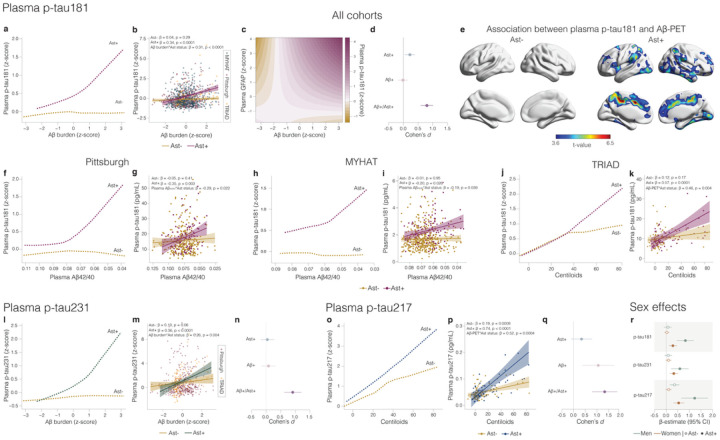
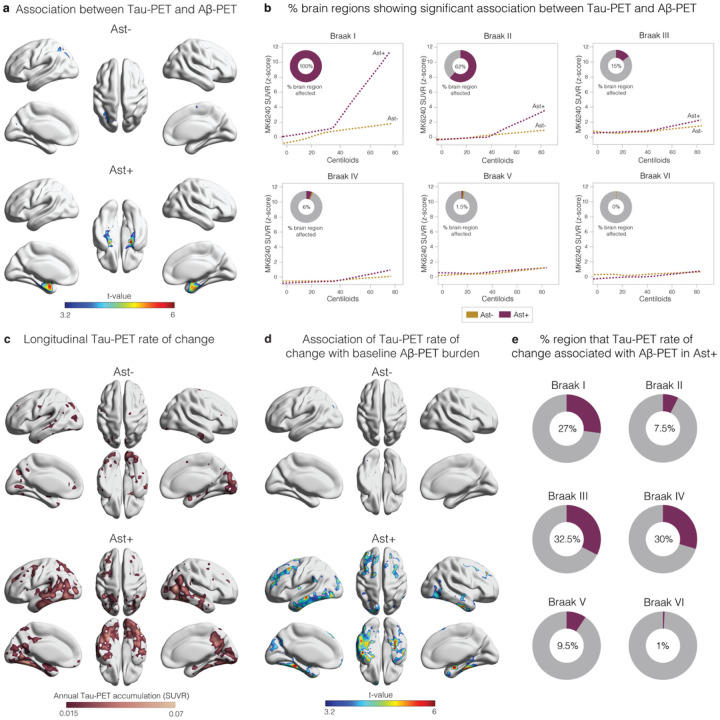
An unresolved question for the understanding of Alzheimer's disease (AD) pathophysiology is why a significant percentage of amyloid β (Aβ)-positive cognitively unimpaired (CU) individuals do not develop detectable downstream tau pathology and, consequently, clinical deterioration. evidence suggests that reactive astrocytes are key to unleashing Aβ effects in pathological tau phosphorylation. In a large study ( =1,016) across three cohorts, we tested whether astrocyte reactivity modulates the association of Aβ with plasma tau phosphorylation in CU people. We found that Aβ pathology was associated with increased plasma phosphorylated tau levels only in individuals positive for astrocyte reactivity (Ast+). Cross-sectional and longitudinal tau-PET analysis revealed that tau tangles accumulated as a function of Aβ burden only in CU Ast+ individuals with a topographic distribution compatible with early AD. Our findings suggest that increased astrocyte reactivity is an important upstream event linking Aβ burden with initial tau pathology which might have implications for the biological definition of preclinical AD and for selecting individuals for early preventive clinical trials.
在理解阿尔茨海默病(AD)病理生理学方面,一个尚未解决的问题是,为什么相当一部分淀粉样β(Aβ)阳性的认知未受损(CU)个体没有出现可检测到的下游tau病理变化,因此也没有出现临床恶化。有证据表明,反应性星形胶质细胞是在病理性tau磷酸化过程中释放Aβ效应的关键因素。在一项针对三个队列的大型研究(n = 1016)中,我们测试了星形胶质细胞反应性是否调节CU个体中Aβ与血浆tau磷酸化之间的关联。我们发现,仅在星形胶质细胞反应性阳性(Ast+)的个体中,Aβ病理与血浆磷酸化tau水平升高相关。横断面和纵向tau-PET分析显示,仅在具有与早期AD相符的地形分布的CU Ast+个体中,tau缠结随着Aβ负担的增加而累积。我们的研究结果表明,星形胶质细胞反应性增加是将Aβ负担与初始tau病理联系起来的重要上游事件,这可能对临床前AD的生物学定义以及为早期预防性临床试验选择个体具有重要意义。