Song Janet, Okano Justin T, Ponce Joan, Busang Lesego, Seipone Khumo, Valdano Eugenio, Blower Sally
Center for Biomedical Modeling, Department of Psychiatry and Biobehavioral Sciences, Semel Institute for Neuroscience and Human Behavior, David Geffen School of Medicine, University of California, Los Angeles, CA 90095.
The African Comprehensive HIV/AIDS Partnerships (ACHAP), Gaborone, Botswana.
medRxiv. 2023 Feb 2:2023.02.01.23285339. doi: 10.1101/2023.02.01.23285339.
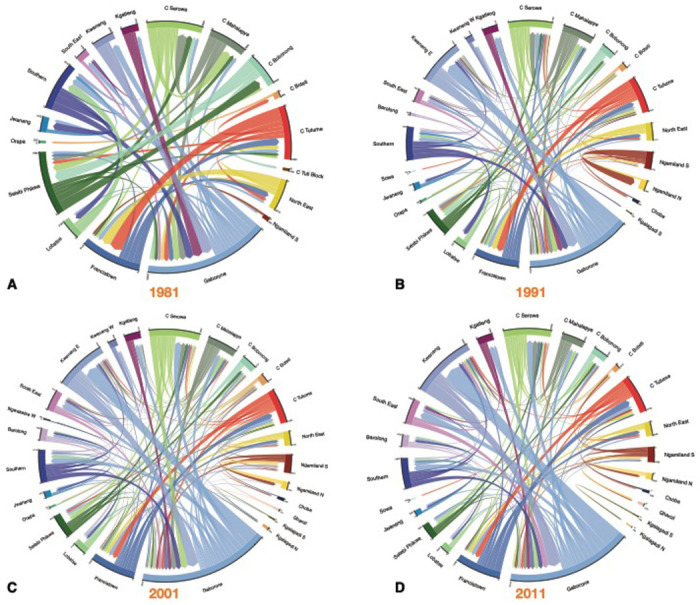
The majority of people with HIV live in sub-Saharan Africa, where HIV epidemics are generalized. For these epidemics to develop, populations need to be mobile. However, population-level mobility has not yet been studied in the context of the development of generalized HIV epidemics. Here we do so by studying historical migration data from Botswana which has one of the most severe generalized HIV epidemics worldwide; in 2021, HIV prevalence was 21%. The country reported its first AIDS case in 1985 when it began to rapidly urbanize. We hypothesize that, during the development of Botswana's epidemic, the population was highly mobile and there were substantial urban-to-rural and rural-to-urban migratory flows. We test this hypothesis by conducting a network analysis using a historical time series (1981 to 2011) of micro-census data from Botswana. We found 10% of the population moved their residency annually, complex migration networks connected urban with rural areas, and there were very high rates of rural-to-urban migration. Notably, we also found mining towns were both important in-flow and out-flow migration hubs; consequently, there was a very high turnover of residents in towns. Our results support our hypothesis, and together, provide one explanation for the development of Botswana's generalized epidemic.
大多数艾滋病毒感染者生活在撒哈拉以南非洲地区,该地区的艾滋病毒疫情呈普遍流行态势。要使这些疫情发展,人口需要具备流动性。然而,在普遍流行的艾滋病毒疫情发展背景下,尚未对人口层面的流动性进行研究。在此,我们通过研究博茨瓦纳的历史移民数据来开展此项研究,该国是全球艾滋病毒疫情最严重的国家之一;2021年,艾滋病毒感染率为21%。该国于1985年报告首例艾滋病病例,当时它开始迅速城市化。我们假设,在博茨瓦纳疫情发展期间,人口流动性很高,存在大量的城乡之间和乡城之间的迁徙流动。我们通过使用博茨瓦纳微观人口普查数据的历史时间序列(1981年至2011年)进行网络分析来检验这一假设。我们发现,每年有10%的人口迁移居住地,复杂的移民网络连接着城乡地区,乡城迁移率非常高。值得注意的是,我们还发现矿业城镇既是重要的流入型也是流出型移民枢纽;因此,城镇居民的更替率非常高。我们的结果支持了我们的假设,共同为博茨瓦纳普遍流行疫情的发展提供了一种解释。