Rubene Diana, Low Matthew, Brodin Anders
Department of Crop Production Ecology, Swedish University of Agricultural Sciences, Uppsala, Sweden.
Department of Ecology, Swedish University of Agricultural Sciences, Uppsala, Sweden.
R Soc Open Sci. 2023 Feb 8;10(2):221336. doi: 10.1098/rsos.221336. eCollection 2023 Feb.
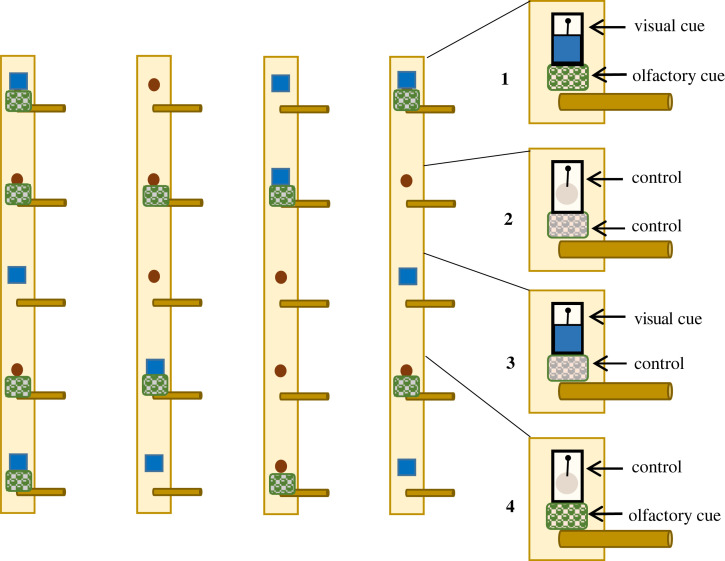
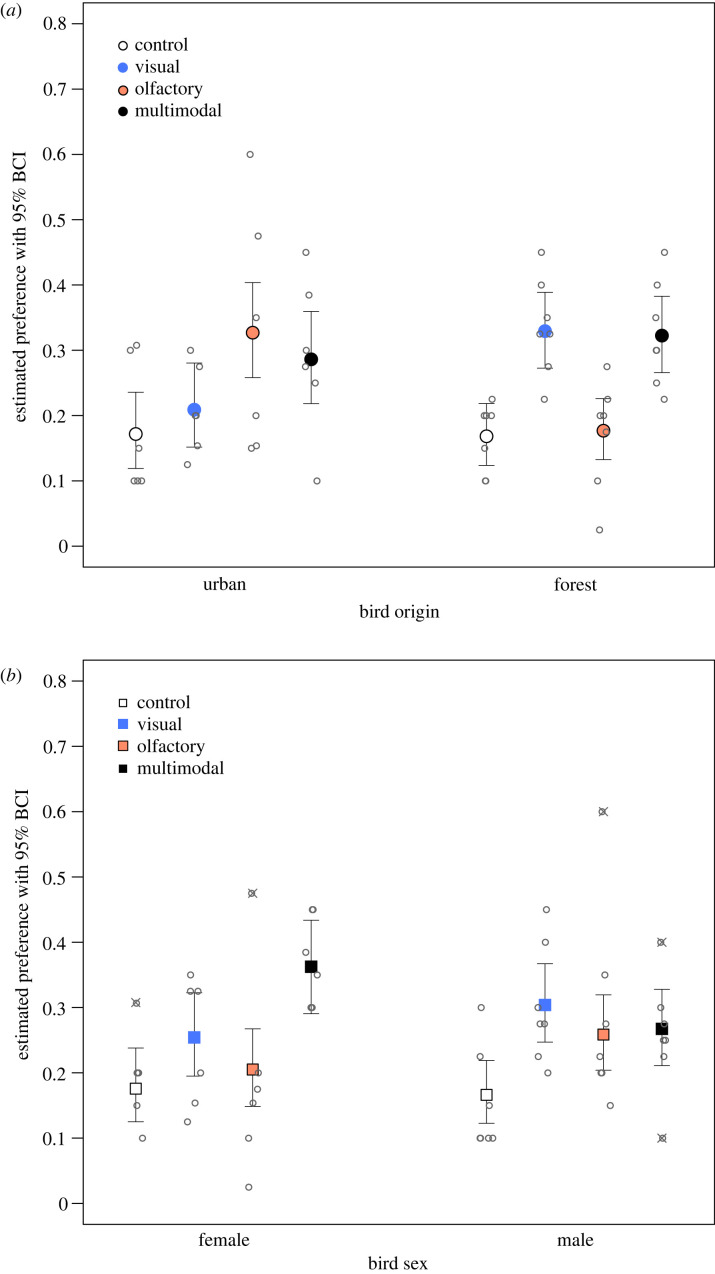
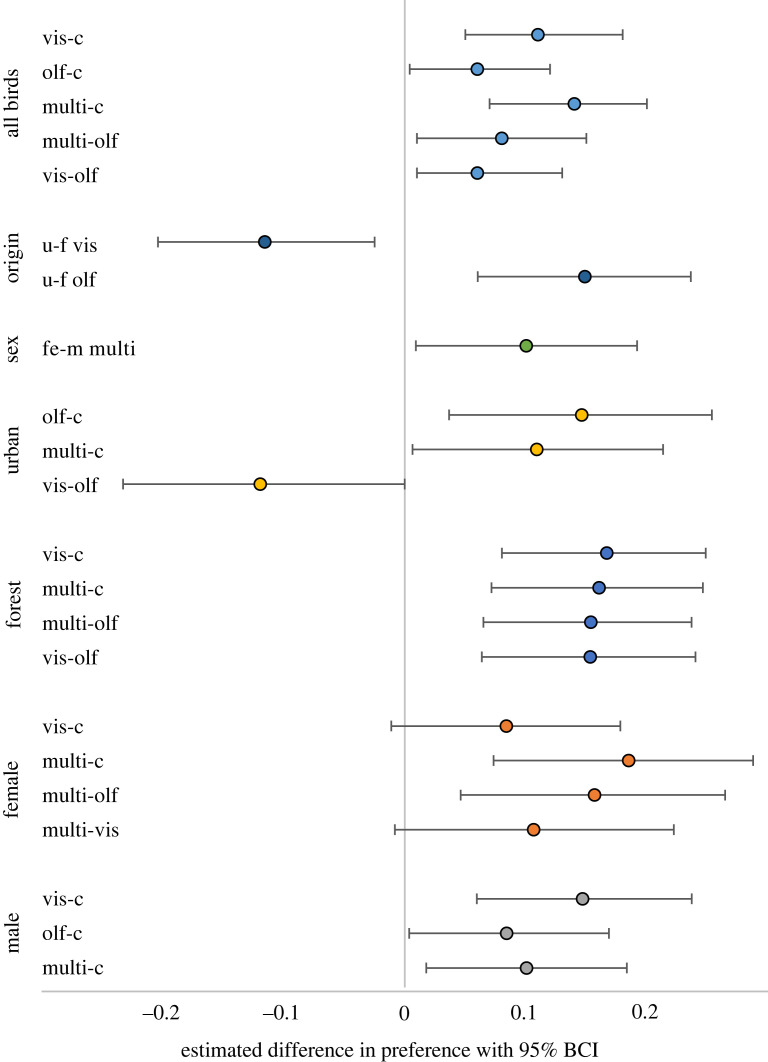
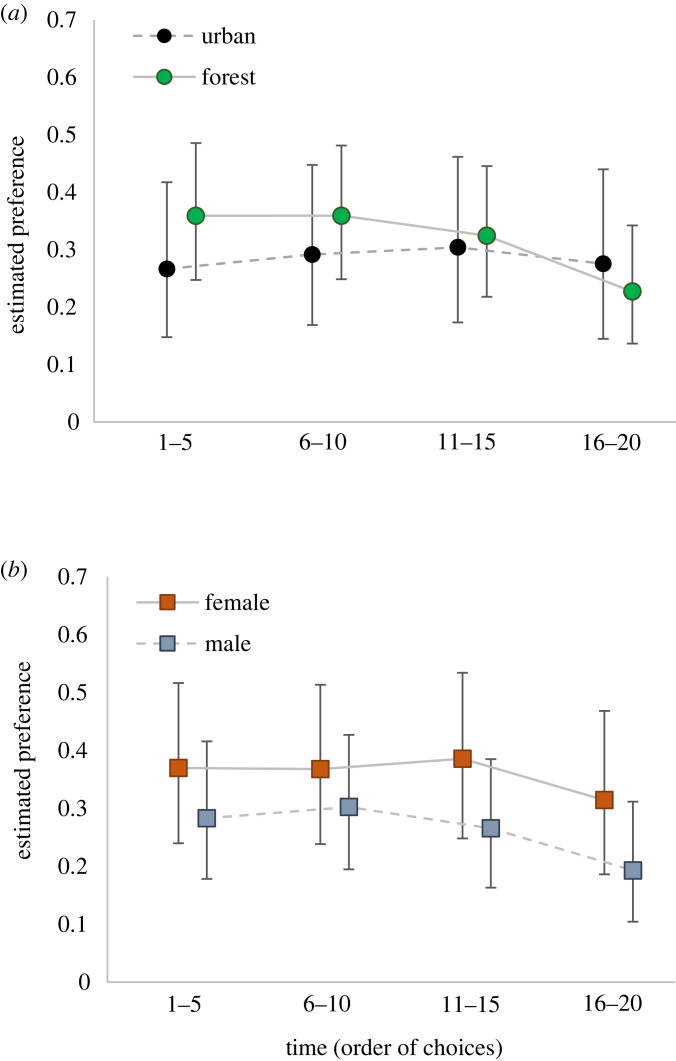
Animals interpret their environment by combining information from multiple senses. The relative usefulness of different senses may vary between species, habitats and sexes; yet, how multimodal stimuli are integrated and prioritized is unknown for most taxa. We experimentally assessed foraging preferences of great tits () to test whether urban and forest individuals prioritize visual and olfactory cues differently during foraging. We trained 13 wild-caught birds to associate multimodal (colour + odour) cues with a food reward and assessed their foraging preferences in a cue-separation test. In this, the birds could choose between the multimodal training cue and its olfactory or visual components. Our results suggest that the birds did not perceive multimodal cues in an integrated way, as their response was not stronger than for unimodal cue components. Urban birds preferred olfactory cues, while forest birds preferred visual cues. Nevertheless, female birds preferred the multimodal cue, while males foraged more randomly with respect to which cue was present. These findings contribute to our understanding of the relative roles of vision and olfaction in bird foraging behaviour. Future work should focus on how habitat- and sex-specific sensory prioritization modifies bird foraging behaviour and foraging success in the context of urban adaptations across populations.
动物通过整合来自多种感官的信息来解读它们的环境。不同感官的相对有用性可能因物种、栖息地和性别而异;然而,对于大多数分类群来说,多模态刺激是如何整合和排序的尚不清楚。我们通过实验评估了大山雀()的觅食偏好,以测试城市和森林中的个体在觅食过程中是否对视觉和嗅觉线索有不同的优先级。我们训练了13只野生捕获的鸟类,使其将多模态(颜色+气味)线索与食物奖励联系起来,并在线索分离测试中评估它们的觅食偏好。在这个测试中,鸟类可以在多模态训练线索及其嗅觉或视觉成分之间进行选择。我们的结果表明,鸟类并没有以整合的方式感知多模态线索,因为它们的反应并不比单模态线索成分更强。城市鸟类更喜欢嗅觉线索,而森林鸟类更喜欢视觉线索。然而,雌鸟更喜欢多模态线索,而雄鸟在有哪种线索存在时觅食更随机。这些发现有助于我们理解视觉和嗅觉在鸟类觅食行为中的相对作用。未来的工作应关注栖息地和性别特异性感官优先级如何在种群适应城市的背景下改变鸟类的觅食行为和觅食成功率。