INSERM, UMR 1287, Gustave Roussy, Université Paris Saclay, Villejuif France, Equipe labellisée Ligue Nationale contre le Cancer; Ecole Doctorale Hematopoïèse, Oncogénèse et Biothérapie, Université Paris Diderot, Université Sorbonne Paris Cité, Paris.
INSERM, UMR 1287, Gustave Roussy, Université Paris Saclay, Villejuif France, Equipe labellisée Ligue Nationale contre le Cancer.
Haematologica. 2023 Aug 1;108(8):2130-2145. doi: 10.3324/haematol.2022.282049.
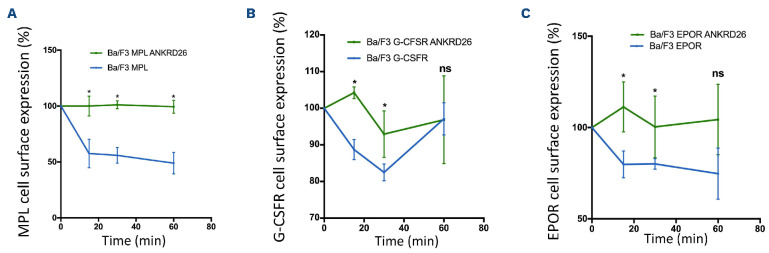
Sustained ANKRD26 expression associated with germline ANKRD26 mutations causes thrombocytopenia 2 (THC2), an inherited platelet disorder associated with a predisposition to leukemia. Some patients also present with erythrocytosis and/or leukocytosis. Using multiple human-relevant in vitro models (cell lines, primary patients' cells and patient-derived induced pluripotent stem cells) we demonstrate for the first time that ANKRD26 is expressed during the early steps of erythroid, megakaryocyte and granulocyte differentiation, and is necessary for progenitor cell proliferation. As differentiation progresses, ANKRD26 expression is progressively silenced, to complete the cellular maturation of the three myeloid lineages. In primary cells, abnormal ANKRD26 expression in committed progenitors directly affects the proliferation/differentiation balance for the three cell types. We show that ANKRD26 interacts with and crucially modulates the activity of MPL, EPOR and G-CSFR, three homodimeric type I cytokine receptors that regulate blood cell production. Higher than normal levels of ANKRD26 prevent the receptor internalization that leads to increased signaling and cytokine hypersensitivity. These findings afford evidence how ANKRD26 overexpression or the absence of its silencing during differentiation is responsible for myeloid blood cell abnormalities in patients with THC2.
ANKRD26 的持续表达与种系 ANKRD26 突变有关,导致血小板减少症 2 (THC2),这是一种与白血病易感性相关的遗传性血小板疾病。一些患者还表现出红细胞增多症和/或白细胞增多症。我们使用多种人类相关的体外模型(细胞系、原发性患者细胞和患者来源的诱导多能干细胞)首次证明,ANKRD26 在红细胞、巨核细胞和粒细胞分化的早期阶段表达,并对祖细胞增殖是必需的。随着分化的进行,ANKRD26 的表达逐渐沉默,以完成三种骨髓谱系的细胞成熟。在原代细胞中,定向祖细胞中异常的 ANKRD26 表达直接影响三种细胞类型的增殖/分化平衡。我们表明,ANKRD26 与 MPL、EPOR 和 G-CSFR 相互作用,并对其活性进行关键调节,MPL、EPOR 和 G-CSFR 是三种调节血细胞生成的同源二聚体 I 型细胞因子受体。高于正常水平的 ANKRD26 阻止了导致信号增强和细胞因子超敏反应的受体内化。这些发现提供了证据,证明 ANKRD26 过表达或在分化过程中缺乏沉默是 THC2 患者骨髓血细胞异常的原因。