School of Earth Sciences, Life Sciences Building, University of Bristol, Tyndall Avenue, Bristol, BS8 1TQ, UK.
Key Laboratory for the Evolutionary Systematics of Vertebrates, Institute of Vertebrate Paleontology and Paleoanthropology, Chinese Academy of Sciences, Beijing, 100044, China.
Commun Biol. 2023 Feb 16;6(1):181. doi: 10.1038/s42003-023-04552-4.
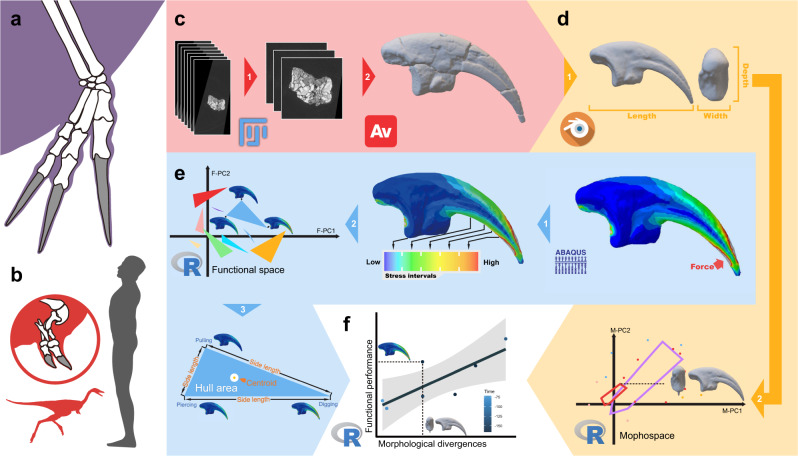
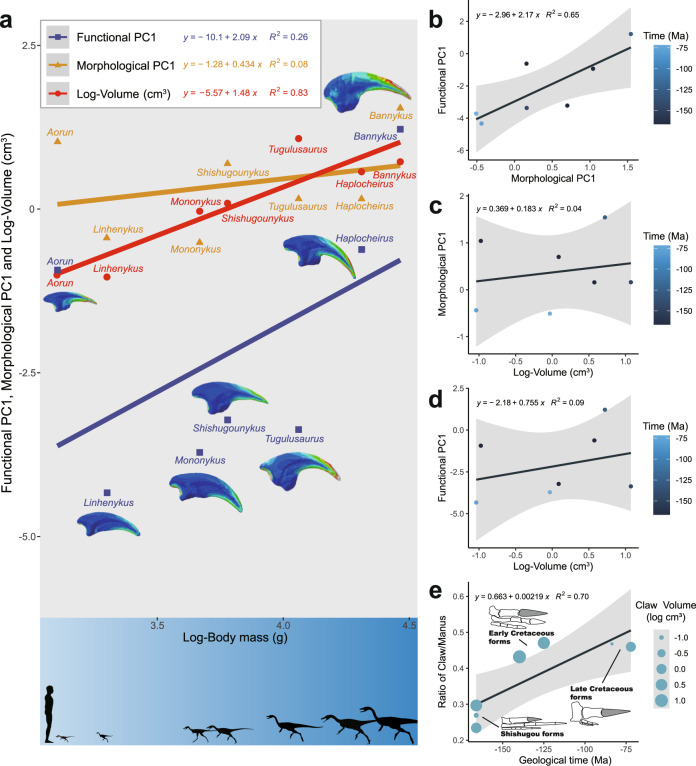
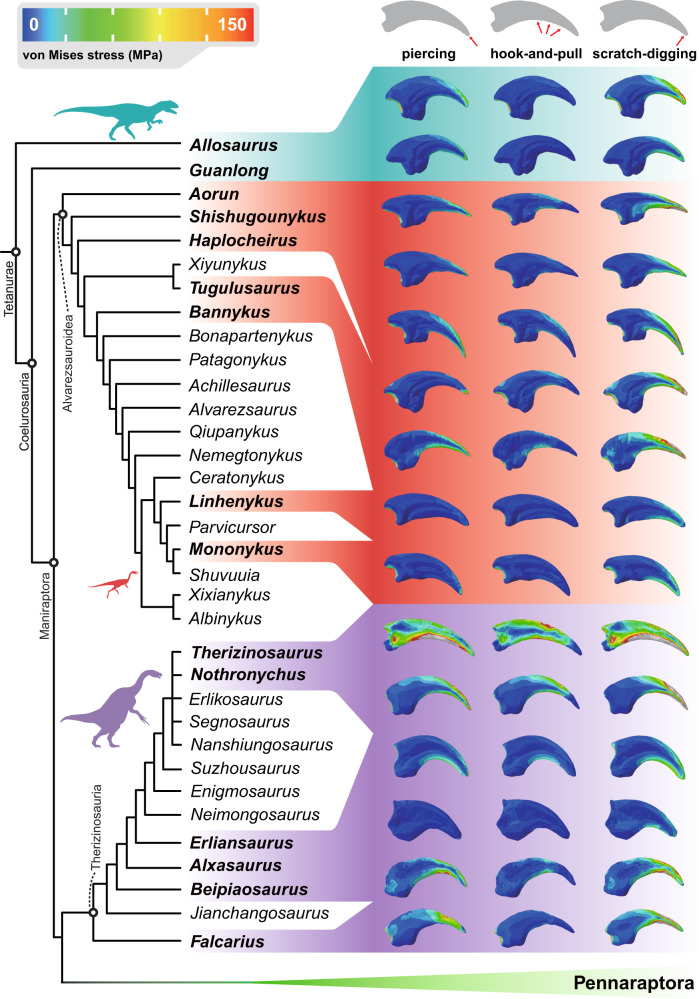
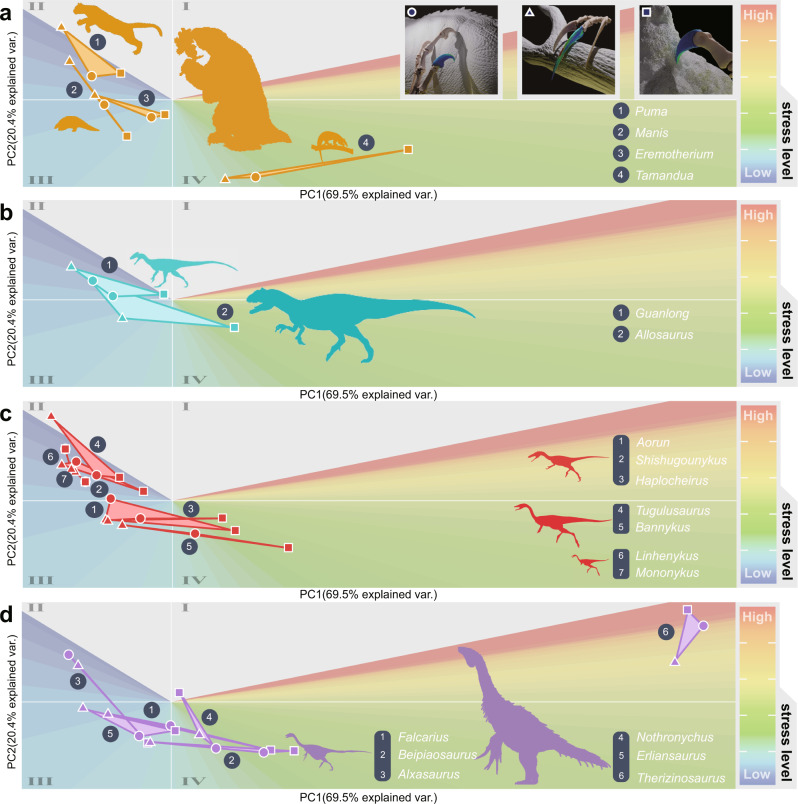
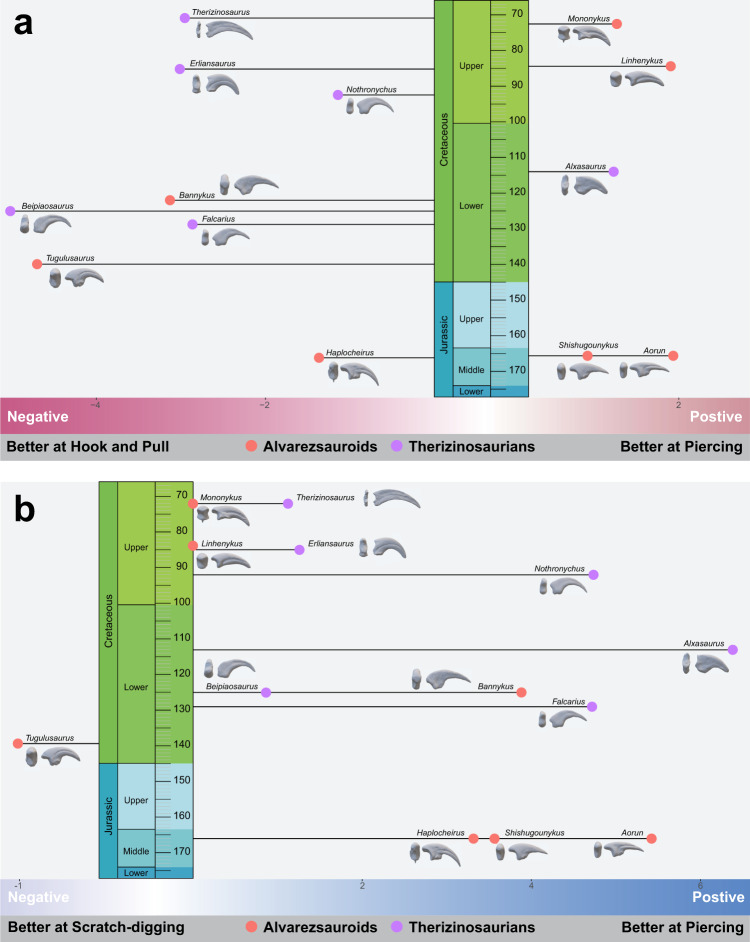
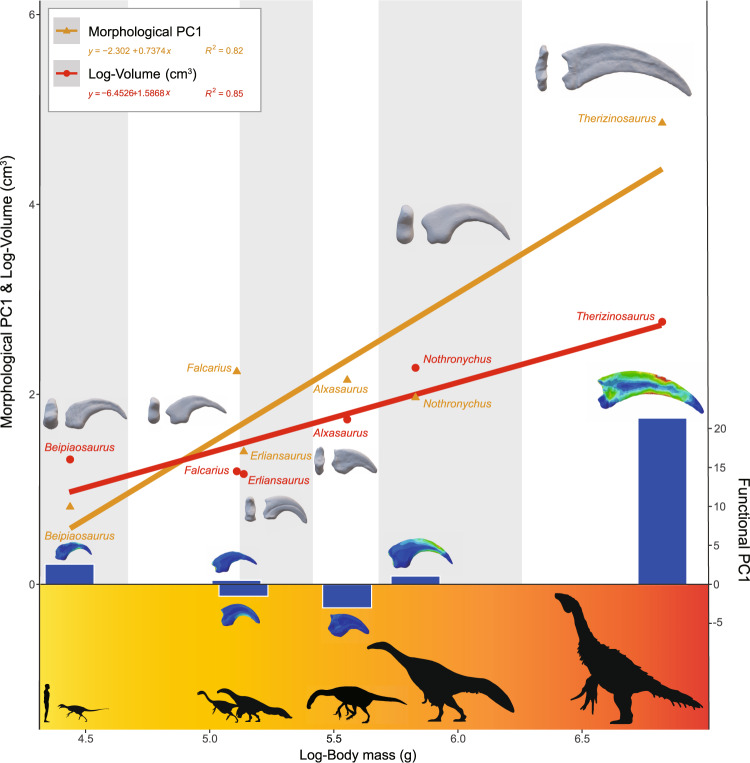
Maniraptoran dinosaurs include the ancestors of birds, and most used their hands for grasping and in flight, but early-branching maniraptorans had extraordinary claws of mysterious function. Alvarezsauroids had short, strong arms and hands with a stout, rock-pick-like, single functional finger. Therizinosaurians had elongate fingers with slender and sickle-like unguals, sometimes over one metre long. Here we develop a comprehensive methodological framework to investigate what the functions of these most bizarre bony claws are and how they formed. Our analysis includes finite element analysis and a newly established functional-space analysis and also involves shape and size effects in an assessment of function and evolution. We find a distinct functional divergence among manual unguals of early-branching maniraptorans, and we identify a complex relationship between their structural strength, morphological specialisations, and size changes. Our analysis reveals that efficient digging capabilities only emerged in late-branching alvarezsauroid forelimbs, rejecting the hypothesis of functional vestigial structures like T. rex. Our results also support the statement that most therizinosaurians were herbivores. However, the bizarre, huge Therizinosaurus had sickle-like unguals of such length that no mechanical function has been identified; we suggest they were decorative and lengthened by peramorphic growth linked to increased body size.
手兽脚亚目恐龙包括鸟类的祖先,它们大多用前肢抓握和飞行,但早期分支的手兽脚亚目恐龙拥有功能神秘的非凡爪子。阿瓦拉慈龙类具有短而强壮的手臂和手部,有一个粗壮的、像用来挑石头的、单一功能的手指。镰刀龙类的手指细长,带有像镰刀一样的爪子,有时长达一米以上。在这里,我们开发了一个全面的方法框架来研究这些最奇特的骨爪的功能以及它们是如何形成的。我们的分析包括有限元分析和新建立的功能空间分析,还涉及在评估功能和进化时的形状和大小效应。我们在手兽脚亚目早期分支的手部爪子中发现了明显的功能分化,并且确定了它们的结构强度、形态特化和大小变化之间的复杂关系。我们的分析表明,高效挖掘能力仅出现在晚期分支的阿瓦拉慈龙类前肢中,从而否定了功能退化结构的假说,如霸王龙。我们的结果还支持大多数镰刀龙类是草食动物的说法。然而,奇怪的、巨大的镰刀龙的爪子长得如此之长,以至于还没有确定其机械功能;我们推测它们是装饰性的,并且通过与体型增大相关的变态生长而变长。