Université Lyon, Université Claude Bernard Lyon 1, Faculté de Médecine Lyon-Sud, EA UCBL/HCL 3738 CICLY, Lyon, France.
University of Washington, Seattle, WA, USA.
EBioMedicine. 2023 Mar;89:104477. doi: 10.1016/j.ebiom.2023.104477. Epub 2023 Feb 16.
PARP inhibitors (PARPi) have revolutionized the management of advanced ovarian carcinoma, and were investigated as forefront treatment in recurrent disease. The objective was to explore if mathematical modeling of the early longitudinal CA-125 kinetics could be used as a pragmatic indicator of the subsequent rucaparib efficacy, like it is for platinum-based chemotherapy.
The datasets of ARIEL2 and Study 10 involving recurrent HGOC patients treated with rucaparib were retrospectively investigated. The same strategy as those successfully developed for platinum chemotherapy, based on CA-125 ELIMination rate constant K (KELIM™), was implemented. Individual values of rucaparib-adjusted KELIM (KELIM-PARP) were estimated based on the longitudinal CA-125 kinetics during the first 100 treatment days, and then scored as favorable (KELIM-PARP ≥1.0) or unfavorable (KELIM-PARP <1.0). The prognostic value of KELIM-PARP regarding treatment efficacy (radiological response, and progression-free survival (PFS)) was assessed using univariable/multivariable analyses, with respect to platinum-sensitivity and homologous recombination deficiency (HRD) status.
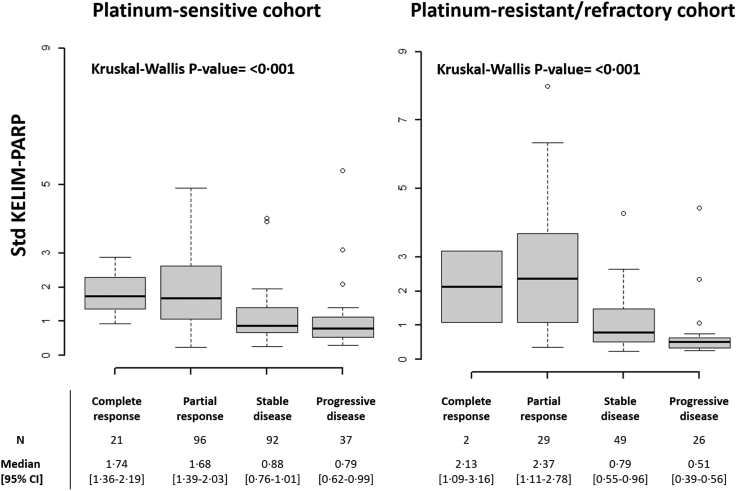
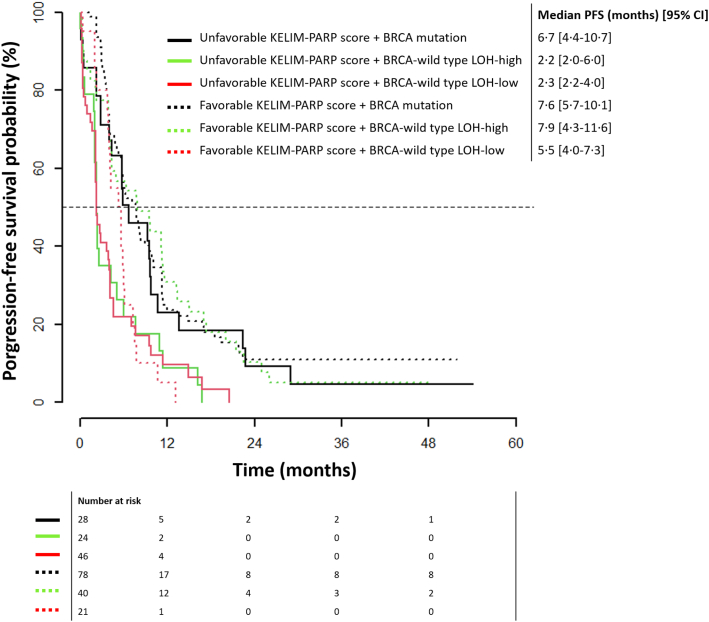
The data from 476 patients were assessed. The CA-125 longitudinal kinetics during the first 100-treatment days could be accurately assessed using the KELIM-PARP model. In patients with platinum-sensitive diseases, BRCA mutational status KELIM-PARP score and were associated with subsequent complete/partial radiological responses (KELIM-PARP: odds-ratio = 2.81, 95% CI 1.86-4.52), and PFS (KELIM-PARP: hazard-ratio = 0.67, 95% CI 0.50-0.91). The patients with BRCA-wild type cancer and favorable KELIM-PARP experienced long PFS with rucaparib regardless of HRD. In platinum-resistant disease patients, KELIM-PARP was associated with subsequent radiological response (odds-ratio = 2.80, 95% CI 1.82-4.72).
This proof-of-concept study confirms the early CA-125 longitudinal kinetics during rucaparib in recurrent HGOC patients are assessable by mathematical modeling, to generate individual a KELIM-PARP score associated with the subsequent efficacy. This pragmatic strategy might be useful for selecting the patients for PARPi-based combination regimens, when identifying efficacy biomarker is challenging. Further assessment of this hypothesis is warranted.
The present study was supported by Clovis Oncology with a grant to academic research association.
PARP 抑制剂(PARPi)彻底改变了晚期卵巢癌的治疗方式,并且被研究作为复发性疾病的前沿治疗方法。本研究旨在探索早期 CA-125 动力学的数学模型是否可以像铂类化疗一样,作为鲁卡帕利后续疗效的实用指标。
回顾性分析了 ARIEL2 和研究 10 中接受鲁卡帕利治疗的复发性 HGOC 患者的数据。基于 CA-125 消除率常数 K(KELIM™),我们成功开发了适用于铂类化疗的相同策略。根据前 100 天治疗期间的 CA-125 纵向动力学,估算鲁卡帕利调整后的 KELIM(KELIM-PARP)的个体值,然后将其评分分为有利(KELIM-PARP≥1.0)或不利(KELIM-PARP<1.0)。使用单变量/多变量分析,根据铂类敏感性和同源重组缺陷(HRD)状态,评估 KELIM-PARP 与治疗效果(影像学反应和无进展生存期(PFS))之间的预后价值。
对 476 名患者的数据进行了评估。使用 KELIM-PARP 模型可以准确评估前 100 天治疗期间的 CA-125 纵向动力学。在铂类敏感疾病患者中,BRCA 突变状态 KELIM-PARP 评分与随后的完全/部分影像学反应(KELIM-PARP:比值比=2.81,95%CI 1.86-4.52)和 PFS(KELIM-PARP:风险比=0.67,95%CI 0.50-0.91)相关。BRCA 野生型癌症且 KELIM-PARP 有利的患者,无论 HRD 状态如何,均能长期接受鲁卡帕利治疗。在铂类耐药疾病患者中,KELIM-PARP 与随后的影像学反应相关(比值比=2.80,95%CI 1.82-4.72)。
本概念验证研究证实,复发性 HGOC 患者在接受鲁卡帕利治疗期间,早期 CA-125 纵向动力学可以通过数学建模进行评估,从而生成与后续疗效相关的个体 KELIM-PARP 评分。这种实用的策略可能有助于选择接受 PARPi 联合治疗方案的患者,当识别疗效生物标志物具有挑战性时。需要进一步评估这一假设。
本研究由 Clovis Oncology 提供资金支持,用于学术研究协会的研究项目。