From the University of Pennsylvania Perelman School of Medicine.
Botswana-Harvard AIDS Institute Partnership.
Epidemiology. 2023 May 1;34(3):430-438. doi: 10.1097/EDE.0000000000001601. Epub 2023 Feb 20.
Randomized trials in pregnancy are extremely challenging, and observational studies are often the only option to evaluate medication safety during pregnancy. However, such studies are often susceptible to immortal time bias if treatment initiation occurs after time zero of follow-up. We describe how emulating a sequence of target trials avoids immortal time bias and apply the approach to estimate the safety of antibiotic initiation between 24 and 37 weeks gestation on preterm delivery.
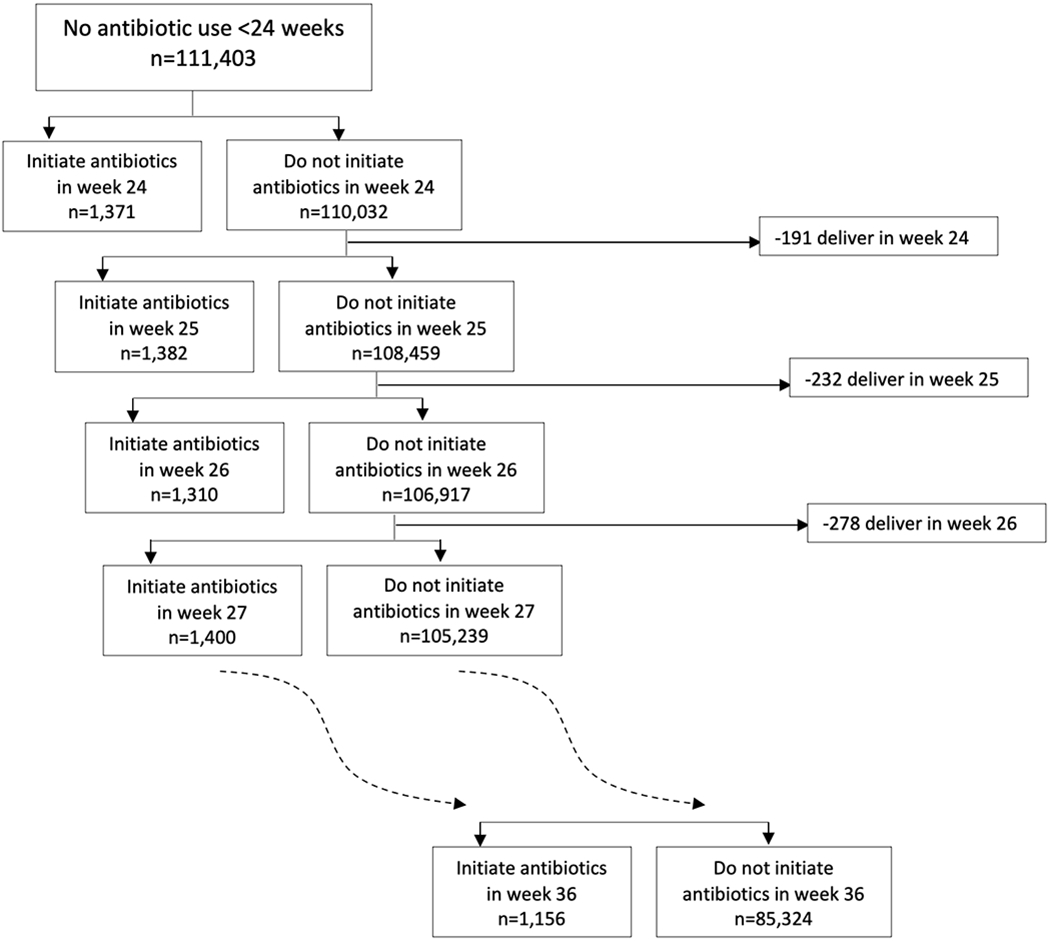
The Tsepamo Study captured birth outcomes at hospitals throughout Botswana from 2014 to 2021. We emulated 13 sequential target trials of antibiotic initiation versus no initiation among individuals presenting to care <24 weeks, one for each week from 24 to 37 weeks. For each trial, eligible individuals had not previously initiated antibiotics. We also conducted an analysis susceptible to immortal time bias by defining time zero as 24 weeks and exposure as antibiotic initiation between 24 and 37 weeks. We calculated adjusted risk ratios (RR) and 95% confidence intervals (CI) for preterm delivery.
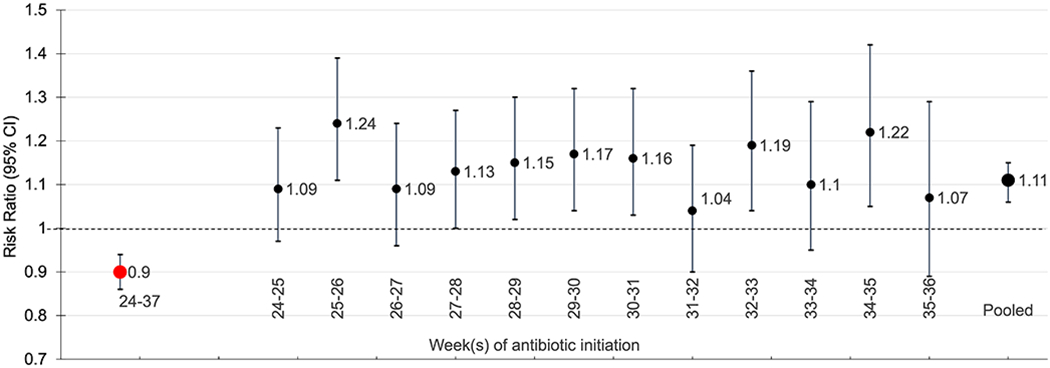
Of 111,403 eligible individuals, 17,009 (15.3%) initiated antibiotics between 24 and 37 weeks. In the sequence of target trials, RRs (95% CIs) ranged from 1.04 (0.90, 1.19) to 1.24 (1.11, 1.39) (pooled RR: 1.11 [1.06, 1.15]). In the analysis susceptible to immortal time bias, the RR was 0.90 (0.86, 0.94).
Defining exposure as antibiotic initiation at any time during follow-up after time zero resulted in substantial immortal time bias, making antibiotics appear protective against preterm delivery. Conducting a sequence of target trials can avoid immortal time bias in pregnancy studies.
在妊娠期间进行随机试验极具挑战性,而观察性研究通常是评估妊娠期间药物安全性的唯一选择。然而,如果治疗起始发生在随访时间零点之后,此类研究往往容易受到不朽时间偏倚的影响。我们描述了如何模拟一系列目标试验来避免不朽时间偏倚,并应用该方法估计在 24 至 37 孕周之间开始使用抗生素与早产的关系。
Tsepamo 研究于 2014 年至 2021 年在博茨瓦纳的各个医院中捕获了分娩结局。我们模拟了 13 项在 24 周之前就诊的个体中开始使用抗生素与不使用抗生素的目标试验,每周一项,从 24 周到 37 周。对于每个试验,合格的个体之前没有使用过抗生素。我们还通过将时间零点定义为 24 周,并将暴露定义为 24 至 37 周之间使用抗生素,进行了一项易受不朽时间偏倚影响的分析。我们计算了早产的调整风险比(RR)和 95%置信区间(CI)。
在 111403 名合格的个体中,有 17009 人(15.3%)在 24 至 37 周之间开始使用抗生素。在一系列目标试验中,RR(95%CI)范围为 1.04(0.90,1.19)至 1.24(1.11,1.39)(汇总 RR:1.11[1.06,1.15])。在易受不朽时间偏倚影响的分析中,RR 为 0.90(0.86,0.94)。
将暴露定义为在随访时间零点之后的任何时间开始使用抗生素,会导致大量不朽时间偏倚,使抗生素看起来对早产有保护作用。进行一系列目标试验可以避免妊娠研究中的不朽时间偏倚。