Huang Yanchao, Wang Meng, Jiang Li, Wang Lijuan, Chen Li, Wang Qiaoyu, Feng Jiatai, Wang Jingyi, Xu Wanbang, Wu Hubing, Han Yanjiang
Laboratory for Quality Control and Evaluation of Radiopharmaceuticals, Department of Nuclear Medicine, Nanfang Hospital, Southern Medical University, Guangzhou, China.
Central Research Institute, United Imaging Healthcare, Shanghai, China.
EJNMMI Phys. 2023 Feb 18;10(1):14. doi: 10.1186/s40658-023-00533-y.
Highly sensitive digital total-body PET/CT scanners (uEXPLORER) have great potential for clinical applications and fundamental research. Given their increasing sensitivity, low-dose scanning or snapshot imaging is now possible in clinics. However, a standardized total-body F-FDG PET/CT protocol is still lacking. Establishing a standard clinical protocol for total-body 18F-FDG PET/CT examination under different activity administration plans can help provide a theoretical reference for nuclear radiologists.
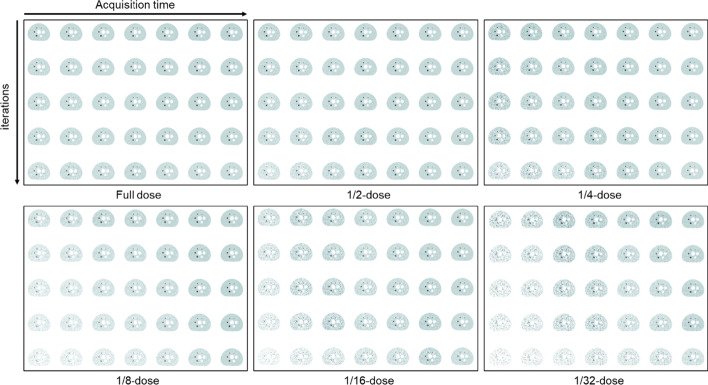
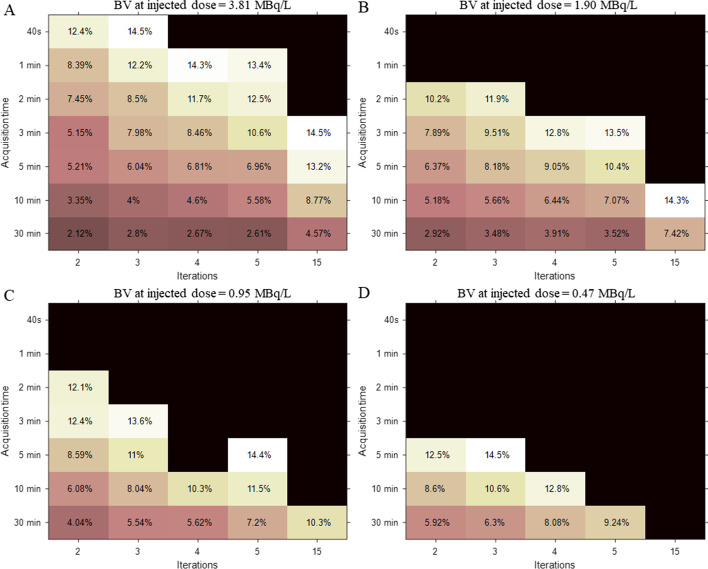
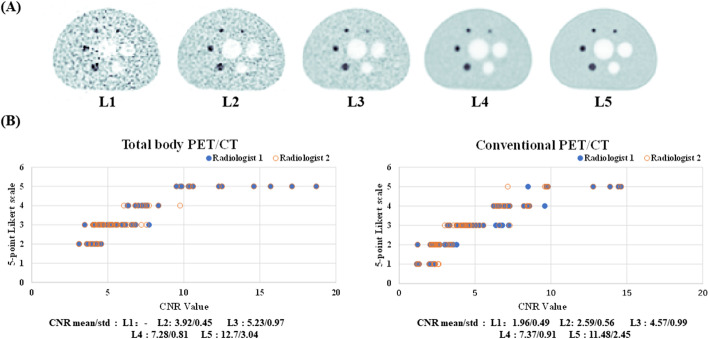
The NEMA image quality (IQ) phantom was used to evaluate the biases of various total-body F-FDG PET/CT protocols related to the administered activity, scan duration, and iterations. Several objective metrics, including contrast recovery (CR), background variability (BV), and contrast-to-noise ratio (CNR), were measured from different protocols. In line with the European Association of Nuclear Medicine Research Ltd. (EARL) guidelines, optimized protocols were suggested and evaluated for total-body F-FDG PET/CT imaging for three different injected activities.
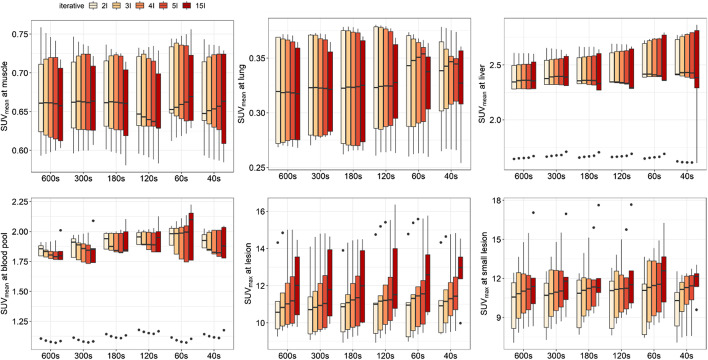
Our NEMA IQ phantom evaluation resulted in total-body PET/CT images with excellent contrast and low noise, suggesting great potential for reducing administered activity or shortening the scan duration. Different to the iteration number, prolonging the scan duration was the first choice for achieving higher image quality regardless of the activity administered. In light of image quality, tolerance of oncological patients, and the risk of ionizing radiation damage, the 3-min acquisition and 2-iteration (CNR = 7.54), 10-min acquisition and 3-iteration (CNR = 7.01), and 10-min acquisition and 2-iteration (CNR = 5.49) protocols were recommended for full-dose (3.70 MBq/kg), half-dose (1.95 MBq/kg), and quarter-dose (0.98 MBq/kg) activity injection schemes, respectively. Those protocols were applied in clinical practices, and no significant differences were observed for the SUV of large/small lesions or the SUV of different healthy organs/tissues.
These findings support that digital total-body PET/CT scanners can generate PET images with a high CNR and low-noise background, even with a short acquisition time and low administered activity. The proposed protocols for different administered activities were determined to be valid for clinical examination and can maximize the value of this imaging type.
高灵敏度数字全身PET/CT扫描仪(uEXPLORER)在临床应用和基础研究方面具有巨大潜力。鉴于其灵敏度不断提高,现在临床上可以进行低剂量扫描或快照成像。然而,仍然缺乏标准化的全身F-FDG PET/CT协议。制定不同给药方案下的全身18F-FDG PET/CT检查标准临床协议有助于为核放射科医生提供理论参考。
使用NEMA图像质量(IQ)体模评估各种全身F-FDG PET/CT协议在给药活度、扫描持续时间和迭代次数方面的偏差。从不同协议中测量了几个客观指标,包括对比度恢复(CR)、背景变异性(BV)和对比度噪声比(CNR)。根据欧洲核医学研究协会(EARL)指南,针对三种不同注射活度的全身F-FDG PET/CT成像提出并评估了优化协议。
我们的NEMA IQ体模评估产生了具有出色对比度和低噪声的全身PET/CT图像,表明在降低给药活度或缩短扫描持续时间方面具有巨大潜力。与迭代次数不同,无论给药活度如何,延长扫描持续时间是获得更高图像质量的首选。根据图像质量、肿瘤患者的耐受性和电离辐射损伤风险,对于全剂量(3.70 MBq/kg)、半剂量(1.95 MBq/kg)和四分之一剂量(0.98 MBq/kg)活度注射方案,分别推荐3分钟采集和2次迭代(CNR = 7.54)、10分钟采集和3次迭代(CNR = 7.01)以及10分钟采集和2次迭代(CNR = 5.49)协议。这些协议应用于临床实践,大/小病变的SUV或不同健康器官/组织的SUV未观察到显著差异。
这些发现支持数字全身PET/CT扫描仪即使在采集时间短和给药活度低的情况下也能生成具有高CNR和低噪声背景的PET图像。针对不同给药活度提出的协议被确定对临床检查有效,并且可以最大化这种成像类型的价值。