Yao Jun, Zhang Minlu, Zhang Xia, Zhang Junqing
Department of Endocrinology, Peking University First Hospital, Nov. 8 Xishiku Street, West City District, Beijing, 100034, China.
Sanofi, Shanghai, China.
Diabetes Ther. 2023 Apr;14(4):653-669. doi: 10.1007/s13300-023-01369-6. Epub 2023 Feb 21.
This analysis investigated the efficacy and safety of add-on lixisenatide by disease duration in Asian people with type 2 diabetes inadequately controlled with basal insulin ± oral antidiabetic drugs.
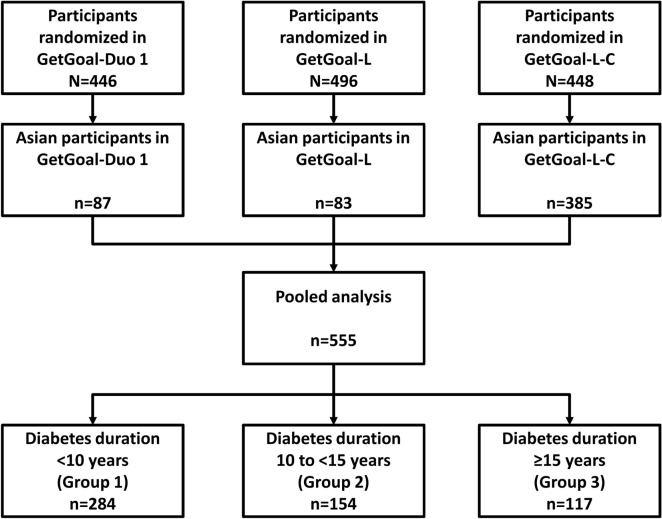
Data for Asian participants in the GetGoal-Duo 1, GetGoal-L, and GetGoal-L-C studies were pooled and categorized by diabetes duration: < 10 years (group 1), 10 to < 15 years (group 2), and ≥ 15 years (group 3). Efficacy and safety of lixisenatide versus placebo were evaluated by subgroup. The potential influence of diabetes duration on efficacy was examined using multivariable regression analyses.
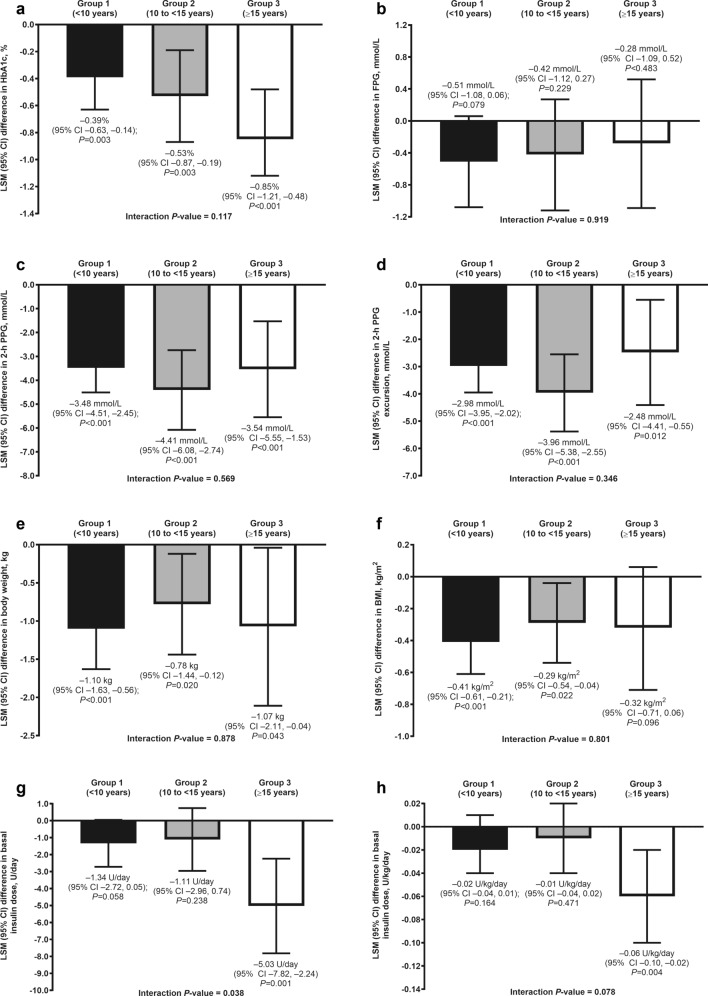
A total of 555 participants were included (mean age 53.9 years, 52.4% male). No significant differences in treatment effect between the duration subgroups were observed for the changes from baseline to 24 weeks in glycated hemoglobin (HbA1c), fasting plasma glucose (FPG), postprandial glucose (PPG), PPG excursion, body weight or body mass index, or the proportion of participants with HbA1c < 7% at 24 weeks (all P values for interaction > 0.1). Change in insulin dosage (U/day) was significantly different between subgroups (P = 0.038). Multivariable regression analysis showed participants in group 1 had a smaller change in body weight and basal insulin dose over the 24-week treatment period than participants in group 3 (P = 0.014 and 0.030, respectively) and were less likely to achieve an HbA1c < 7% than participants in group 2 (P = 0.047). No severe hypoglycemia was reported. A higher proportion of participants in group 3 versus the other groups had symptomatic hypoglycemia, for both lixisenatide and placebo, and T2D duration had a significant effect on hypoglycemia risk (P = 0.001).
Lixisenatide improved glycemic control in Asian individuals regardless of diabetes duration, without increasing the risk of hypoglycemia. Individuals with longer disease duration had a greater risk of symptomatic hypoglycemia than individuals with shorter disease duration regardless of treatment. No additional safety concerns were observed.
GetGoal-Duo 1, ClinicalTrials.gov record NCT00975286; GetGoal-L, ClinicalTrials.gov record NCT00715624; GetGoal-L-C, ClinicalTrials.gov record NCT01632163.
本分析研究了在基础胰岛素±口服降糖药治疗控制不佳的亚洲2型糖尿病患者中,按病程分组加用利司那肽的疗效和安全性。
汇总GetGoal-Duo 1、GetGoal-L和GetGoal-L-C研究中亚洲参与者的数据,并按糖尿病病程分类:<10年(第1组)、10至<15年(第2组)和≥15年(第3组)。通过亚组评估利司那肽与安慰剂的疗效和安全性。使用多变量回归分析检查糖尿病病程对疗效的潜在影响。
共纳入555名参与者(平均年龄53.9岁,52.4%为男性)。糖化血红蛋白(HbA1c)、空腹血糖(FPG)、餐后血糖(PPG)、PPG波动幅度、体重或体重指数从基线到24周的变化,以及24周时HbA1c<7%的参与者比例,在病程亚组之间未观察到治疗效果的显著差异(所有交互作用P值>0.1)。胰岛素剂量(单位/天)的变化在亚组之间有显著差异(P = 0.038)。多变量回归分析显示,在24周治疗期内,第1组参与者的体重和基础胰岛素剂量变化小于第3组参与者(分别为P = 0.014和0.030),且达到HbA1c<7%的可能性低于第2组参与者(P = 0.047)。未报告严重低血糖事件。与其他组相比,第3组中无论使用利司那肽还是安慰剂,有症状低血糖的参与者比例更高,且2型糖尿病病程对低血糖风险有显著影响(P = 0.001)。
无论糖尿病病程长短,利司那肽均可改善亚洲个体的血糖控制,且不增加低血糖风险。无论接受何种治疗,病程较长的个体发生有症状低血糖的风险高于病程较短的个体。未观察到其他安全问题。
GetGoal-Duo 1,ClinicalTrials.gov记录号NCT00975286;GetGoal-L,ClinicalTrials.gov记录号NCT00715624;GetGoal-L-C,ClinicalTrials.gov记录号NCT01632163。