Faculty of Medicine, Jalan Hospital, Universiti Teknologi MARA, Selangor Branch, Sungai Buloh Campus, 47000, Sungai Buloh, Selangor, Malaysia.
Faculty of Dentistry, Jalan Hospital, Universiti Teknologi MARA, Selangor Branch, Sungai Buloh Campus, 47000, Sungai Buloh, Selangor, Malaysia.
Sci Rep. 2023 Feb 22;13(1):3108. doi: 10.1038/s41598-023-29925-x.
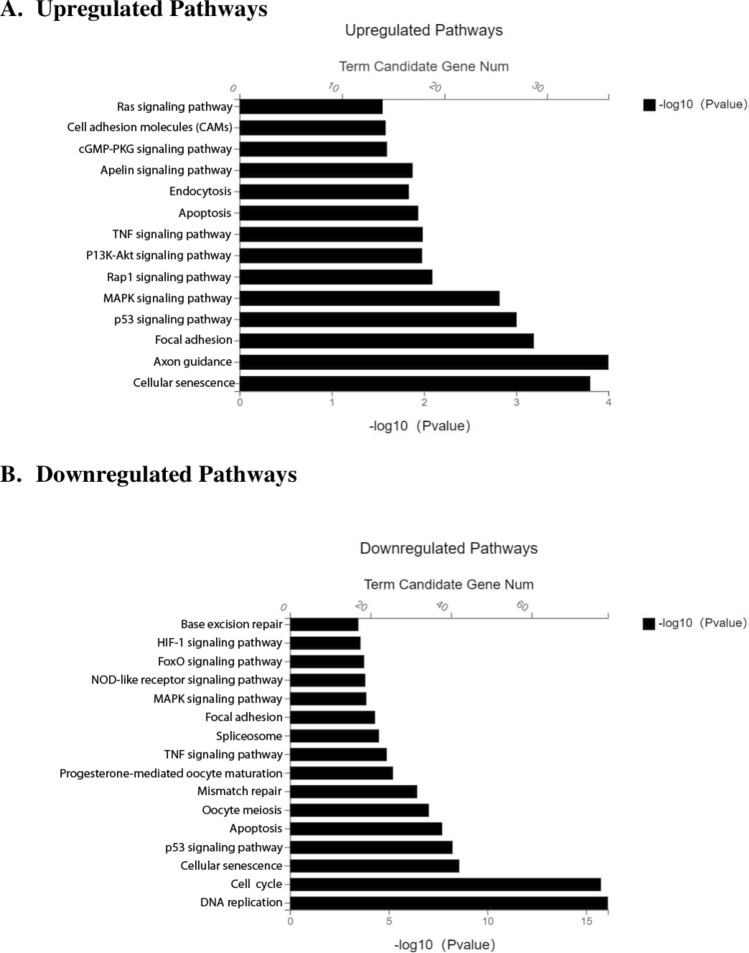
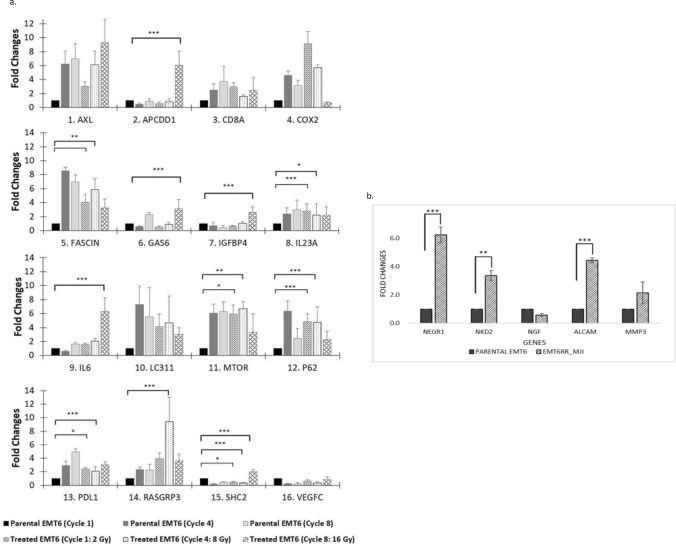
Cancer recurrence is often associated with the acquisition of radioresistance by cancer tissues due to failure in radiotherapy. The underlying mechanism leading to the development of acquired radioresistance in the EMT6 mouse mammary carcinoma cell line and the potential pathway involved was investigated by comparing differential gene expressions between parental and acquired radioresistance cells. EMT6 cell line was exposed to 2 Gy/per cycle of gamma-ray and the survival fraction between EMT6-treated and parental cells was compared. EMT6 (acquired radioresistance) cells was developed after 8 cycles of fractionated irradiation. The development of EMT6 cells was confirmed with further irradiation at different doses of gamma-ray, and both the survival fraction and migration rates were measured. Higher survival fraction and migration rates were obtained in EMT6 cells after exposure to 4 Gy and 8 Gy gamma-ray irradiations compared to their parental cells. Gene expression between EMT6 and parental cells was compared, and 16 genes identified to possess more than tenfold changes were selected and validated using RT-PCR. Out of these genes, 5 were significantly up-regulated i.e., IL-6, PDL-1, AXL, GAS6 and APCDD1. Based on pathway analysis software, the development of acquired radioresistance in EMT6 was hypothesized through JAK/STAT/PI3K pathway. Presently, CTLA-4 and PD-1 were determined to be associated with JAK/STAT/PI3K pathway, where both their expressions were significantly increased in EMT6 compared to parental cells in the 1st, 4th and 8th cycle of radiation. As a conclusion, the current findings provided a mechanistic platform for the development of acquired radioresistance in EMT6 through overexpression of CTLA-4 and PD-1, and novel knowledge on therapeutic targets for recurrent radioresistant cancers.
癌症复发通常与癌症组织因放射治疗失败而获得放射抗性有关。通过比较亲本细胞和获得性放射抗性细胞之间的差异基因表达,研究了 EMT6 小鼠乳腺癌细胞系中获得性放射抗性发展的潜在机制及其潜在途径。EMT6 细胞系接受 2Gy/周期的γ射线照射,比较 EMT6 处理细胞与亲本细胞的存活分数。在 8 个分次照射周期后开发了 EMT6(获得性放射抗性)细胞。通过在不同剂量的γ射线下进一步照射来确认 EMT6 细胞的发展,并且测量了存活分数和迁移率。与亲本细胞相比,EMT6 细胞在暴露于 4Gy 和 8Gy γ射线照射后获得了更高的存活分数和迁移率。比较 EMT6 和亲本细胞之间的基因表达,选择并使用 RT-PCR 验证了具有十倍以上变化的 16 个基因。在这些基因中,有 5 个基因显著上调,即 IL-6、PDL-1、AXL、GAS6 和 APCDD1。基于途径分析软件,假设 EMT6 中获得性放射抗性的发展是通过 JAK/STAT/PI3K 途径。目前,CTLA-4 和 PD-1 被确定与 JAK/STAT/PI3K 途径相关,在第 1、4 和 8 个辐射周期中,与亲本细胞相比,EMT6 中这两种基因的表达均显著增加。总之,目前的研究结果为 EMT6 通过 CTLA-4 和 PD-1 的过度表达获得性放射抗性的发展提供了一个机制平台,并为复发性放射抗性癌症的治疗靶点提供了新的知识。