Jiang Bo, Qi Junyuan, Sun Mingyuan, Zheng Weiwei, Wei Yongyue, Wang Jianxiang, Zhang Fengkui
State Key Laboratory of Experimental Hematology, National Clinical Research Center for Blood Diseases, Institute of Hematology, Chinese Academy of Medical Sciences, Tianjin, China.
Department of Biostatistics, School of Public Health, Nanjing Medical University, Nanjing, China.
Front Oncol. 2023 Feb 6;13:1101738. doi: 10.3389/fonc.2023.1101738. eCollection 2023.
Flumatinib is a novel, oral breakpoint cluster region-abelson (BCR-ABL) tyrosine kinase inhibitor that has demonstrated manageable safety and promising efficacy in patients with newly diagnosed chronic phase (CP) chronic myeloid leukemia (CML).
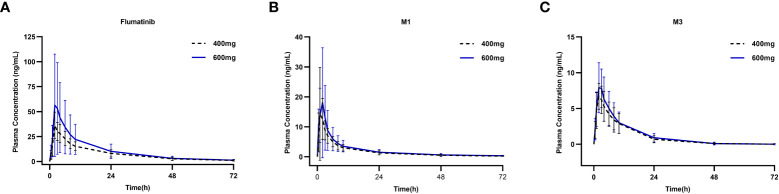
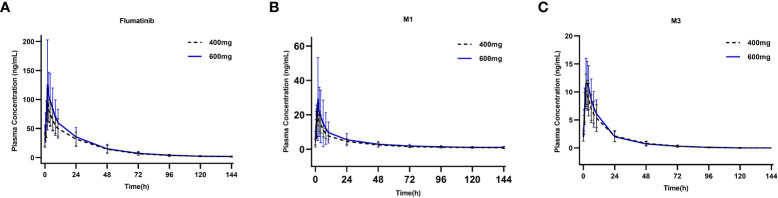
This study evaluated the pharmacokinetic (PK) profiles of flumatinib mesylate tablets at a dose of 400 mg and 600 mg in patients with CML-CP. The study was registered at chictr.org Identifier (ChiCTR2100044700). In this open-label, pharmacokinetic study, eligible patients were administered a single-dose of flumatinib 400 mg or 600 mg on day 1, followed by 2-day washout and 8 consecutive days of once-daily administration. Serial plasma samples were assayed for flumatinib and its metabolites (N-demethylate metabolite M1 and amide-bond hydrolytic metabolite M3).
Twenty-nine patients were assigned to flumatinib 400 mg (n=14) or 600 mg (n=15). Serum concentrations of flumatinib reached maximum measured plasma concentration (Cmax) at a median time of 2 hours after each single dose, and then eliminated slowly with a mean apparent terminal disposition half-life (t1/2) from 16.0 to 16.9 hours. Following single- and multiple-dose administration, flumatinib exposure (Cmax, area under the concentration-time curve from 0 to t hours (AUC), area under the concentration-time curve from 0 hours to infinity (AUC)) increased in an approximately dose-proportional manner. There was approximately 4.1- and 3.4- fold drug accumulation at steady-state after multiple-dose administration at 400 mg and 600 mg, respectively. The drug-related AEs associated with both treatments were primarily low-grade and tolerable events.
Analysis of PK parameters indicated that flumatinib exposure increased in an approximately dose-proportional manner. Further research needs to be conducted in a large sample-size study.
氟马替尼是一种新型口服断裂簇集区-阿贝尔森(BCR-ABL)酪氨酸激酶抑制剂,在新诊断的慢性期(CP)慢性髓性白血病(CML)患者中已显示出可控的安全性和有前景的疗效。
本研究评估了甲磺酸氟马替尼片在400 mg和600 mg剂量下对慢性期慢性髓性白血病(CML-CP)患者的药代动力学(PK)特征。该研究已在chictr.org注册,标识符为(ChiCTR2100044700)。在这项开放标签的药代动力学研究中,符合条件的患者在第1天接受单剂量400 mg或600 mg的氟马替尼治疗,随后进行2天的洗脱期,然后连续8天每日给药一次。对系列血浆样本进行氟马替尼及其代谢产物(N-去甲基代谢产物M1和酰胺键水解代谢产物M3)的检测。
29例患者被分配接受400 mg(n = 14)或600 mg(n = 15)的氟马替尼治疗。每次单剂量给药后,氟马替尼血清浓度在中位时间2小时达到最大实测血浆浓度(Cmax),然后缓慢消除,平均表观终末处置半衰期(t1/2)为16.0至16.9小时。在单剂量和多剂量给药后,氟马替尼的暴露量(Cmax、0至t小时浓度-时间曲线下面积(AUC)、0小时至无穷大浓度-时间曲线下面积(AUC))以近似剂量比例的方式增加。在400 mg和600 mg多剂量给药后,稳态时的药物蓄积分别约为4.1倍和3.4倍。与两种治疗相关的药物不良反应主要为低级别且可耐受的事件。
药代动力学参数分析表明,氟马替尼的暴露量以近似剂量比例的方式增加。需要在大样本量研究中进行进一步研究。