Fu Maggie P, Merrill Sarah M, Sharma Mehul, Gibson William T, Turvey Stuart E, Kobor Michael S
Department of Medical Genetics, Faculty of Medicine, University of British Columbia, Vancouver, BC, Canada.
Centre for Molecular Medicine and Therapeutics, University of British Columbia, Vancouver, BC, Canada.
Front Genet. 2023 Feb 6;14:1113086. doi: 10.3389/fgene.2023.1113086. eCollection 2023.
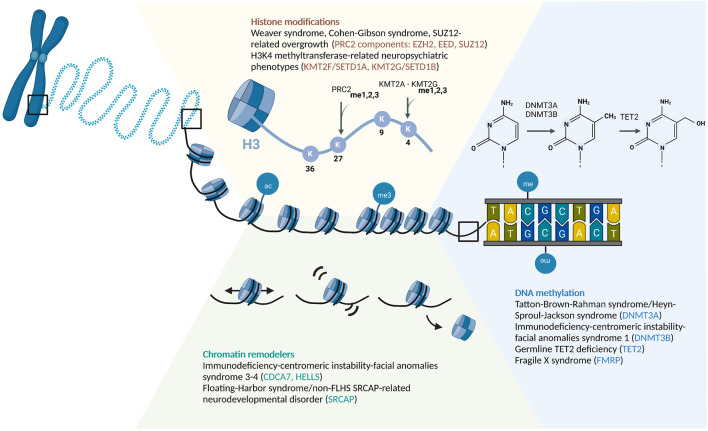
Rare diseases (RDs), more than 80% of which have a genetic origin, collectively affect approximately 350 million people worldwide. Progress in next-generation sequencing technology has both greatly accelerated the pace of discovery of novel RDs and provided more accurate means for their diagnosis. RDs that are driven by altered epigenetic regulation with an underlying genetic basis are referred to as rare diseases of epigenetic origin (RDEOs). These diseases pose unique challenges in research, as they often show complex genetic and clinical heterogeneity arising from unknown gene-disease mechanisms. Furthermore, multiple other factors, including cell type and developmental time point, can confound attempts to deconvolute the pathophysiology of these disorders. These challenges are further exacerbated by factors that contribute to epigenetic variability and the difficulty of collecting sufficient participant numbers in human studies. However, new molecular and bioinformatics techniques will provide insight into how these disorders manifest over time. This review highlights recent studies addressing these challenges with innovative solutions. Further research will elucidate the mechanisms of action underlying unique RDEOs and facilitate the discovery of treatments and diagnostic biomarkers for screening, thereby improving health trajectories and clinical outcomes of affected patients.
罕见病(RDs)中超过80%都有遗传起源,全球约有3.5亿人受其影响。新一代测序技术的进步极大地加快了新型罕见病的发现速度,并为其诊断提供了更准确的方法。由潜在遗传基础的表观遗传调控改变所驱动的罕见病被称为表观遗传起源的罕见病(RDEOs)。这些疾病在研究中带来了独特的挑战,因为它们常常表现出复杂的遗传和临床异质性,这源于未知的基因 - 疾病机制。此外,包括细胞类型和发育时间点在内的多种其他因素,会干扰对这些疾病病理生理学进行解卷积分析的尝试。导致表观遗传变异性的因素以及在人体研究中收集足够数量参与者的困难,进一步加剧了这些挑战。然而,新的分子和生物信息学技术将为这些疾病如何随时间表现提供见解。本综述重点介绍了近期通过创新解决方案应对这些挑战的研究。进一步的研究将阐明独特的RDEOs的作用机制,并促进用于筛查的治疗方法和诊断生物标志物的发现,从而改善受影响患者的健康轨迹和临床结果。