Aguade Aragaw E, Gashu Chalachew, Jegnaw Tigist
Statistics Department, Under Natural and Computational Science College University of Gondar Gondar Ethiopia.
Statistics Department, Under Natural and Computational Science College University of Odabultum Ethiopia.
Health Sci Rep. 2023 Feb 19;6(2):e1121. doi: 10.1002/hsr2.1121. eCollection 2023 Feb.
Cervical cancer is the fourth most common cause of cancer-related death in the world. The objective of this study was to determine factors that affect the longitudinal change of tumor size and the time to death of outpat.
A retrospective follow-up study was carried out among 322 randomly selected patients with cervical cancer at the University of Gondar Referral Hospital from May 15, 2018 to May 15, 2022. Data were extracted from the patient's chart from all patients' data records. Kaplan-Meier estimator, log-rank test, the Cox proportional-hazard model, and the joint model for the two response variables simultaneously were used.
Among 322 outpatients with cervical cancer, 148 (46%) of them were human immunodeficiency virus (HIV) positive and 107 (33.3%) of them died. The results of joint and separate models show that there is an association between survival and the longitudinal data in the analysis; it indicates that there is a dependency between longitudinal terms of cervical tumor size and time-to-death events. A unit centimeter square rise in tumor size, corresponding to an exp(0.8502) = 2.34 times, significantly raised the mortality risk.
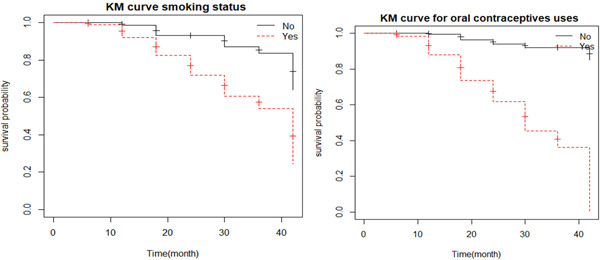
The study showed that HIV, stage of cancer, treatment, weight, history of abortion, oral contraceptive use, smoking status, and visit time were statistically significant factors for the two outcomes jointly.
As a result, adequate health services and adequate resource allocations are critical for cervical cancer control and prevention programs. Therefore, the government should provide adequate funding and well-trained health professionals to hospitals to sustain screening programs with appropriate coverage of cervical cancer patient treatments.
宫颈癌是全球癌症相关死亡的第四大常见原因。本研究的目的是确定影响肿瘤大小纵向变化以及门诊患者死亡时间的因素。
2018年5月15日至2022年5月15日,在贡德尔大学转诊医院对322例随机选取的宫颈癌患者进行了一项回顾性随访研究。数据从所有患者的数据记录中的病历中提取。使用了Kaplan-Meier估计量、对数秩检验、Cox比例风险模型以及同时针对两个响应变量的联合模型。
在322例宫颈癌门诊患者中,148例(46%)为人类免疫缺陷病毒(HIV)阳性,其中107例(33.3%)死亡。联合模型和单独模型的结果表明,在分析中生存与纵向数据之间存在关联;这表明宫颈肿瘤大小的纵向指标与死亡时间事件之间存在依赖性。肿瘤大小每增加一平方厘米,对应的风险比exp(0.8502) = 2.34倍,显著增加了死亡风险。
研究表明,HIV、癌症分期、治疗、体重、流产史、口服避孕药使用情况、吸烟状况和就诊时间是这两个结果共同的统计学显著因素。
因此,充足的卫生服务和充足的资源分配对于宫颈癌控制和预防计划至关重要。因此,政府应向医院提供充足的资金和训练有素的卫生专业人员,以维持宫颈癌患者治疗覆盖率适当的筛查计划。