Ruican Dan, Petrescu Ana-Maria, Istrate-Ofiţeru Anca-Maria, Iliescu Dominic Gabriel
Department of Obstetrics and Gynecology, University Emergency County Hospital, Craiova, Romania.
Doctoral School, University of Medicine and Pharmacy of Craiova, Romania.
Curr Health Sci J. 2022 Jul-Sep;48(3):247-254. doi: 10.12865/CHSJ.48.03.01. Epub 2022 Sep 30.
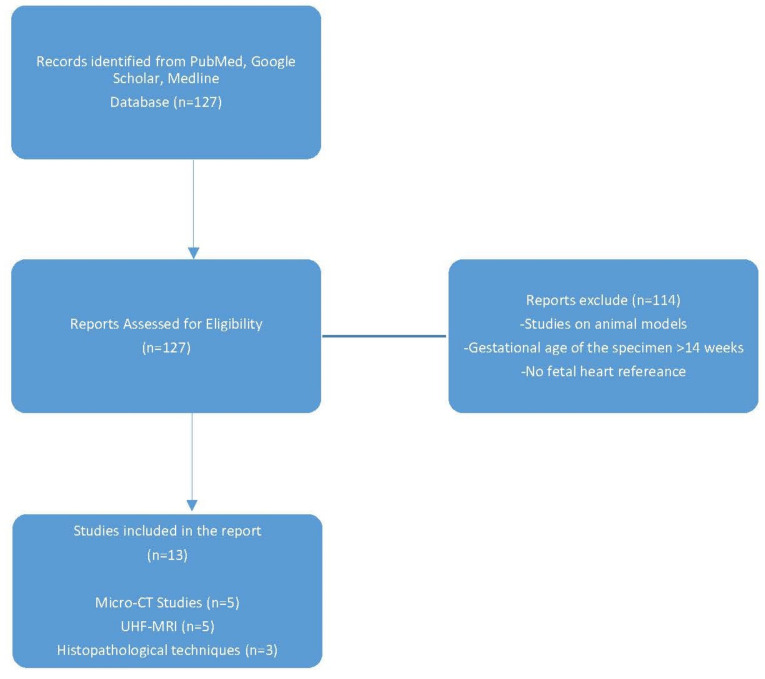
Due to rapid technology advancement and increasing diagnostic expertise, fetal medicine is rapidly improving. Prenatal diagnostic advancements made it possible to identify structural abnormalities in fetuses as early as the first trimester of pregnancy. However, to validate the echocardiographic diagnosis that led to the pregnancy termination, the termination of pregnancy owing to severe fetal deformities should be audited in accordance with a correct anatomic diagnosis. Following the PRISMA declaration, a systematic literature search was done to find articles on post-mortem first trimester human fetal heart evaluation. Thirteen suitable studies were found using the search method. It is theoretically possible to examine the human fetal heart after death in early pregnancy however these methods are not widely available due the costs associated with the procedure and the equipment, the effects of tissue coloration and distortion brought on by the fixation and contrasting processes (for micro-CT), the current requirement for a skilled operator to acquire, reconstruct, and process the images, and data storage requirements greater than those of conventional clinical scans.
由于技术的快速进步和诊断专业知识的不断增加,胎儿医学正在迅速发展。产前诊断的进步使得早在妊娠早期就能识别胎儿的结构异常。然而,为了验证导致终止妊娠的超声心动图诊断,因严重胎儿畸形而终止妊娠应根据正确的解剖诊断进行审核。遵循PRISMA声明,进行了系统的文献检索,以查找关于孕早期人类胎儿心脏尸检评估的文章。使用该检索方法找到了13项合适的研究。理论上,在妊娠早期死亡后检查人类胎儿心脏是可行的,然而,由于该程序和设备相关的成本、固定和对比过程(用于微型CT)带来的组织着色和变形影响、目前对熟练操作人员获取、重建和处理图像的要求,以及大于传统临床扫描的数据存储要求,这些方法尚未广泛应用。